
EVSE end-of-line testing
Catch defective chargers before they leave the factory.
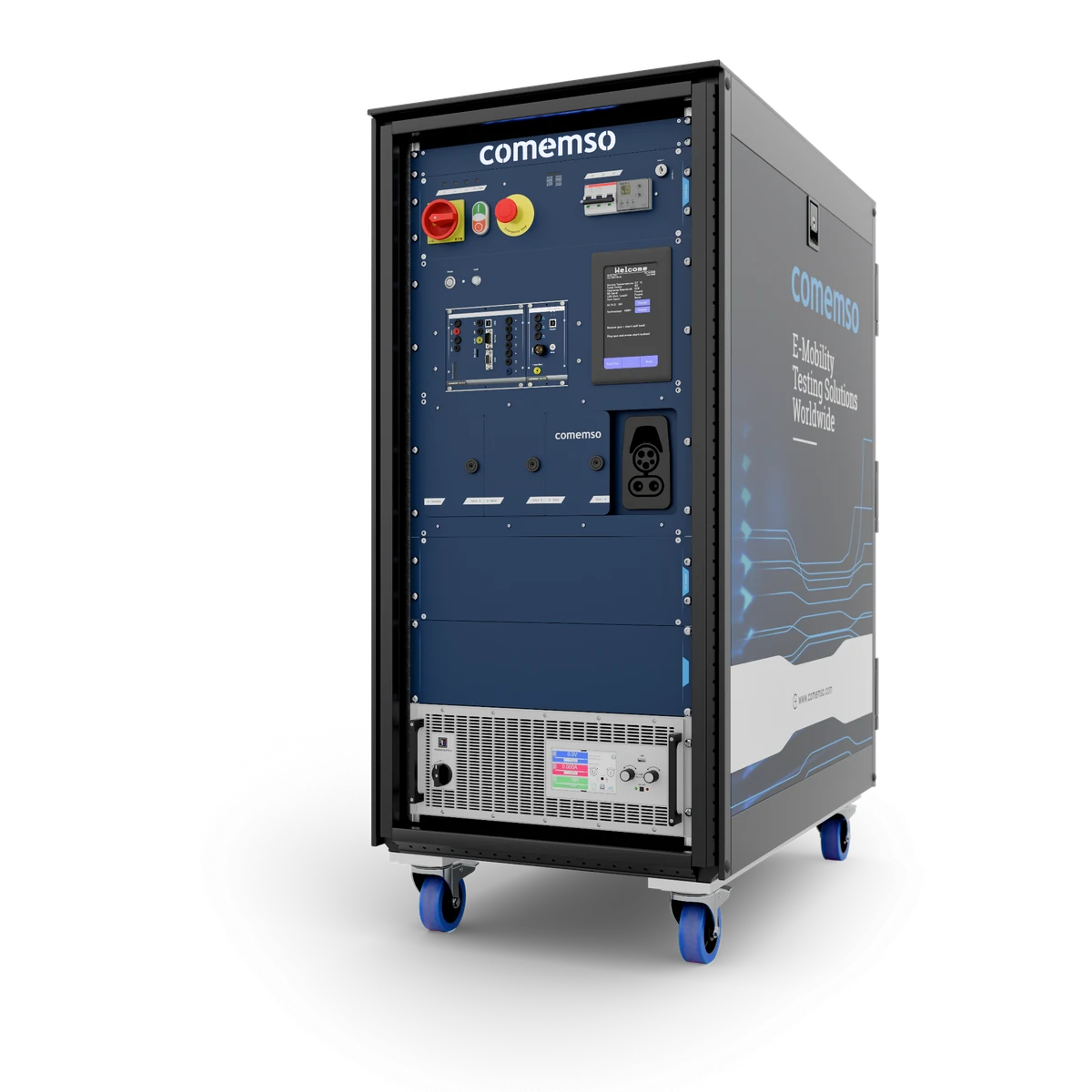
To catch defects early, Easy Chester EOL runs a defined test sequence on each AC or DC charging station, records the result against its serial number and flags defective chargers for rework – instead of sample checks with separate instruments.1
Used in production – for legal-metrology end-of-line testing and with customer-owned power electronics.
In 30 seconds
- What for
- Charger manufacturers who must catch defective units before they leave the factory.
- What it does
- Easy Chester EOL runs a defined sequence on every AC or DC unit and stores one result per serial number, with rework flagged.
- Not for
- Inspections at the installation site – that is EVSE commissioning and service testing.
A defective unit that leaves production costs a site visit, a replacement and the operator's confidence.
The production outcome
Decide whether each charging station is ready for release.
Engineering approves the acceptance requirements. Production applies them to each identified charger and records the result.
Release
All mandatory checks were executed with the released profile and the unit met the approved acceptance criteria.
Rework
Route a known, repairable deviation to the defined rework process, then repeat the relevant checks.
Reject
The unit cannot be released because a mandatory criterion failed or the required test boundary could not be established.
Engineering review
Send unexpected results, test-system conditions or new product behaviour to engineering for analysis outside the standard line flow.
Factory acceptance scope
Define the acceptance checks before choosing the tester.
You set the mandatory series checks for charger family, market and interface. Type testing, development investigations and other quality processes stay separate from the production acceptance plan.
Serial number, production order, variant, options, firmware and other approved identity fields.
Connector and locking checks, Control Pilot (CP), Proximity Pilot (PP), PLC and CAN interfaces, and auxiliary signals.
Released charging protocol, expected sequence, configurable parameters, timing and selected negative reactions.
Selected charger-side protective behaviour, interlocks, isolation or residual-voltage checks where included in the production contract.
Connection states, enable conditions, contactor sequence, voltage and current response, start and controlled termination.
Defined source or load points, duration, ramps and limits sized to the production decision rather than a headline power value.
Reference comparison at defined operating points when production also owns a metrology-oriented verification step.
Controlled production cycle
Apply the approved profile and record the result for each unit.
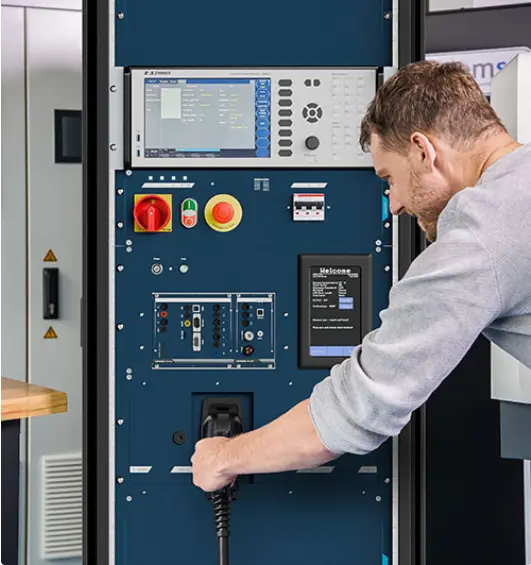
The released profile gives production the approved test sequence, parameters and evaluation rules.
- 1Identify the unit
Read or enter the serial number, charger variant, firmware, order and other required production data.
- 2Load the released profile
Select the approved test sequence and parameter set for the identified product configuration.
- 3Establish the protected test boundary
Confirm connections, interlocks, external equipment and safe initial conditions before power is enabled.
- 4Execute the charging checks
Run the released communication, function, parameter, safety-reaction and optional power or metrology steps.
- 5Evaluate automatically
Apply the approved result logic, preserve measured values and make every deviation visible.
- 6Release, rework, reject or escalate
Store the result and test record against the unit, then route the charger to the next production step.
Unit-level traceability
Link each result to the charging station tested.
The record holds executed checks, approved profile and test conditions. Include the reason for release, rework, rejection or engineering review.
Factory architecture
Integrate charging-specific tests into the production line.
Agree responsibilities for product identification, the EVSE (electric vehicle supply equipment, or charging station), external power and measurement equipment, automation and production data before integration.
Maintain approved test requirements
Approve profiles, limits and configuration changes, and define when to involve engineering in diagnosis.
The released sequence runs
You decide what counts as a pass – and how long records are kept
We define release records, audit needs, rework rules and record retention per project.
Your test system talks to your line
Barcode, PLC, MES, QMS and databases connect through approved data interfaces.

System path
Choose the system for your production task.
The system for your acceptance plan. Product pages cover hardware, ratings, interfaces, options and released functions.
For repeatable EVSE function, communication and parameter checks with unit-level traceability in production.
Explore Easy Chester EOLFor DC fast-charger production with defined power operating points and a coordinated high-power test cell.
Explore Easy Chester EOL HPCReal energy transfer, a suitable AC or DC reference meter and metrological checks extend the unit record.
Open applicationAn open engineering environment covers extensive fault simulation, power integration or deeper protocol analysis in production or during transfer.
Explore EVCA FlexSupported test equipment, customer-owned devices, automated sequences, evaluation, reporting and data handover work together.
Open softwareSystems compared for factory acceptance, high-power production, field service and mobile calibration.
Compare systemsRequirements for the test setup
Specify the product, cycle, interfaces and required records.
Complete EVSE or module, connector families, charging technologies, market versions, options and firmware.
Mandatory communication, function, parameters, safety reactions, power points and pass/fail rules.
Target takt time, repetitions, stabilization, peak and continuous duty, shift model and maintenance window.
Independent voltage, current, power, duration, regeneration, cooling, switching and facility constraints.
Operator guidance, remote control, line PLC, robotics, barcode, sequence ownership and safe-state handling.
MES, QMS, database, file exchange, APIs, result acknowledgement and offline behaviour.
Required fields, raw data, step results, reports, signatures, audit trail, storage location and retention period.
Reference meter, range, uncertainty, traceability, procedure, operating points and responsible legal or quality process.
Published implementation examples
Integrate customer-specific equipment into a standard test workflow.
Customer-owned power electronics inside one EOL workflow
A customer combined Easy Chester EOL with internally developed power electronics for a specific production setup. Standard Easy Chester operation is designed to work without a laptop; production interfaces are specified separately.
Read the customer projectConsistent test data in development and production
A portable EVCA Flex unit supported development, while a smaller rack system tested at the production site. Shared test and measurement data helped keep the engineering and factory results consistent.
Read the system storyFrequently asked questions
EVSE end-of-line testing
What is EVSE end-of-line testing?
EVSE end-of-line testing checks a completed charging station or defined production module against approved factory acceptance criteria before release. Each test record links the unit identity, released configuration, executed checks, measurements and final result.
How does end-of-line testing differ from development validation?
Development validation explores behaviour, limits, robustness and faults as the product changes. End-of-line testing repeatedly applies the released acceptance plan to manufactured units, with a focus on consistent results, cycle time, traceability and release decisions.
What should be checked on every manufactured charging station?
The exact scope is product-specific. Typical checks can include unit identity, charging-interface behaviour, low-level signals, high-level communication, functional charging, selected electrical-safety reactions, configured parameters and production records. Mechanical, visual and regulatory checks remain separate unless explicitly integrated.
How is the test result linked to the charger serial number?
Read or receive the unit identity, load its released profile and store the test configuration, measurements, step results and overall result under that identity.
Can one test station handle several EVSE variants?
Yes, if the hardware supports the required interfaces and every variant has a released test profile. Select the variant from the production identity or an approved operator workflow, then use its defined sequence for each unit.
Can customer-owned power electronics or factory equipment be integrated?
Yes, within a defined integration scope. comframe and released interfaces can coordinate supported external sources, loads, meters, production control systems and databases. The May 2025 customer project integrated customer-owned power electronics through the Generic Source API.
Customer projects, success stories and technical articles related to this page.
- Customer projectEOL Testing with Customer Power Equipment, May 2025Easy Chester EOL connects customer power electronics through the Generic Source API for repeatable EVSE end-of-line tests. Project report, May 2025.
- Customer projectEasy Chester EOL: Metrology, June 2024Easy Chester EOL: EVSE meter data, reference checks with an ISO 17025-calibrated meter, and documented functional and safety tests in production.
- Customer projectEVCA AC for ISO 15118 and End-of-Line TestingEVCA AC combines three-phase charging tests and ISO 15118 communication with Expert and Production modes, plus REST integration for end-of-line testing.
- KnowledgeEVSE end-of-line tests and acceptanceDefine EVSE end-of-line electrical, functional and communication checks. Link results to unit identity and handle failed tests.
- Product newscomframe 1.1: Simulation, Gateway and EOLThe July 2025 comframe release added more control over protocol simulation, bidirectional message manipulation and AC/DC end-of-line testing.
Choose EVSE testing for field and production
For commissioning and service, the CCS EVSE tester route leads to the appropriate field test. Production workflows instead need a DUT connection, automatic sequence and result association. Each task gets the interfaces and released profiles it needs; Micro remains an AC installation tester.
Production test planning
Plan the release process for each charging station.
Agree the unit identity, approved test profile, cycle time, acceptance criteria and rework path. Translate the production process into the required EOL configuration and line interfaces.