
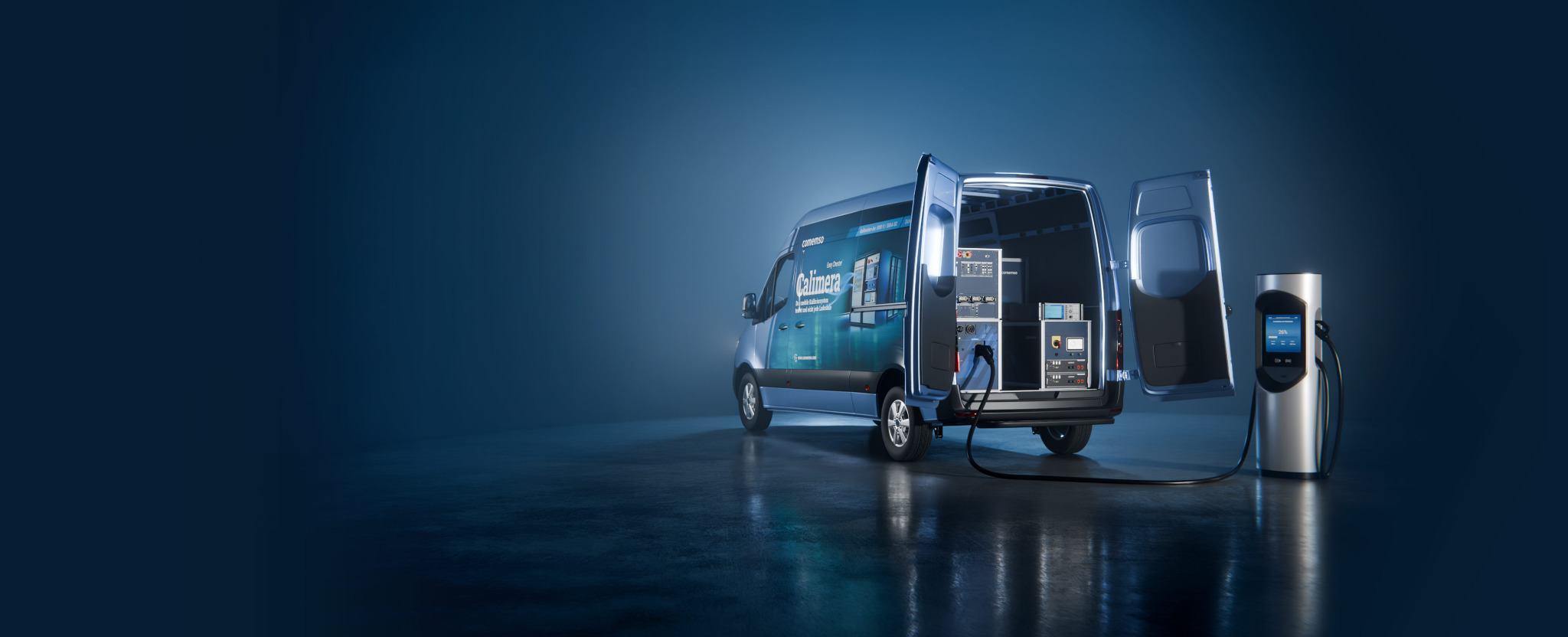
Mobile calibration for AC and DC chargers
Calibrate installed chargers on site – PTB-certified.
The PTB-certified Easy Chester Calimera calibrates AC and DC charging stations at the charging point under real load and documents every reading and deviation – instead of a fully equipped laboratory at the charging site.1
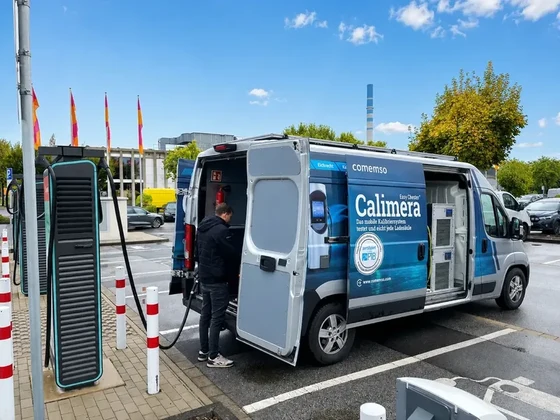
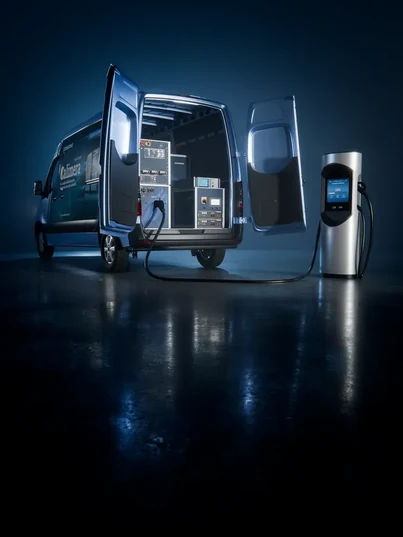
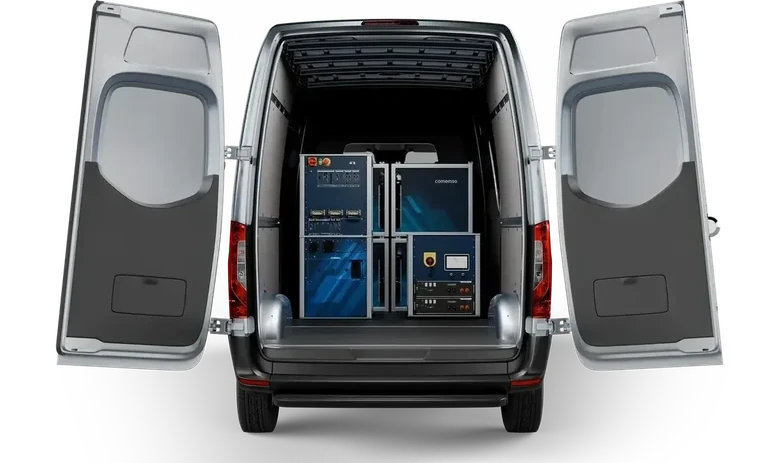
The Czech national metrology institute calibrates charging stations with Calimera from its own service vehicle.
 PTB certifiedEasy Chester CalimeraView certification details
- What for
- Calibration labs, operators and service providers who must calibrate installed AC and DC chargers on site.
- What it does
- Real load at the charging point – up to 260 kW DC and 22 kW AC, depending on the model – with every reading and deviation documented.
- Not for
- End-of-line calibration in production – that is Easy Chester EOL with the Calimera GUI.
A charger that measures wrongly bills wrongly – every session, until someone checks.
Product role
What is Easy Chester Calimera?
Installed charging stations are calibrated under defined charging conditions with a traceable energy reference. For test planning and the measurement workflow, see EVSE calibration.
Calimera combines the reference instrument with EV-side charging behaviour, communication, load, cooling and test-point control. It acquires the readings synchronously and brings the measurement and result into one report.
The charging station is calibrated where it is installed – in the environment where it delivers energy.
Voltage, current and duration define repeatable measurement points.
Reference value and charger value belong to the same charging event.
Configuration, readings, identifiers and result stay together for the report.
Calimera certification
PTB certified
Easy Chester Calimera. For technical qualification and procurement, review the PTB certificate for the Calimera configuration relevant to your measurement task.
Controlled execution
Run defined calibration points and document each result.
- Identify
Register EVSE, connector, meter and site information.
- Configure
Select interface, test points, load mode and reference equipment.
- Connect
Establish the charging session with controlled EV-side behaviour.
- Stabilize
Reach and hold the required voltage and current point.
- Compare
Acquire reference and EVSE meter values for the same interval.
- Report
Document configuration, values, deviations and result.
Link charger identity, operating point, reference readings and result in one calibration record.
Controlled real-load verification
Compare energy readings during real charging.
Calimera compares charging-station and reference readings during the same physical energy transfer at a defined operating point. Include charging communication, the installed current path and thermal behaviour in the repeatable test. Specialised meter-circuit methods follow the applicable procedure.
The charging station follows the actual low-level and high-level sequence required by the selected interface.
The configured load and cooling concept hold the measurement point long enough for the required evaluation.
The approved reference meter and its uncertainty information are part of the calibration chain.
The EVSE value remains linked to charger identity, firmware, connector and test point.
Mobile laboratory architectures
From a compact service vehicle to a complete mobile calibration laboratory
The mobile platform matches your charger portfolio, power, payload and cooling needs. It is planned around the local metrology framework and the calibration organisation’s working methods.
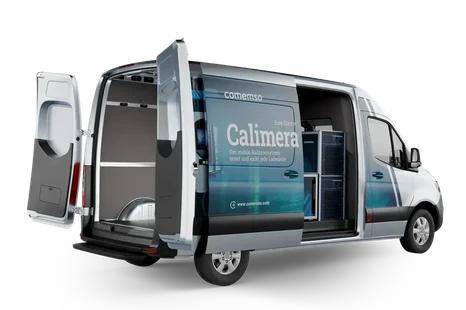
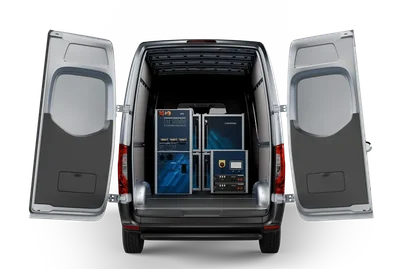
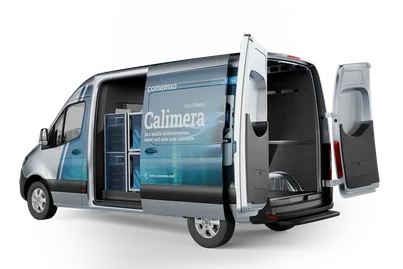
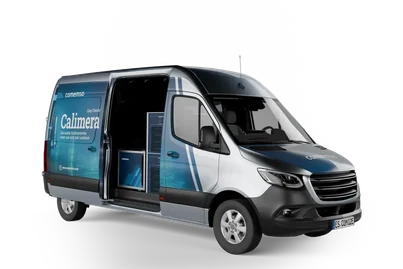
High-power calibration laboratory in a compact van
Load, cooling, reference measurement and an operator workspace come together in a mobile vehicle for AC and DC calibration.
- Built around the target CCS, CHAdeMO, NACS or AC portfolio
- Standard and Boost operating modes by released configuration
- Power supply, ventilation, payload and cable routing engineered as one system
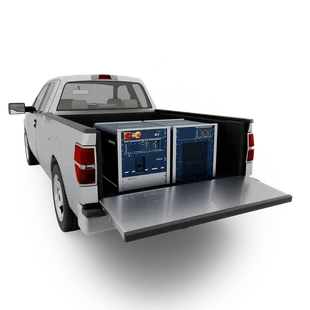
Pickup laboratory for USA and NIST workflows
A dedicated mobile configuration for North American field deployment and NIST-related metrology workflows.
- Vehicle and payload concept adapted to regional operation
- NIST Handbook 44 and Handbook 130 context by approved project scope
- Connector, load and reference equipment selected for the target market
Load configuration and operating limits
Match the Calimera configuration to your operating points.
The Calimera configuration brings the load, reference instrument and cooling suited to the voltage, current and dwell time of your calibration procedure.
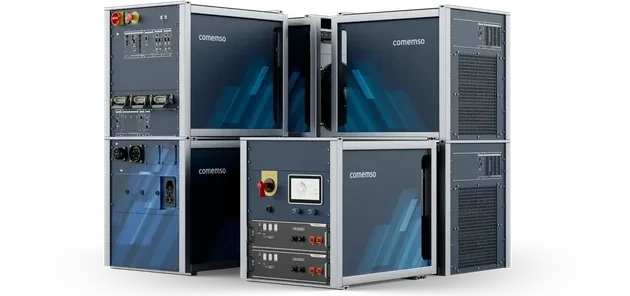
| Configuration / order number | DC | AC |
|---|---|---|
| Calimera-062126-4-011 | 40 kW | 22 kW |
| Calimera-130126-4-012 | 130 kW | Not listed |
| Calimera-152126-4-013 | 130 kW | 22 kW |
| Calimera-282126-4-014 | 260 kW | 22 kW |
Source: Calimera brochure, page 4. DC and AC ratings are separate values, not a guaranteed simultaneous operating point. Voltage, current, holding time, cooling and reference-meter range are confirmed for the selected configuration.
Document each step in the measurement chain.
Retain operating conditions, timestamps, identifiers, values and diagnostics for each test point.
Calibration capability, laboratory accreditation and legal recognition are separate statements.
Open measurement integration
Connect precision power meters through documented open interfaces.
The laboratory’s approved power meter integrates through an open, documented interface.
The reference equipment selected by the laboratory, with its uncertainty budget, stays in use.
Calimera records meter readings alongside the charger results, test point and report.
Transfer readings with their timestamps and test assignment to reduce manual entry errors.
Further instruments join when an open and maintainable interface is available.
Standards and legal-metrology context
Plan calibration for your target market.
Calimera supplies the technical measurement workflow. The approved procedure, reference chain, uncertainty, authority requirements and legal recognition remain market-specific.
ISO/IEC 17025
ISO/IEC 17025 applies to the calibration laboratory and its accredited scope, not generically to the hardware.
OIML G 22
Relevant metrological guidance for electric vehicle supply equipment, applied by approved edition and project scope.
Eichrecht and VDE context
- VDE-AR-E 2418-3-100
- REA Document 6-A
- IEC 62053-41
- VDE/GMP 6.8
NIST context
- NIST Handbook 44
- NIST Handbook 130
- Project-specific state and authority requirements

No single product configuration, report or accreditation statement automatically satisfies every national procedure. The released system scope and the responsible authority or laboratory decision remain decisive.
Deployment engineering
Choose the mobile platform around access, payload and operating environment
We plan the vehicle as part of the measurement system. We coordinate load modules, cooling, ventilation, supply, cable routing, mass distribution, operator access and protection.
Calimera can be used as a mobile service system, an integrated van or pickup laboratory, a trailer solution, or a controlled stationary laboratory setup.
Software and reporting
Configure operating points and review voltage and current traces.
comframe configures test points, shows measurements and device events, and creates the PDF report.
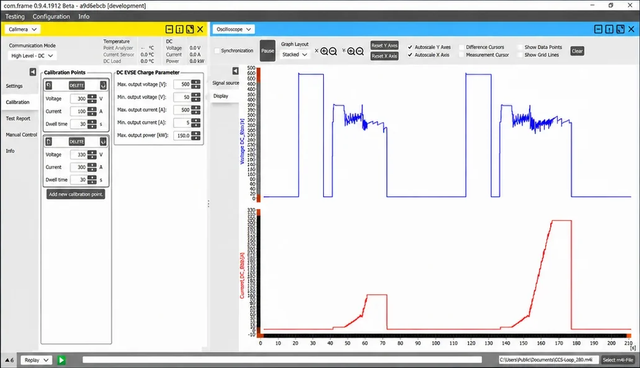
- 1Test requirement: configured calibration points.
- 2Device response: recorded voltage and current.
- 3Result record: replay file and shared time axis.
Define the operating points Set voltage, current and dwell time for each point in the Calibration Points area.
Review the recorded trace Review voltage and current over time in the oscilloscope area. The example uses Replay for an existing recording.
Create the report After the measurement workflow, use Test Report to create the PDF test report.
Configuration, measurement display and PDF reporting
- Test-point configuration
- Configure test points and their activation period.
- Measurement display
- Review AC/DC measurements in the graphical oscilloscope view or the measurement data.
- Device status and events
- See the device operating status and information about malfunctions.
- PDF reporting
- Save the test report as a PDF file.
Use the measurement workflow in the field, laboratory and production.
The measurement chain serves on-site calibration, checks after service and laboratory procedure development. The Calimera GUI and a suitable AC or DC power meter add production measurements to Easy Chester EOL or EOL HPC.
The complete system, configured with you
Build the EVSE calibration system around the approved measurement task
CCS1, CCS2, CHAdeMO, NACS, Type 1 or Type 2.
Voltage, current, power, Standard mode and Boost mode.
Power meter, calibration status, interface and uncertainty.
ISO/IEC 17025, OIML, Eichrecht, VDE or NIST context.
Identifiers, data, reports, approvals and traceability.
Frequently asked questions
Easy Chester Calimera FAQ
The released quotation, calibration scope and market approval remain authoritative for the final system.
Why use a controlled load instead of a vehicle?
Calimera uses controlled real load and reference measurement to make selected operating points repeatable within its configured range. A vehicle follows its battery state, temperature and charging curve, so a vehicle and adapter cannot freely reproduce every voltage/current point needed for a complete metrological test.
The PTB presentation explains this limitation and states: “Benötigen ein voll-ausgestattetes Labor an der Ladeeinrichtung”.
The permitted method depends on the task: calibration, formal verification (Eichung) and an in-service investigation (Befundprüfung) have different purposes. GM-P 6.8 includes procedure-specific vehicle use for a Befundprüfung; this is not a universal ban on vehicle-based checks. The applicable procedure determines the required test points and any permitted exceptions.
What is Easy Chester Calimera?
It is a mobile EVSE calibration system for traceable on-site calibration and metrological verification of installed AC and DC charging infrastructure.
Why calibrate a charging station on site?
The charger remains in its real electrical, thermal and operational environment. The complete measurement chain comes to the place where energy is delivered.
Which charging technologies can be supported?
Published configurations cover CCS1, CCS2, CHAdeMO, NACS, AC Type 1 and AC Type 2. Exact connectors and protocol versions depend on the released system.
How do operating modes relate to catalogue configurations?
Catalogue ratings identify the selected configuration. Supported voltage/current combinations, holding time and thermal recovery depend on the load, cooling and reference-meter range. These operating limits must match the measurement task. View the configuration table.
Which Calimera configurations are listed in the brochure?
Calimera-062: 40 kW DC and 22 kW AC; Calimera-130: 130 kW DC; Calimera-152: 130 kW DC and 22 kW AC; Calimera-282: 260 kW DC and 22 kW AC. AC and DC ratings are separate values. Reference-meter range, load limits and holding time must match the measurement task. View the configuration table.
Can Calimera cover 400 V and 800 V charging systems?
Yes. The published voltage range is intended to cover typical 400 V and 800 V charging technology. You specify required current, power and holding time separately.
Customer projects, success stories and technical articles related to this page.
- Customer projectMobile EVSE Calibration in a Test VanA metrology institute uses Easy Chester Calimera in a mobile test van to compare AC and DC charging station energy measurements with a reference on site.
Plan the charging-station records
For EVSE calibration and legal metrology, choose the reference chain, operating points and records around the measurement task. Calibration, conformity assessment and statutory verification have separate roles. Agree the required records before the campaign.
Field workflow planning
AC/DC operating points, reference meter, load and cooling, mobile platform and measurement report are specified for the calibration task.
Easy Chester product roles
Choose Calimera for charging-station energy calibration.
Calimera
Traceable reference comparison, controlled operating points and a calibration record.
Commissioning, safety, function, service, repair and periodic inspection.
Repeatable end-of-line function, communication and parameter verification.
High-power production cells with load, cooling, safety logic and traceability.
EVSE calibration knowledge
Plan the measurement scope for real-load verification.
Controlled load, operating points and measurement chain for repeatable EVSE calibration and verification.