
Software / Conformance Test Libraries
Conformance Test Libraries for EV and EVSE testing
Use repeatable charging tests for the defined device role, standard edition and software release. Each Test Library specifies the starting conditions, action, expected response and evaluation for its included test cases.
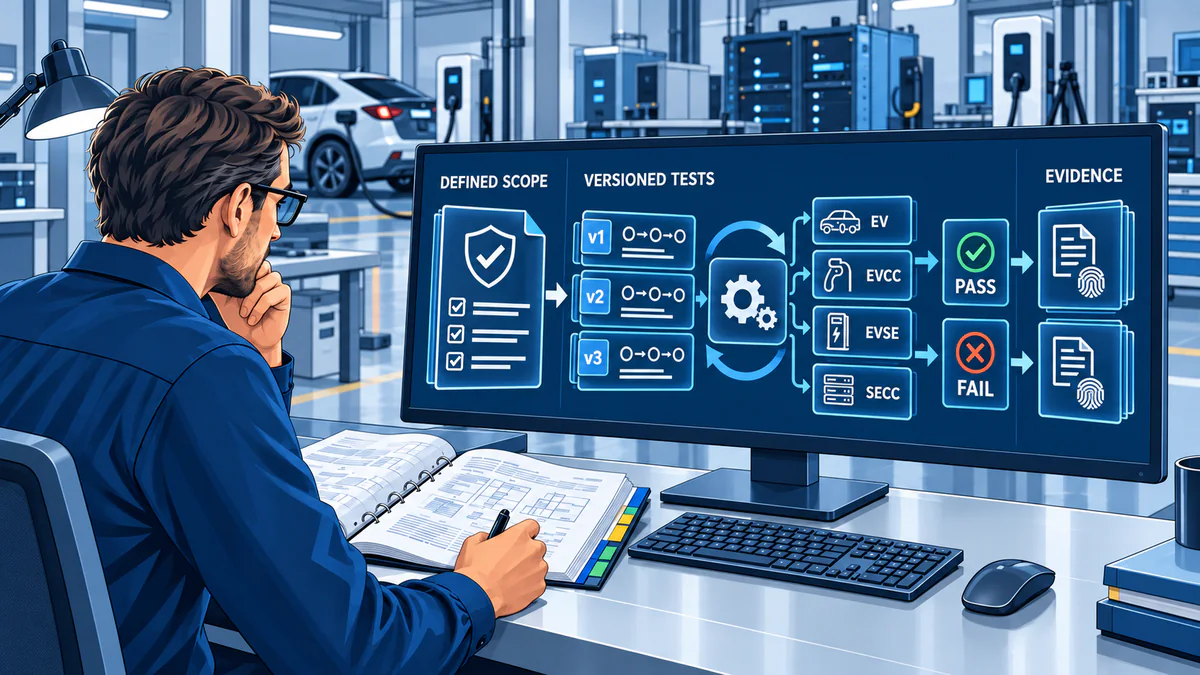
Choose the Test Library for your test requirement
Basis and scope
Source text dated:
Turn requirements into repeatable tests
Verify standard requirements with the Test Library
Connect the DUT through its charging connector, communication interface or simulator. Use the Test Library for controlled preconditions, a defined sequence, observations, acceptance criteria, verdict logic and measurements linked to their test conditions.
Standard, edition, amendment, profile, DUT role and referenced documents.
- What behaviour is required?
- Which implementation is in scope?
- Which conditions and exclusions apply?
Use implemented test logic to prepare, execute, observe, evaluate and document the test.
- Preconditions and parameter sets
- Sequence and simulated counterpart
- Verdict and report logic
Keep the result linked to the executed case, system setup and software versions.
- Pass, fail or inconclusive
- Trace, signal, timing and measurement context
- Repeatable regression asset
Physical access
Connector, pilot signals, PLC (power line communication), CAN, measurement, power boundary, fault hardware and simulated EV or EVSE (electric vehicle supply equipment, or charging station) role.
Executable logic
Preconditions, sequence, parameters, observations, tolerances, verdict rules, reporting and released version support.
Define the library and test configuration
Link each verdict to the exact Test Library version
Specify the complete scope for every released package and result. Include the exact document, edition and cases for an ISO 15118 test or IEC 61851 test.
Base document, part, publication year, amendments, profile and referenced external specifications.
EV, EVCC (vehicle-side charging communication controller), EVSE or SECC (station-side charging communication controller), simulated counterpart, charging direction and connector context.
Named test cases, exclusions, capability declarations, preconditions and selectable parameters.
EVCA path, interface modules, source or load, measurement devices, firmware, licences and the application software release required by the TestLib.
Observed values, timing windows, tolerances, verdict logic, trace links, report content and result status.
Library version, validation status, release notes, compatibility, maintenance and application support.
Standard edition + DUT role + case ID + Test Library version + EVCA configuration + firmware + application software release + DUT buildSelect by DUT and released scope
Compare Test Library scope, hardware and software status
Compare the software implementation and hardware for each test family. Record exact editions, case sets, versions and licences in the quotation.
CharIN Charging SystemBasic DC EVSE

Validated test-system capability for the published CharIN Basic DC EVSE application profile and approved setup.
- DUT
- DC EVSE
- Proof point
- CharIN provider listing
- Use
- Conformance and product-development testing within the stated profile
CharIN Charging SystemExtended DC EVSE
Validated test-system capability for the published CharIN Extended DC EVSE application profile and approved setup.
- DUT
- DC EVSE
- Proof point
- CharIN provider listing
- Use
- Extended profile testing within the approved system boundary
| Family or profile | Typical DUT role | Verification layer | Scope and hardware to specify | Software implementation and availability |
|---|---|---|---|---|
| IEC 61851-1AC charging control and electrical behaviour | EV or EVSE, depending on released package | Low-level signalling, states and electrical requirements | Portfolio route. Confirm edition, cases and configuration. | Confirm the selected IEC 61851-1 cases, application software and release together. This listing does not establish comframe support for every low-level test. |
| SAE J1772 / NACSNorth American AC and DC interface route | EV or EVSE, depending on released package | Low-level signalling, communication and electrical behaviour within released scope | Portfolio route. Confirm connector, standard edition, DUT role and case set. | Agree the J1772/NACS interface, test package and application-software release. The connector family alone does not confirm comframe availability. |
| IEC 61851-23DC EVSE tests, including Annex CC.7.5 | DC EVSE | Charging sequence, electrical behaviour, safety and fault-related scope | Annex CC.7.5 setup: EVCA Flex, IEC rack, switching and fault paths, source or load and measurement equipment matched to the agreed cases and operating limits. | Available: comemso IEC TestLib for the demonstrated customer setup. The port to comframe is prepared and is not yet released. |
| DIN SPEC 70121 / DIN SPEC 70122First-generation CCS communication | EVCC or SECC, depending on package | High-level communication conformance | Portfolio route. Confirm DUT direction and exact edition. | Confirm the current application with the selected package. Further CCS TestLibs in comframe are planned; see the roadmap below. |
| ISO 15118-2 with -4 / -5CCS communication conformance | EVCC or SECC, depending on package | Network and application behaviour within released scope | Confirm edition, included cases, role, security scope and EVCA configuration. The released comframe package covers ISO 15118-4/-5 SECC tests for AC and DC communication. | Released in comframe: ISO 15118-4/-5, SECC, AC and DC communication. Confirm EVCC packages separately; the SECC release does not establish their availability. |
| CHAdeMOVersion-specific charging communication | EV or EVSE, depending on package | Protocol and functional conformance | Portfolio route. Confirm association version and DUT role. | TestLibs are implemented in firmware. Confirm the complete application workflow for your package. Further application workflows are planned. |
| GB/T DCEdition-specific Chinese DC charging | EV or EVSE, depending on package | Protocol, states and electrical conformance | Portfolio route. Confirm standard edition and compatible interface. | DC-China / GB/T DC TestLibs are implemented in firmware. Confirm the complete application workflow for your package. Further application workflows are planned. |
CharIN Conformance Test System
A validated test system for defined CharIN profiles
CharIN lists comemso as a validated Conformance Test System vendor for the specific Charging System Basic and Charging System Extended DC EVSE profiles and approved setups.
Open the official CharIN listingSystem capability for the stated profile
The approved test-system setup can execute the validated CharIN application-profile scope.
Other functions and later software releases
Optional EVCA functions, other standards, modified cases and later software versions are not automatically covered.
DUT certification or release responsibility
The tested product, responsible laboratory and applicable conformity scheme remain separate from test-system validation.
From project definition to regression
Reuse controlled test logic through development, validation and release
Use the Test Library to reduce recurring test-programming work. Focus engineering effort on the DUT, observed deviations and the release decision.
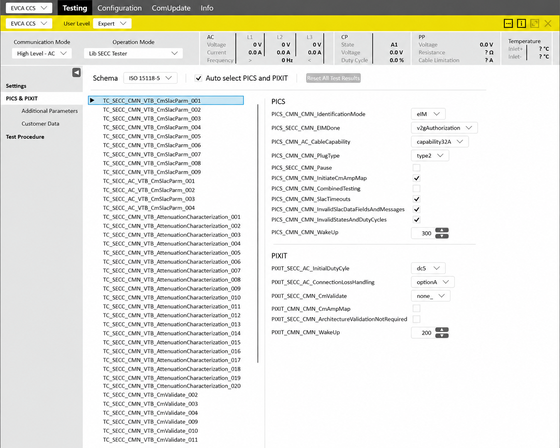
- 1Test requirement: selected case, PICS and PIXIT.
- 2Device state: live CP values in the status bar.
- 3Result workflow: Test Procedure; no verdict is visible in this capture.
- Select
Choose the standard, edition, DUT role, interface, case scope and decision.
- Configure
Load the released library, connect the approved hardware and record the DUT build.
- Execute
Prepare the preconditions, run the sequence and control the simulated counterpart.
- Evaluate
Apply the defined acceptance logic and link the verdict to the test case.
- Diagnose
Investigate the first deviation in its protocol, signal, timing and electrical context.
- Re-run
Keep the case as a repeatable regression test for the next build.
From verdict to engineering decision
Investigate the verdict with its recorded test context
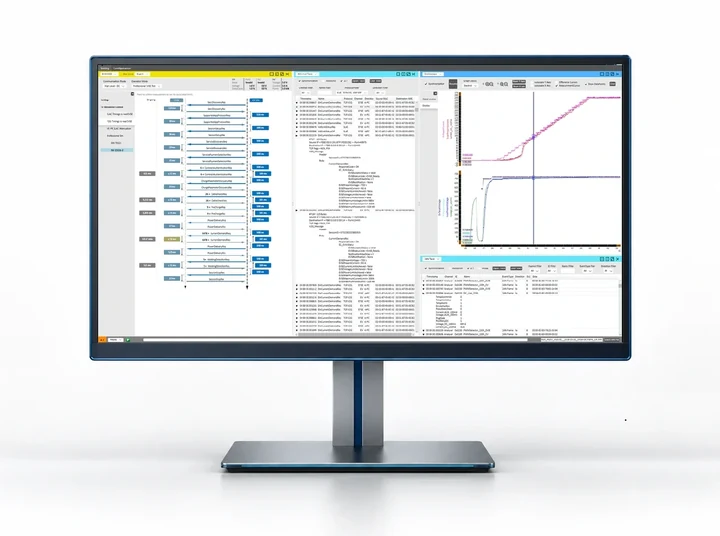
- Partner request: charging-message sequence.
- Device response: synchronised voltage and current traces.
- Result record: decoded messages and event data.
Test identification
DUT build, case ID, library version, EVCA hardware, firmware, application software release and configuration.
Synchronised context
Decoded messages, protocol states, timing, pilot signals, CAN and electrical measurements where configured.
Transparent verdict
Expected behaviour, observed behaviour, acceptance limit and result linked to the active case.
Reusable regression
The released sequence and record structure can be repeated after firmware changes and across product variants.
ISO 15118-20 conformance route
Use published conformance plans to define the test scope
Second-generation conformance specifications now define common and DC-specific test plans for EVCC and SECC implementations of ISO 15118-20. Product availability remains a separate comemso release decision.
Both ISO specifications focus on communication capabilities and behaviour within their stated scope. They do not by themselves assess performance, robustness, reliability or the complete physical power path.
Define the test before requesting a quotation
Six inputs for selecting the Test Library
Define the engineering decision, then select the product configuration for that test.
- 1DUT and role
EV, EVCC, EVSE or SECC, including the simulated counterpart.
- 2Charging interface
AC, CCS, NACS, CHAdeMO, GB/T or MCS and the required connector path.
- 3Standard and edition
Exact parts, publication years, amendments, profile and security context.
- 4Required case scope
Communication, low-level signals, electrical behaviour, safety, faults or combined results.
- 5Power and measurement boundary
Communication-only, reduced power, full power, external source or load and metrology integration.
- 6Decision and results
Development, pre-compliance, validated profile, certification support or regression.
Official reference points
Verify profile status and normative editions at the source.
Current validated CCTS vendors and Charging System application profiles.
Publicly described charging standards, test-library families and EVCA configurations.
Published common conformance-test plan for ISO 15118-20 implementations.
Second generation, DCPublished DC-specific conformance-test plan for ISO 15118-20 implementations.
Frequently asked questions
Conformance Test Library FAQ
Which Test Libraries are available in comframe?
The published comframe release covers ISO 15118-4/-5 SECC tests for AC and DC EVSE communication. The IEC 61851-23 TestLib described here is available in its current application software; its comframe port is not yet released. Confirm the library version, DUT role, included cases and licence for your configuration.
What is a Conformance Test Library?
A Conformance Test Library provides implemented, versioned and supported test logic for a defined standard, edition, DUT role and released scope. It prepares the test, controls the sequence, evaluates observations and keeps the result with its technical data.
How is a Test Library different from a charging interface?
Use the charging interface for physical and communication access to the DUT. The Test Library adds preconditions, parameter sets, sequence control, observations, verdict rules, report content and version control for the defined conformance scope.
Does a PASS verdict mean that the DUT is certified?
Not automatically. A PASS verdict applies to the executed cases, configuration and versions recorded in the result. Formal product certification or a Supplier Declaration of Conformity can require a defined scheme, an approved laboratory and additional evidence.
What does CharIN CCTS validation prove?
CharIN validation confirms the test-system capability for the stated Charging System application profile and approved setup. It does not validate every EVCA function, every optional library, every later software release or the customer DUT.
Can conformance test cases be modified?
Depending on the released package, parameters or engineering copies can be adapted for development work. Once normative logic or acceptance criteria are changed, the result must be identified as an engineering test rather than an unchanged formal conformance case.
Can one library test both EV and EVSE roles?
Only when the released package explicitly includes both directions. EVCC and SECC testing use different simulated counterparts, preconditions and expected behaviour. DUT role is part of the library identity.
Customer projects, success stories and technical articles related to this page.
- Customer projectEVCA Flex for Certification LaboratoriesThe 350 kW-class EVCA Flex configuration supports repeatable charging-station tests with defined CharIN test cases in a certification laboratory.
- KnowledgeCharIN CCTS validation: scopeUnderstand the CharIN CCTS test-system scope, supported profiles and limits. Distinguish validation from EVSE certification.
- Product newsCharIN CCTS: EVCA DC EVSE Basic and ExtendedCharIN CCTS validation for EVCA: DC EVSE Basic and Extended. Plan conformance tests with the validated test system and applicable test-library release.
- Product newscomframe ISO 15118-4/-5 EVSE Test LibrariesISO 15118-4 and ISO 15118-5 EVSE communication tests in comframe: AC/DC, PICS/PIXIT configuration and a report for each test case.
Defined conformance scope
Specify standard, edition, DUT role, released Test Library and required report.