
Run Repeatable Charging Test Campaigns
A test campaign is a series of saved charging tests. Run the configurations in sequence, keep each result with its settings and repeat the same campaign after a software or hardware change.
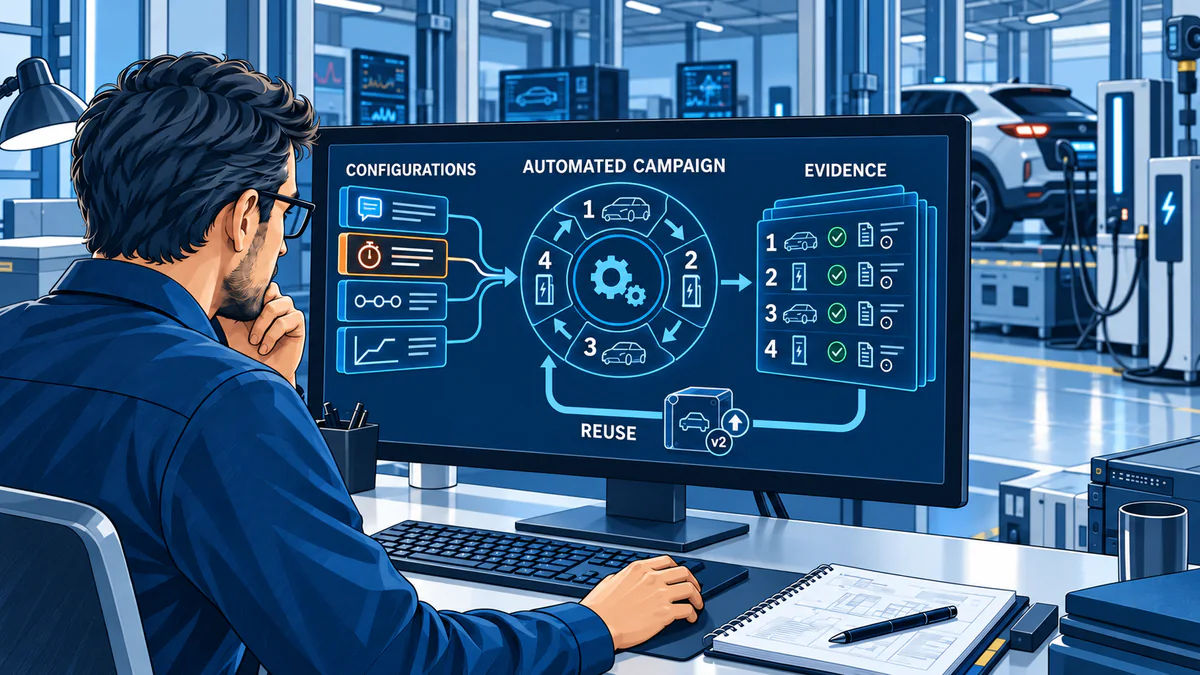
Automate the charging behaviour, not only the test command
A script can call functions in sequence. A charging test campaign also establishes the simulated charging partner, runs the complete interaction and keeps the active configuration with each result. This links every result to the behaviour that produced it.
Six steps from one test to a repeatable campaign
Retain the evidence for comparison with the next DUT (device under test) version.
- Create configuration
Save the charging behaviour.
- Select configurations
Choose the behaviours for the campaign.
- Define sequence
Set the order and repetitions.
- Run charge cycles
Execute the selected sequence.
- Evaluate results
Evaluate the campaign automatically.
- Reuse for regression
Repeat the campaign for the next DUT version.
Save the EV or EVSE (electric vehicle supply equipment, or charging station) behaviour, interfaces, limits, timing and evaluation context required for one meaningful charge cycle.
Select configurations, define order and repetitions, then identify the supported stop or continuation criteria.
Run the same charging test campaign after every DUT change. Compare the results linked to each configuration.
Combine normal, difficult and field-derived behaviour in one sequence
A charging test campaign can represent different virtual vehicles, charging stations, protocol behaviours, software versions or robustness scenarios. The selected release determines which sources can be combined and repeated.
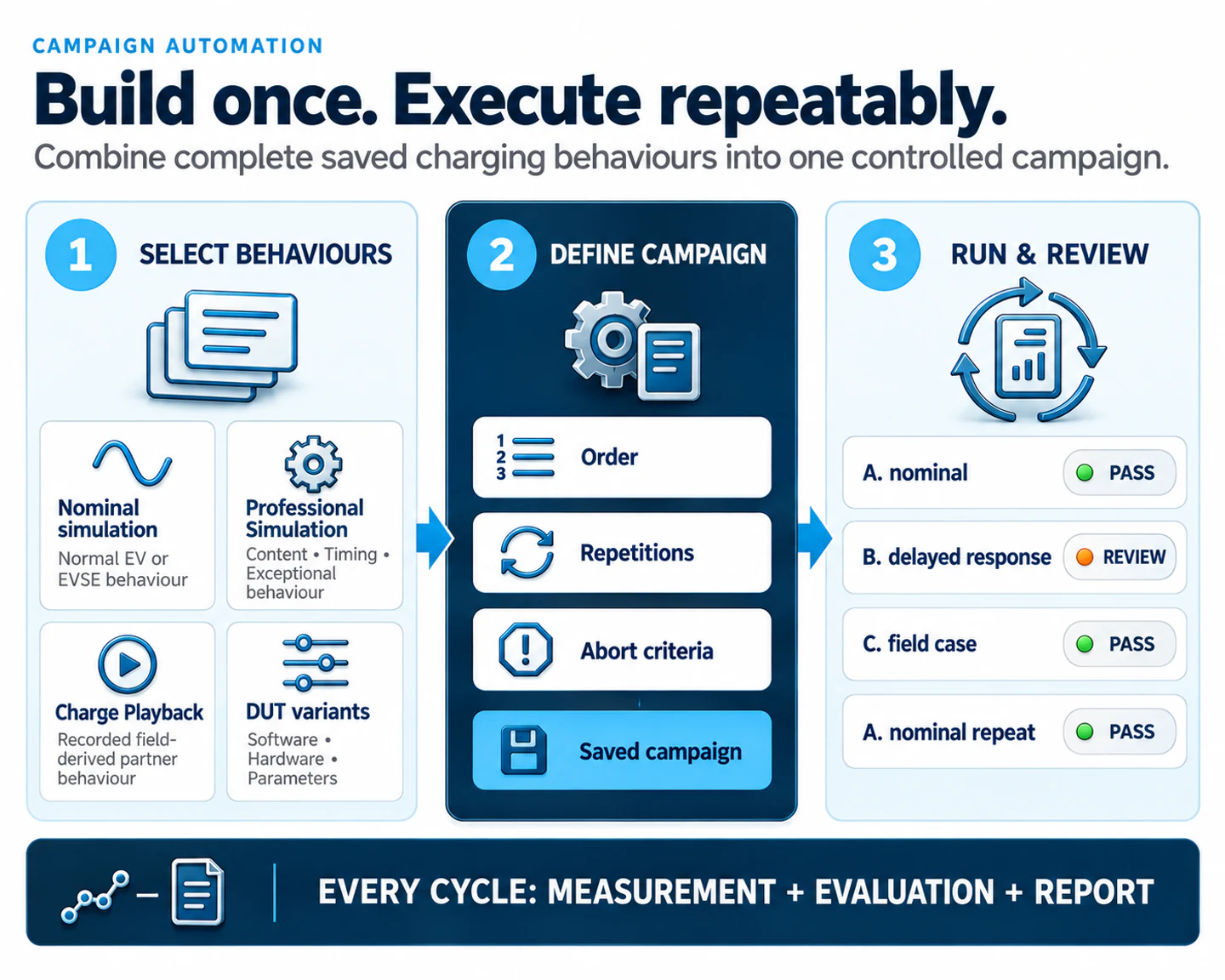
Baseline behaviour
Confirm the normal charging sequence and expected DUT response before adding difficult variants.
Professional Simulation configurations
Where released, add saved content, timing and exceptional protocol behaviour without programming a new test case.
Charge Playback configurations
Where supported, include recorded charging-partner behaviour so a difficult field case remains repeatable.
Run complete charge cycles beyond normal working hours
Overnight EV testing and unattended EVSE test automation increase coverage without requiring an engineer to supervise every connection and test start. Safe operation still depends on the released system, duration, abort logic and hardware limits.
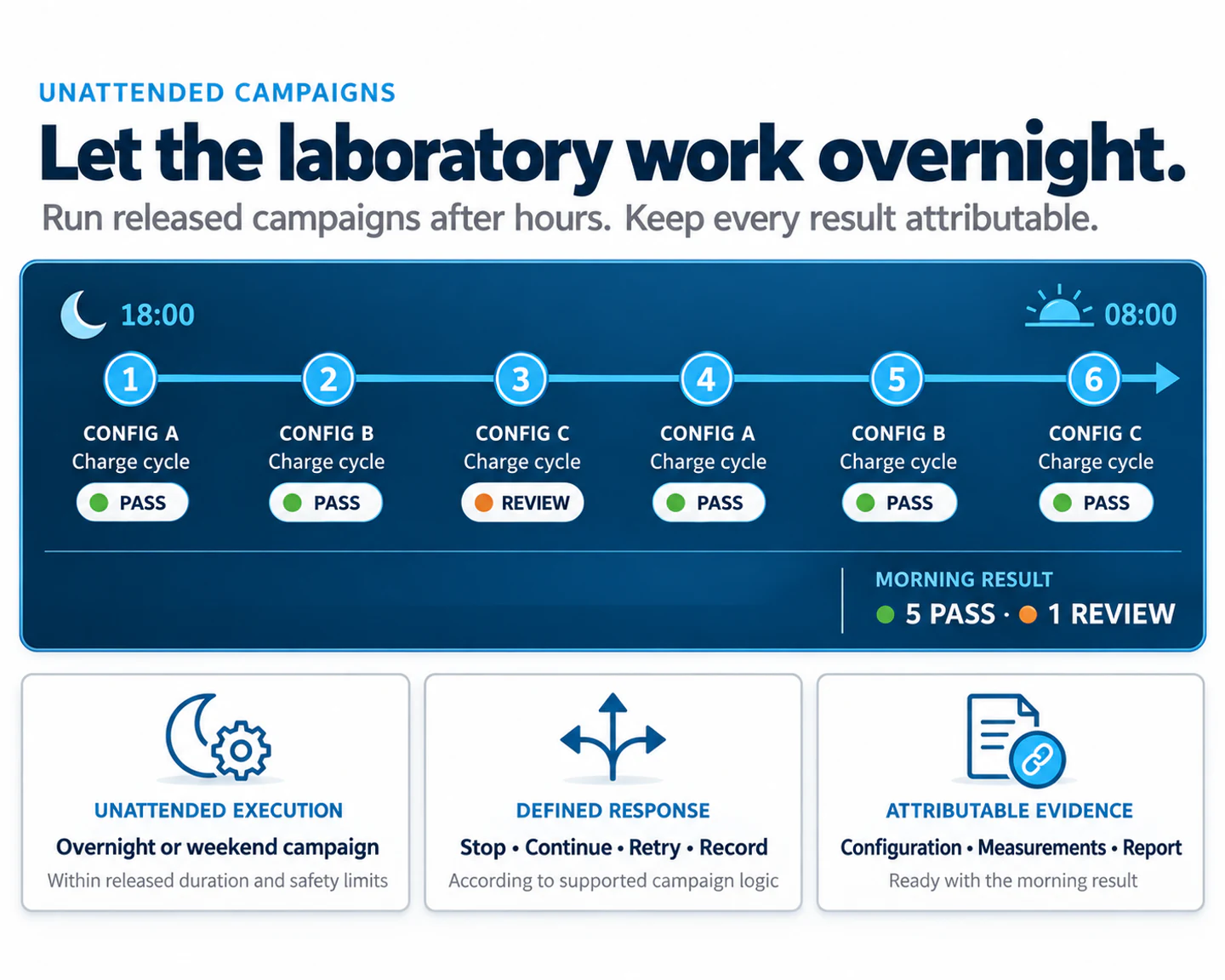
Execute one configuration after another
The campaign establishes the charging sequence, completes the configured session and proceeds according to the supported campaign logic.
Handle deviations predictably
Record, stop, continue or retry only where the selected release provides the required criteria and safe-state behaviour.
Return measurements linked to their test conditions
Every cycle retains configuration identity, timestamps, measurements, evaluation and reports where configured.
Unattended campaigns depend on the selected system’s duty cycle, protection, recovery and environmental limits. Confirm these operating conditions before planning an overnight or weekend run.
Know which behaviour produced every deviation
For useful engineering evidence from automation, keep measurements, evaluations and reports linked to the active configuration and DUT version.
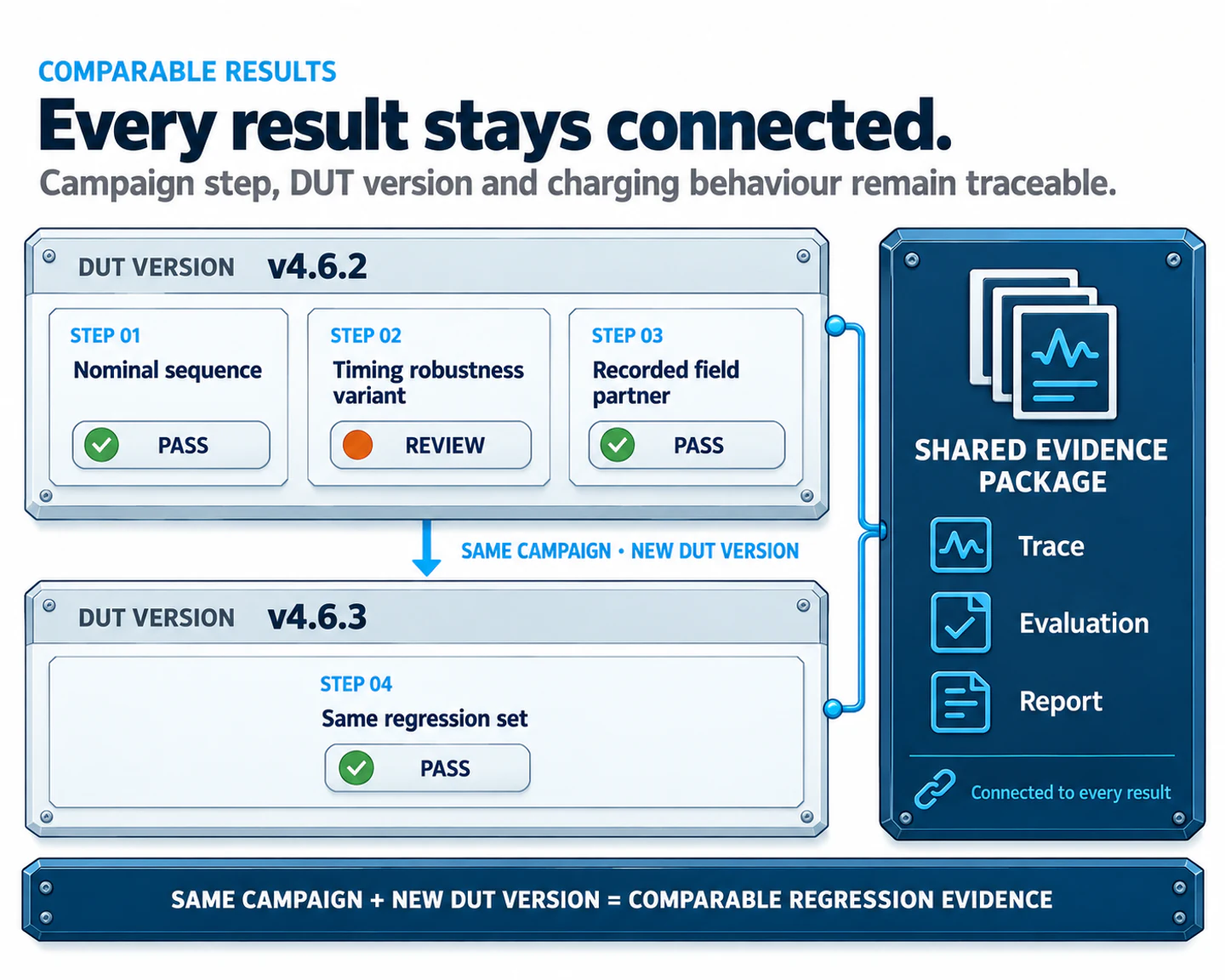
Trace the result to exact behaviour
Retain the campaign step, charging parameters, behaviour variant and repetition number.
Connect measurement and the applicable standard requirements
Where configured, combine protocol, signals, power and automated standards analysis in the same result package.
Repeat after every product change
Keep the campaign and the structure of its test records consistent so you can compare charging regression testing results.
Campaign execution and formal test procedures solve different problems
On smaller screens, scroll the table horizontally to see every column.
| Selection criterion | Charge Cycle Automation | Conformance Test Libraries | External API orchestration |
|---|---|---|---|
| Primary purpose | Sequence complete saved charging behaviours | Execute defined standards-based test cases and verdicts | Coordinate the charging system with a wider toolchain |
| Test input | Configurations, order, repetitions and criteria | Released test procedure and parameter set | External code, triggers and system integration |
| Best fit | Regression, variants, overnight campaigns | Conformance and traceable standards testing | Exceptional laboratory or CI integration |
| Programming | Not required for the core workflow | Not required for released library execution | Usually required for the external orchestration layer |
Use the same campaign logic across development, regression and interoperability work
Repeat EVCC and vehicle charging behaviour
Challenge a new vehicle software version with the same simulated charging-station configurations.
Repeat vehicle and battery variants
Use saved EV behaviours to test charging-station software, parameters and robustness changes.
Preserve a stable test baseline
Run the same campaign after every build or release candidate where integration supports the workflow.
Increase coverage outside staffed hours
Use released unattended functions while preserving traceability and laboratory operating limits.
Repeat difficult partner cases in regression tests
Combine field-derived behaviour with saved nominal and robustness configurations where supported.
Keep evidence comparable across versions
Link each result to the configuration, DUT version, measurement and report used for the decision.
Core capability
- Charge Cycle Automation sequences saved charging configurations.
- Complete charge cycles can be repeated as a campaign.
- Results remain attributable to the active configuration.
- Open interfaces can support broader automation where released.
What requires project approval
- Supported EVCA systems and hardware variants.
- Repetition limits, loops, retries and abort criteria.
- Unattended duration, recovery and safe-state behaviour.
- Report content, API scope and external CI integration.
Define the configurations, sequence and evidence before selecting the automation scope
Define the DUT, simulated role, configuration sources, operating limits and evidence for the Charge Cycle Automation setup.
Charge Cycle Automation FAQ
What is Charge Cycle Automation?
Charge Cycle Automation is the EVCA and comframe capability for arranging saved charging configurations into a repeatable campaign. The system executes configured charging behaviour after configured charging behaviour, associates the results with the active configuration and supports unattended regression where the selected release and hardware setup permit it.
How is Charge Cycle Automation different from simple command automation?
Simple command automation calls individual functions or sends isolated instructions. Charge Cycle Automation works with complete charging configurations and complete charge cycles. It preserves the charging sequence, communication behaviour, configured timing and evidence needed to understand the DUT response.
What does one charging configuration contain?
A configuration defines the charging behaviour required for one test. Depending on the selected system and release, it can include standard EV or EVSE simulation parameters, interface settings, protocol behaviour, limits, timing, Professional Simulation settings and associated measurement or evaluation settings.
Can Professional Simulation scenarios be used in a campaign?
Yes, where Professional Simulation is released for the selected charging standard and system. A saved robustness configuration can become one campaign step, allowing normal, boundary and intentionally non-conform behaviour to be repeated without rebuilding the scenario.
Can Charge Playback scenarios be automated?
Recorded charging behaviour can be part of a repeatable workflow where Charge Playback and campaign integration are supported in the selected release. Exact playback preparation, hardware, repetition and evidence functions must be confirmed for the project.
Can the same configuration be repeated several times?
Campaigns can include repetitions where supported. The available repetition logic, loop handling and limits must be confirmed against the current software release and selected hardware configuration.
Repeatable campaigns
Turn approved configurations into a repeatable campaign.
Define configurations, order, repetitions, limits and the evidence assigned to each cycle.