
CCS tester for EVCC and SECC
Test your charging controller's communication – before the power hardware exists.
EVCA ComOnly connects a real EVCC or SECC to a simulated charging partner and tests CCS, MCS or ASIA communication and signals – without waiting for a complete vehicle or charger.1
CharIN CCTS validated: Basic and Extended DC EVSE test profiles.
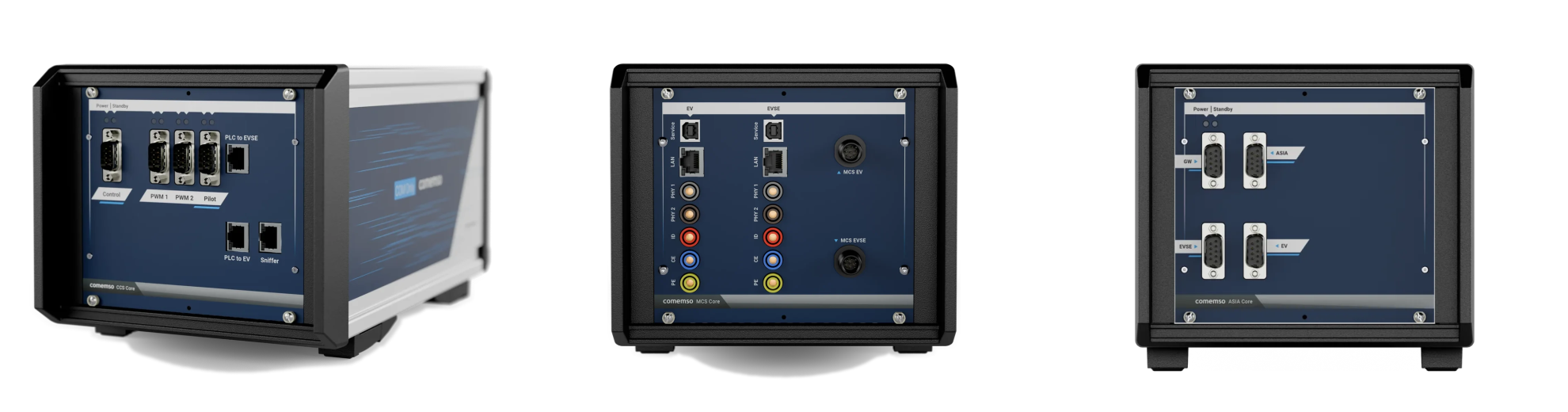
- What for
- Developers of EVCC and SECC charging controllers – before the power hardware exists.
- What it does
- Connects a real EVCC or SECC to a simulated partner and tests CCS, MCS or ASIA communication and signals; CharIN CCTS validated for the Basic and Extended DC EVSE test profiles.
- Not for
- Power tests – ComOnly has no load circuit; for real power use EVCA Flex.
A communication error found only after integration costs a complete vehicle or charger test cycle to reproduce.
Your path to CCS communication testing
Choose the ComOnly configuration for your communication test.
Your real device under test (DUT) is the EVCC or the SECC – the setup follows that choice.
CCS tester for EVCC and SECC communication development
For charging communication testing, EVCA ComOnly connects a real EVCC or SECC to a configurable charging communication partner. Teams develop controller software, protocol stacks, modems and chipsets before a complete vehicle or charger exists.
comframe correlates signal states, decoded messages and timing with the controller response. Supported normal and negative cases run again across software versions; configuration and traces stay for regression review.
Controller roles at the ComOnly interface
| Real controller | Simulated communication partner | Core and interface |
|---|---|---|
| EVCC | SECC / charging-station side. | The CCS, MCS or ASIA Core matches the protocol and controller signal interface. |
| SECC | EVCC / vehicle side. | Each Core brings the corresponding EV-side interface and released simulation profile. |
CCS uses the configured pilot and PLC interfaces, MCS uses 10BASE-T1S and its selected signal access, and ASIA uses CAN and protocol-specific states. For tests with a high-voltage source or load, use a separate EVCA power-test configuration alongside the communication test.
Core selection · Published Core front-panel views · CCS reference connectors and dimensions
One ComOnly principle, three protocol directions
ComOnly cores and interfaces: CCS, MCS and ASIA
CCS, MCS and ASIA cores provide different physical interfaces, communication links and protocol families.
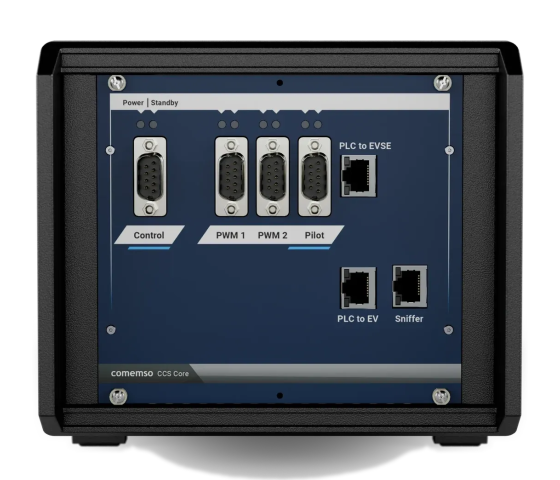
With the CCS Core, ComOnly is a CCS tester for EVCC and SECC development. AC and NACS communication are also available within the configured scope.
Access Control Pilot, PLC (power line communication) and high-level communication at the controller.
- IEC 61851-1, DIN 70121 and ISO 15118 communication by configured release
- PLC to EV, PLC to EVSE and optional PLC sniffer hardware
- Professional Simulation and Charge Playback for supported profiles
- DIN 70122 and ISO 15118-4/-5 Test Library scope by configuration

Develop MCS controllers and test 10BASE-T1S communication and low-level signals directly at the controller bench.
EVCC or SECC development starts with an MCS communication partner that is configurable and repeatable.
- EV and EVSE test directions on the MCS communication interface
- Service, LAN, PHY1 and PHY2 access
- Insertion Detection, Charge Enable and protective-earth signal context
- ISO 15118-20-based application behaviour by released configuration
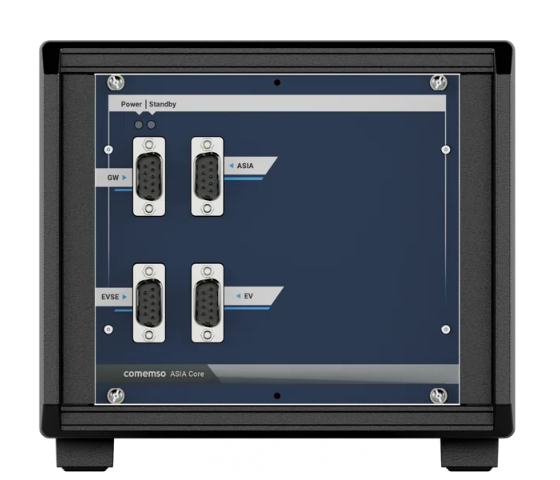
CHAdeMO and GB/T DC controller development with CAN and protocol-specific low-level states.
- Real EVCC or SECC with a simulated CHAdeMO or GB/T counterpart
- CAN communication, message timing and value analysis
- CHAdeMO release and GB/T 27930 generation defined per configuration
- Low-level state access and application-specific results by released scope
One system, two controller perspectives
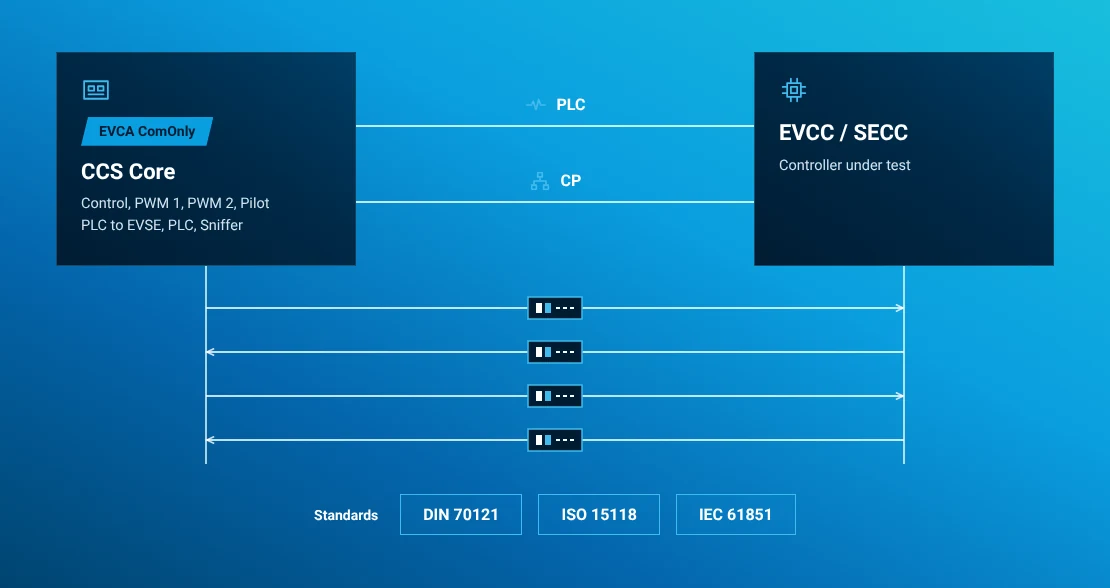
EVCC and SECC tests: simulated partner and controller response
The DUT (device under test) remains real; its communication partner is configurable.
Communication test objective: timeout after a missing charging message
| Test element | Defined scope |
|---|---|
| Starting condition | Select the real EVCC or SECC, Core, protocol version and supported session state. Keep the controller configuration and other simulated-partner conditions constant. |
| Changed partner behaviour | Withhold a selected message using the supported simulation functions. The expected message and permitted timing come from the chosen protocol and test requirement. |
| Expected controller reaction | Check timeout detection, the required state transition and the specified diagnostic reaction against the selected protocol and test requirement. |
| Evaluation | Correlate the last message, simulated signal states, controller response and timing. Preserve configuration, traces and the acceptance decision for regression; a Test Library verdict requires the corresponding released test case. |
This example shows how to plan a timeout test and evaluate the controller response. comframe records the measurements and compares them with the acceptance criteria defined for the actual run.
Professional Simulation · Automated Standards Analysis · Conformance Test Libraries
Vehicle controller development
EVCC tests
EVCA ComOnly behaves as the charging-station communication controller and challenges the EVCC from connection detection through session negotiation and error handling.
- SECC or EVSE behaviour simulated for the selected protocol family
- States, values, message order, optional content and timing varied
- Controller reactions, limits, certificates and state transitions verified
- Regression automated across software versions and parameter sets
Charging-station controller development
SECC tests
EVCA ComOnly behaves as the vehicle communication controller and supplies controlled vehicle, battery and protocol behaviour to the SECC implementation.
- Configurable EV behaviour at the controller interface
- Challenge negotiation, limits, timeouts and negative cases
- Assess protocol conformity and robustness before power integration
- Supported Test Libraries for controlled verdicts and reports
Controller-response analysis: signals, messages, states and timing
View physical and low-level states alongside PLC, 10BASE-T1S or CAN and the application protocol. Interface and timing context explain each controller reaction.
Configured simulation varies messages, values, delays and supported negative behaviour. Released analysis functions and Test Libraries add evaluations, deviations and reports.
Relevant EVCA capabilities
ComOnly functions for simulation, protocol analysis and regression
Core, protocol, hardware, software licences and Test Libraries follow the functions you need.
comframe monitors communication signals and shows quality, states and timing alongside the charging sequence.
Find physical-layer causes earlier.comframe compares measured values, states, timings and protocol events with executable requirements; clear deviations stand out.
Reduce manual trace interpretation.For supported profiles, vary message content, timing, optional messages and non-conform behaviour without rebuilding the test environment.
Reach difficult state-machine scenarios.ComOnly replays supported recorded charging behaviour at the physical interface – a repeatable counterpart from the field session.
Bring difficult field behaviour to the bench.Supported standards-based test cases run with controlled steps, automated verdicts and traceable reports.
Move from ad hoc checks to repeatable results.Supported functions integrate into HiL (hardware-in-the-loop) benches, laboratory automation and continuous regression workflows.
Reuse the controller test in the development toolchain.Certificate and security context are configurable for supported ISO 15118-based charging profiles.
Test more than nominal message exchange.Configuration, measurements, protocol events, evaluations and test results stay together for review and reuse.
Make every result attributable.Protocol families and implementation profiles
CCS, MCS and ASIA protocol profiles and released Test Library scope
We define Core, DUT role, interface, protocol generation, optional services, security context, simulation depth and results separately.
- Low-level context
- IEC 61851-1, control pilot and the applicable SAE J1772 or NACS interface context.
- Communication link
- PLC-based high-level communication, including optional PLC sniffer hardware in the published reference configuration.
- Application protocols
- DIN 70121, ISO 15118-2 and ISO 15118-20 by configured release, with ISO 15118-3 communication-layer context.
- Test results
- DIN 70122 and ISO 15118-4/-5 Test Library scope where released and configured.
- Low-level context
- MCS-specific Charge Enable, Insertion Detection, protective-earth and physical interface access by configuration.
- Communication link
- 10BASE-T1S, service and LAN access, plus PHY1 and PHY2 measurement or integration points.
- Application protocol
- ISO 15118-20-based MCS communication according to the released edition, amendment and service profile.
- Test results
- Simulation, monitoring, pre-conformance or Test Library scope must be stated separately from the protocol name.
- Low-level context
- Technology-specific EV and EVSE states and interface signals according to the selected system and connector path.
- Communication link
- CAN communication with protocol-specific message timing, values and controller reactions.
- Application protocols
- CHAdeMO release by configuration, plus GB/T 27930 variants in the relevant GB/T 18487.1 charging context.
- Test results
CharIN currently lists comemso as a validated Conformance Test System vendor for the Charging System Basic and Extended DC EVSE application profiles.
View the CharIN CCTS listingWe specify role, protocol edition, test standard, Test Library release, certificate or security context and expected report per project. This is especially important for evolving ISO 15118-20 and MCS profiles.
Published 2024 CCS reference configuration
Compact hardware for the controller bench
These published reference values apply to the CCS tester with CCS Core in the 2024 brochure configuration; MCS and ASIA dimensions and interfaces require separate confirmation.
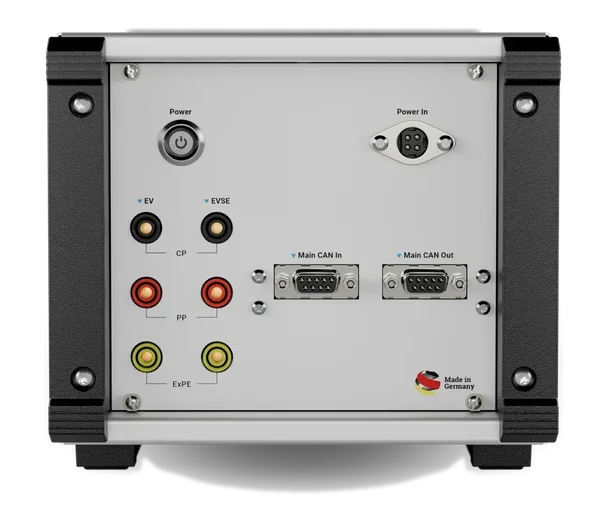
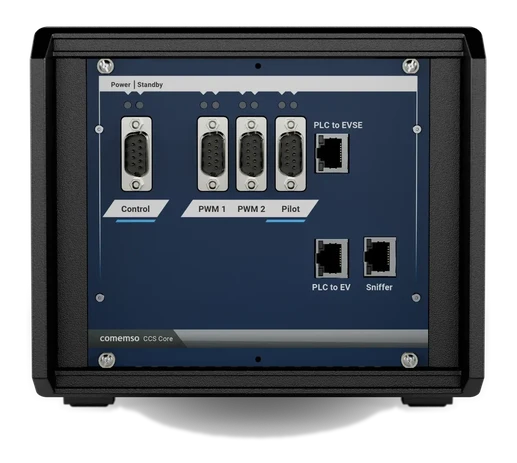
- Model numbers
- 116-2-015 CCS Core, 116-2-016 with PLC sniffer, 116-1-011 ComOnly case.
- Dimensions
- 18.6 × 15.8 × 32.6 cm.
- Reference weight
- Approximately 3 kg.
- Power input
- 24 V DC.
- Published connections
- Insulated banana sockets, SUB-D9 for CAN data and RJ45 for PLC data.
- Published protocol scope
- AC, CCS and NACS, with the simulation and Test Library scope stated in the brochure.
Package contents
EVCA ComOnly, 24 V power supply, CAN cable and termination, firmware update kit, Quick Start Guide and user manuals in the published reference package.
Usable software
The brochure lists comemso com.frame and Vector CANoe with a comemso project.
Upgrade path
The 2024 brochure positions ComOnly as the communication-focused entry into EVCA Flex. Power, switching and electrical fault depth come in when the test objective grows.
From the controller interface to reusable test records
EVCC/SECC test integration: comframe, API and HiL
Your communication tests carry over to HiL, automated regression and your existing toolchain.
Compact manual or semi-automated setups serve early hardware and software development.
You configure behaviour, visualise data and correlate events. The resulting records stay available for later tests.
Embed supported functions into automated laboratories, HiL systems and regression pipelines.
Interop, Multi Mobile, Flex or the full MCS system extend the setup as physical test requirements grow.

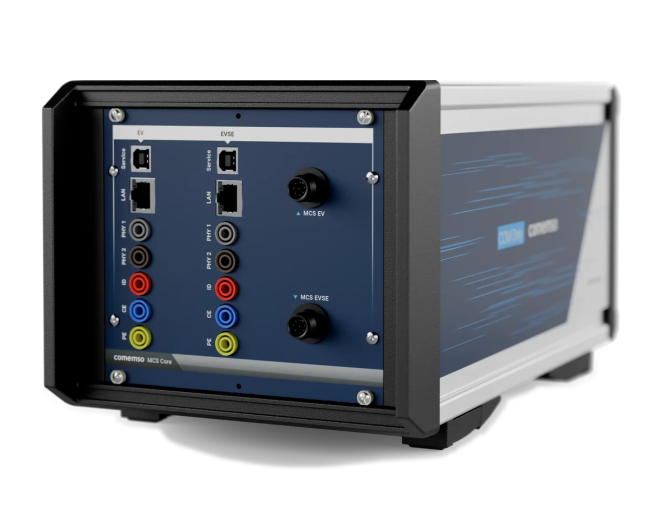
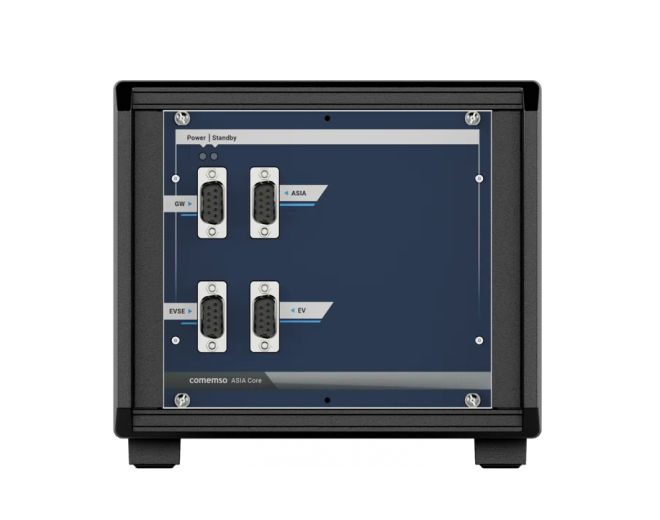
From controller development to regression testing.
Vehicle and charger teams validate EVCC and SECC implementations; semiconductor and software teams test modems, chipsets and protocol stacks. Laboratories investigate standards and prepare conformance campaigns.
The controller test, specified for your quotation
ComOnly configuration: controller role, Core, interfaces and software
- 1DUT and role. EVCC, SECC, ECU, protocol stack, modem or chipset.
- 2Core and interface. CCS and NACS, MCS, or ASIA with the required controller and signal connections.
- 3Communication depth. Low-level states, PLC, 10BASE-T1S or CAN, high-level messages, timing and certificates.
- 4Simulation depth. Nominal, boundary, invalid, delayed, missing and supported non-conform behaviour.
- 5Automation and reports. Test Libraries, API, reports, regression and traceability.
- 6Growth path. Interop, Multi Mobile, EVCA Flex or the full EVCA MCS architecture.
Systems by test objective
ComOnly, Interop, Multi Mobile and Flex by device under test and physical test scope
| Selection criterion | EVCA ComOnly | EVCA Interop | EVCA Multi Mobile | EVCA Flex or full EVCA MCS |
|---|---|---|---|---|
| Primary question | Does the EVCC or SECC communicate correctly and robustly? | Why did a real EV and real EVSE fail together? | What is happening around the real charging interface in lab or field? | How does the complete interface behave with real power, faults, cooling or high-voltage integration? |
| Typical DUT | EVCC, SECC, protocol stack, modem or chipset. | Real EV and real EVSE pair. | Vehicle, charging station or charging interface. | EV, EVSE, subsystem, power stage or full MCS interface. |
| Counterpart | Simulated EV or EVSE communication partner. | Both partners are real, with synchronised analysis and manipulation. | Simulation, monitoring or real interface depending on configuration. | Configured simulation plus external source, load and application hardware. |
| Power boundary | Communication and controller testing. HV source and load belong to a separate power-test configuration. | Real-pair measurement or project-specific setup. | Mobile and field-oriented electrical context. | Scalable voltage, current, power, switching, electrical faults, cooling and safety. |
| Best next step | Standards, Test Libraries, automation or another core added Expand when power is required. | Interoperability cause reproduced and verified | Field recordings linked back to development and release campaigns | The complete physical test setup validated |
Product documents
Brochure and technical datasheet
EVCA ComOnly brochure
Product overview · English · PDF
Open brochureEVCA Flex ComOnly datasheet
Rev. 01.02 · English · PDF
Open datasheetFrequently asked questions
EVCA ComOnly FAQ
What is EVCA ComOnly?
EVCA ComOnly is the communication-focused configuration of the EV Charging Analyzer/Simulator platform. Connect a real EVCC or SECC to a configurable simulated counterpart and test low-level signals, communication links and protocol behaviour. Use its configured analysis and automation functions to evaluate and record the controller response.
Which EVCA ComOnly variants are available?
The product family is configured for three main protocol directions: EVCA ComOnly CCS for AC, CCS and NACS communication, EVCA ComOnly MCS for MCS controller and 10BASE-T1S work, and EVCA ComOnly ASIA for CHAdeMO and GB/T DC communication.
Can EVCA ComOnly test both EVCC and SECC controllers?
Yes. For EVCC development the system represents the charging-station communication counterpart. For SECC development it represents the vehicle communication counterpart. The real controller remains the DUT while its partner becomes repeatable and configurable.
Does EVCA ComOnly transfer charging power or high voltage?
ComOnly provides communication and controller testing at the EVCC or SECC bench. The configuration focuses on signals and protocols; an internal source, load or high-voltage power stage is outside that scope. Choose EVCA Flex, EVCA MCS or another configured EVCA system when real voltage, current, power, switching, cooling or electrical fault injection become part of the test objective.
Which standards are covered by EVCA ComOnly CCS?
For the CCS tester with CCS Core, published reference information includes IEC 61851-1, DIN 70121, ISO 15118-2, ISO 15118-3 and ISO 15118-20 communication. NACS and SAE J3400 context can be configured where applicable. Simulation support, protocol version, security profile and Test Library availability must be specified separately.
What does EVCA ComOnly MCS test?
Test EVCC and SECC communication, 10BASE-T1S, service and LAN access, MCS low-level signals and controller behaviour. Specify the ISO 15118-20 profile, signal access and released functions for your MCS configuration.
Customer projects, success stories and technical articles related to this page.
- Customer projectPortable CCS EVSE TesterCustom EV Charging Analyzer/Simulator in a compact transport case for mobile EVSE development, CCS communication testing and diagnostics.
- KnowledgeISO 15118-20: Plug & Charge and BPT testsPlan ISO 15118-20 EVSE tests for Plug & Charge and bidirectional power transfer. Define profiles, credentials and failure cases.
- Product newsEVCA Interface: Operation Made EasyEVCA user interface: user levels, consistent controls and saved test presets for EV and EVSE testing. Interface concept and update plans published in 2022.
Customer feedback on the EVCA platform.
EVCA system planning
We define EVCC or SECC, charging protocol, signal paths and automation interface for your communication test bench.