
Portable EV and EVSE analyzer
Take your charging lab to the vehicle and the station.
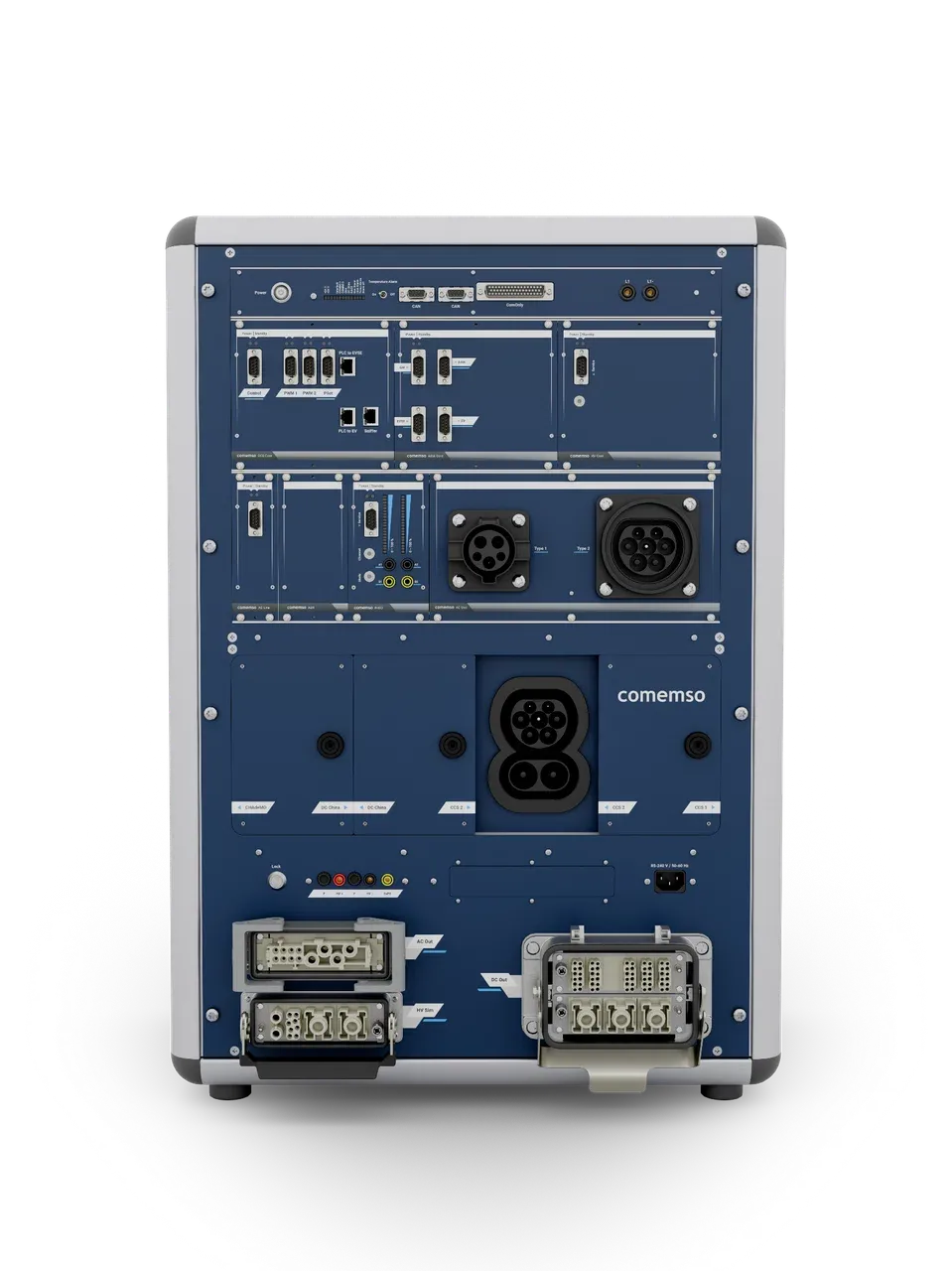
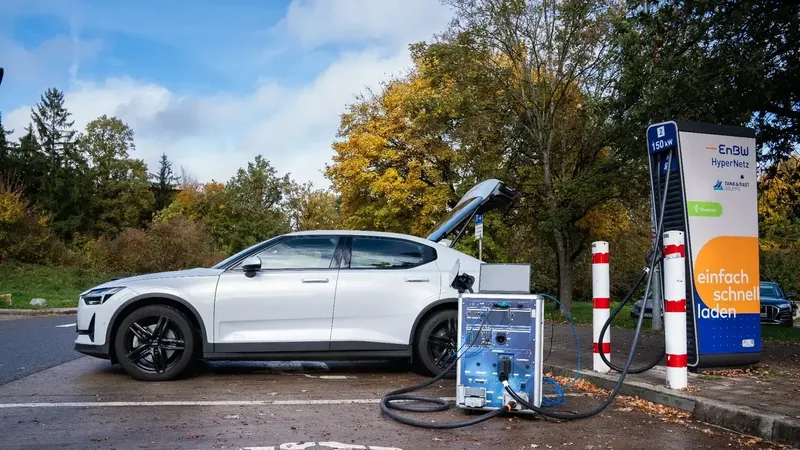
Take EVCA Multi Mobile to the test object: it records a real charging pair or simulates the partner – in the lab, at the vehicle and in the field – instead of shipping vehicles or chargers to a laboratory.1
Used by the charging specialists at umlaut in their EFECT lab in Braunschweig.
- What for
- Teams who test charging where the vehicle or charger stands – in the lab, at the vehicle and in the field.
- What it does
- Simulates EV or EVSE or records a real pair; AC, CCS, NACS, CHAdeMO and GB/T, with external power such as a 3 kW laboratory source/load.
- Not for
- High-power laboratory tests – that is EVCA Flex.
A fault that only occurs at one site stays unsolved until the test equipment gets there.
From a field finding to a repeatable laboratory test.
An EVSE (electric vehicle supply equipment, or charging station) manufacturer purchased Multi Mobile with a 3 kW laboratory source/load after a precharge investigation. About three minutes of human analysis followed the recording; setup, software work and retest took additional time.
Portable engineering system
Investigate charging behaviour at the vehicle or field site
You investigate charging behaviour where the vehicle, prototype or charging partner is: on site, in the workshop, on the proving ground or at a test event. Keeping the DUT (device under test) in its original setting helps preserve the conditions behind a charging failure.
EVCA Multi Mobile brings the charging interface to the test site. The findings carry over to controlled reproduction and regression tests back in the laboratory.
Multi Mobile serves portable development, analysis and validation. EVCA Flex provides the laboratory path for tests centred on integrated high power, switching and deep electrical fault injection.
One system. Three test roles.
Simulate the vehicle, simulate the charging station or analyse the real charging pair.

EV simulation
Charging station tests.
Simulates the electric vehicle to test a real EVSE with controlled vehicle behaviour, battery requests and communication.
- Normal, boundary and non-conform EV behaviour, configurable.
- Control Pilot (CP), HLC, timing and configured voltage/current values, measured.
- Project-specific load or bidirectional power hardware joins where energy transfer is required.
- Reusable simulations, automation and supported EVSE Test Libraries.
EVSE simulation
Electric vehicle tests.
Simulates the charging station to test the real charging inlet, EVCC (vehicle-side charging communication controller), onboard charger and vehicle charging logic.
- Configurable SECC, signal and protocol behaviour.
- Messages, timing, limits, authorisation and termination, varied.
- Project-specific source hardware joins when the vehicle must receive power.
- Vehicle-side CAN data and EVCC, OBC and battery management system (BMS) reactions, correlated where integrated.
Passive or manipulating gateway
Real EV and EVSE analysis.
Multi Mobile sits between the charging partners. Their communication, measurements and behaviour appear on one synchronised timeline.
- Observes the real pair without replacing either implementation.
- Decode supported CCS communication, including applicable gateway access for TLS/PnC.
- Modify, delay, suppress or replace selected live information where configured.
- Records field behaviour for root-cause verification and later reproduction.
Charging-specific analysis
Showing decoded data is not the same as analysing the charging process.
Multi Mobile analyses the charging process across physical interface, low-level signals, protocol content, timing and available electrical measurements.

comframe analysis
Decode. Correlate. Evaluate. Highlight. Preserve.
Automated Standards Analysis identifies relevant deviations. Cross-Layer State Monitoring relates messages, signals and electrical state. The resulting records remain usable for supplier alignment, correction verification, Charge Playback and regression.
Engineering resultFindings, not raw data
Regional connector, inlet, CP, Proximity Pilot (PP), PLC (power line communication) or CAN path and auxiliary signals remain part of the measurement.
Retain sender, message content, order, state and configured TLS or certificate context.
Message delays, state transitions and the physical reaction share one timeline.
Configured voltage, current and external measurement channels line up with the communication sequence.
comframe compares the recorded behaviour with expected limits. Highlight relevant deviations and save the analysis as a test result.
From field recording to laboratory test
Reproduce a charging event under controlled laboratory conditions.

From a real charging event to a reusable test case
- Connect and capture
- Isolate the cause
comframe aligns every layer, and standards-aware analysis highlights the deviation.
- Change one variable
Modify message content or timing with the Manipulating Gateway or simulation.
- Reproduce physically
Charge Playback recreates recorded behaviour at the charging interface.
- Automate regression
Save the case, vary it and run it repeatedly through Charge Cycle Automation or REST API.
Field recordings become controlled, repeatable laboratory tests.
Shared EVCA analysis, simulation and automation
Configure the test. Do not develop the test environment from scratch.
The comframe analysis, simulation and automation functions of your Multi Mobile configuration are available.
comframe relates measurements, state transitions, timing and messages to normative expectations and highlights deviations.
Supported message values, timing, optional sequences and deliberately non-conform behaviour are configurable.
Manipulating Gateway observes and changes selected live communication while both real charging partners stay connected.
Physically reproduce recorded protocol-level EV or EVSE behaviour so the DUT interacts with a repeatable partner.
Sequence configurations and variants for repeatable campaigns, endurance work and regression.
Released standards-based test cases run with automated steps, supported verdicts and reports.
Multi Mobile connects to project automation, external measurement, HIL (hardware-in-the-loop) and CI workflows.
Charging technologies and standards
Configure one portable EVCA system for the charging technologies in your test programme.
Connectors, protocol versions, measurement ranges and Test Libraries are configuration-specific.
PLC-based charging
Type 1, Type 2, Combo or NACS interfaces for EV, EVSE and gateway roles.
CAN-based DC charging
Configured CHAdeMO connector, CAN communication and low-level state access in EV, EVSE or measurement roles.
Chinese DC charging
Address EV and EVSE communication for supported GB/T generations without changing to a separate analysis architecture.
Charging communication under stress
An optional EMC-compatible housing supports configured EV or EVSE test roles while the DUT is exposed to conducted or radiated stress.
Configuration logic
Configure Multi Mobile for your device under test, charging interface and test objective.
- 01DUT and role
EV, EVSE, both real partners, charging controller or coordinated subsystem.
- 02Charging interfaces
AC, CCS1, CCS2, NACS, CHAdeMO or GB/T DC, including connector arrangement.
- 03Communication depth
Low-level signals, PLC or CAN, HLC (high-level communication), timing, TLS, certificates and external CAN data.
- 04Power context
Measurement only, customer load, source, bidirectional supply or planned EVCA Flex link.
- 05Capabilities and results
Gateway, Professional Simulation, Charge Playback, Test Libraries, automation, REST API and reports.
- 06Environment and growth
Laboratory, vehicle, field, test event, EMC chamber, Interop workflow or later Flex expansion.
Frequently asked questions
EVCA Multi Mobile product questions
What is EVCA Multi Mobile?
EVCA Multi Mobile is the portable system in the comemso EV Charging Analyzer/Simulator platform. It combines configured physical charging interfaces, EV and EVSE simulation, passive or manipulating gateway analysis and comframe analysis, simulation and automation for laboratory, vehicle and field tests.
Can one system test both electric vehicles and charging stations?
Yes. In EV simulation, Multi Mobile acts as the vehicle side to test a real EVSE. In EVSE simulation, it acts as the charging-station side to test a real EV. Exact interfaces, power integration and protocol releases depend on the configured system.
Can EVCA Multi Mobile analyse a real EV and a real EVSE at the same time?
Yes. In passive or manipulating gateway configurations, Multi Mobile is placed between both charging partners and correlates supported signals, protocol messages, timing and electrical measurements on one timeline. Applicable TLS access requires the corresponding gateway, certificate and release configuration.
Which charging technologies can be configured?
Published Multi Mobile configurations cover AC and DC CCS Type 1 and Type 2, NACS, CHAdeMO and GB/T DC.
Does EVCA Multi Mobile support ISO 15118-20?
ISO 15118-20 communication is available in applicable released EVCA configurations. Basic communication support, simulation depth, security functions and conformance Test Library availability are separate scopes and must be confirmed independently.
Does the system include a high-power source or load?
Not by default. Multi Mobile is optimised for portable physical-interface access, simulation and synchronised analysis. Project-specific resistive loads, sources or bidirectional power systems can be integrated. EVCA Flex is the dedicated path when scalable high-power and deep electrical fault testing are primary.
Customer projects, success stories and technical articles related to this page.
- Customer projectHybrid EVSE Testing for Laboratory and FieldEVCA Multi Mobile connects on-site EVSE testing with repeatable laboratory tests using a Gustav Klein power source and a shared charging-test workflow.
- Customer projectEVCA Multi Mobile in the Field, April 2025EVCA Multi Mobile combines AC and DC CCS charging tests with customer resistive-load equipment for mobile EVSE testing. Project report, April 2025.
- Customer projectPortable CCS EVSE TesterCustom EV Charging Analyzer/Simulator in a compact transport case for mobile EVSE development, CCS communication testing and diagnostics.
- KnowledgeReproduce EV–EVSE interoperability faultsRecord an EV–EVSE fault on one time base, identify the first deviation and reproduce supported partner behaviour in the lab.
- Product newsEVCA Multi Mobile Generation 5: Launch 2024EVCA Multi Mobile Generation 5: modular Flex architecture introduced in March 2024, with replaceable modules for repairs and hardware extensions.
- Product newsEVCA Interface: Operation Made EasyEVCA user interface: user levels, consistent controls and saved test presets for EV and EVSE testing. Interface concept and update plans published in 2022.
EVCA in the EFECT charging laboratory.
“The charging specialists at umlaut use the comemso EV Charging Analyzer in our EFECT lab at the Braunschweig site. Since our collaboration with comemso has been excellent for many years, umlaut has once again upgraded the EFECT with comemso hardware.”
EVCA system planning
Charging interfaces, EV/EVSE simulation or gateway role, software options and external power equipment are specified for your laboratory and field work.
Published project examples: January 2025: connected field and laboratory tests · Generation 5: the March 2024 announcement.The articles document the configuration used in each project at that time.
EVCA system selection and growth
Choose Multi Mobile for laboratory, vehicle and field tests.
Systems compared by the task you need to test.
Communication development and controller tests for EVCC and SECC (station-side charging communication controller).
Grow toward Multi Mobile or FlexEVCA Multi Mobile
Portable EV/EVSE simulation and gateway analysis.
Current product pathRecords real EV-to-EVSE charging sessions, analyses them on a synchronised timeline, validates behaviour and transfers field findings to laboratory tests.
Use when the real pair is primaryExternal or integrated source/load architecture, switching, high voltage and deep electrical fault testing.
Upgrade when power risk dominatesSystem selection at a glance
| Selection criterion | ComOnly | Multi Mobile | Interop | Flex |
|---|---|---|---|---|
| Primary purpose | Controller communication | Portable lab, vehicle and field testing | Structured real-pair investigation | Modular high-power validation |
| Physical charging interface | Controller or integration interface | Portable regional connectors | Defined by the real-pair setup | Configurable laboratory interfaces |
| EV and EVSE simulation | Yes, communication-focused | Yes, with portable physical context | Case-dependent | Yes, scalable |
| Real EV + EVSE analysis | Interface-dependent | Strong mobile role | Primary product role | Configurable |
| Power and fault depth | Communication only | Measurement and external project hardware | Measurement and partner interaction | Low to high power and deep faults |