
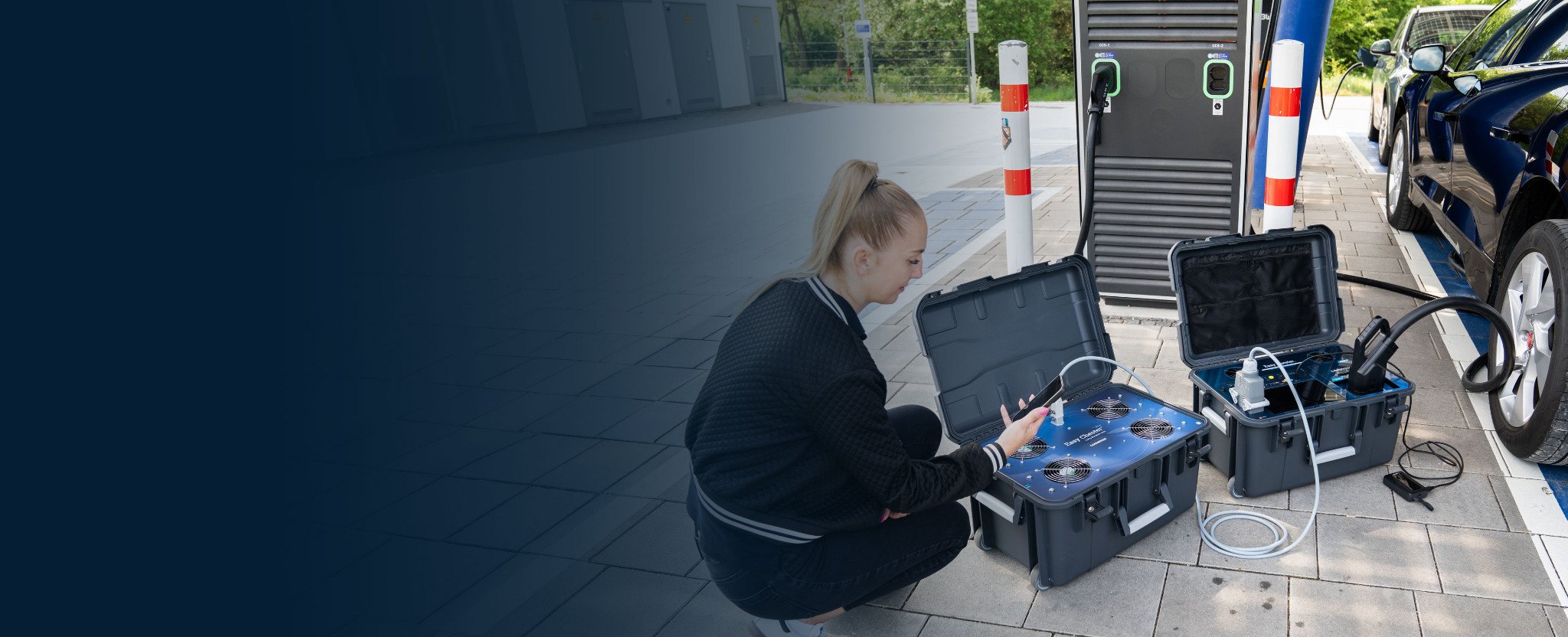
EV charger tester for commissioning and service
EV charger tester: hand over chargers tested and documented in one visit.
Easy Chester Micro (AC) and Ultimate (AC/DC) are the comemso EV charger testers for the field: they take the role of the vehicle, check electrical safety and charging function on site and produce the test report – instead of a test vehicle plus separate instruments.1
Ultimate line in the field since 2016. “…we can guarantee our customers quick service calls …” – Michael Borowski, synfis
- What for
- Installers, service teams and operators who hand over or maintain chargers.
- What it does
- Micro (AC) and Ultimate (AC/DC) check electrical safety, charging function and communication on site and create the test report in one visit; Ultimate loads up to 60 kW with two units.
- Not for
- Laboratory qualification of new charger designs or legal-metrology calibration – EVCA and Calimera cover those.
Choose the EV charger tester for AC or DC field checks
Two comemso EV testers for charging stations cover field work: Easy Chester Micro for AC commissioning, Easy Chester Ultimate for AC and DC. Interfaces, electrical safety functions and options match the work planned at the site.
AC EVSE installation tester
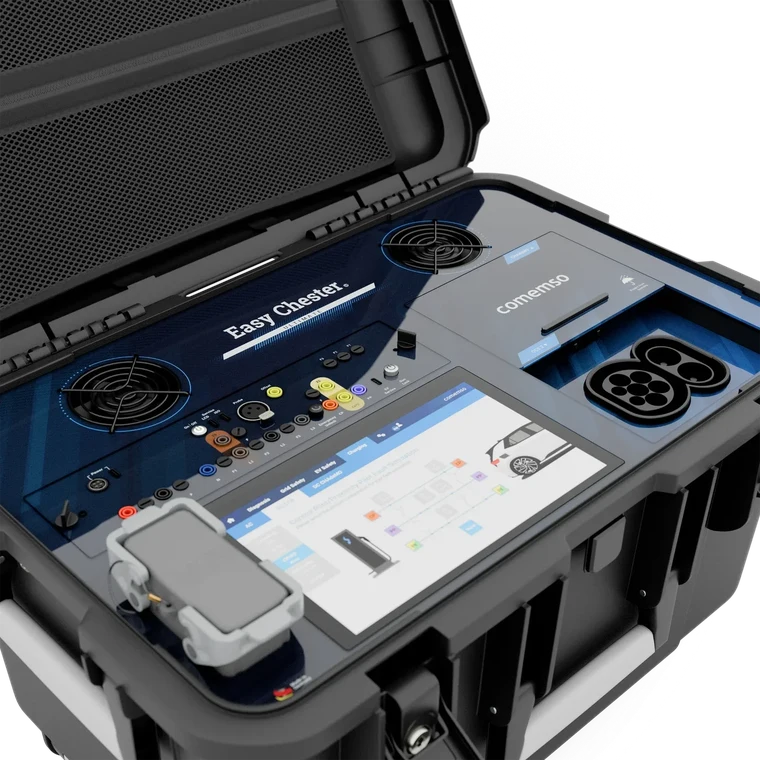
Easy Chester Micro is the AC EV charger tester for wallboxes and AC charging stations. Checks configured grid-side and EV-side electrical safety, phase sequence, communication and charging function during commissioning, maintenance and periodic inspection.
Easy Chester Micro: AC installation testerAC/DC EVSE installation tester
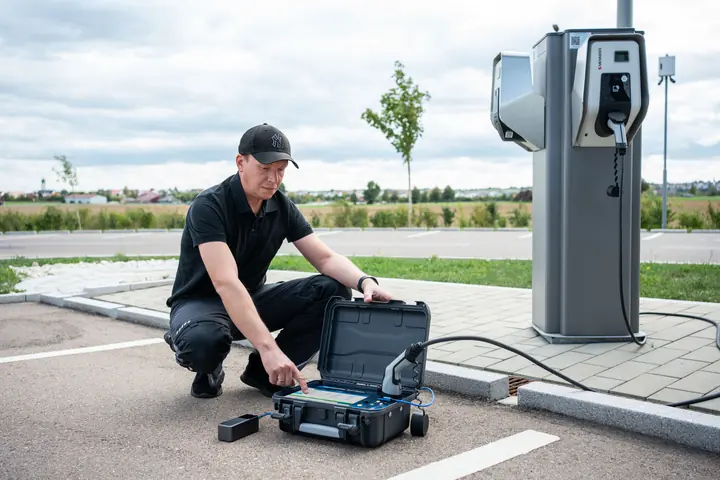
Easy Chester Ultimate is the DC EV charger tester for CCS commissioning and service, and can be configured for AC charging stations. With this EV charger tester, run the selected electrical safety, charging-function and communication checks and record the results. At HPC sites, match the connector, test load and electrical ranges to the planned test.
Easy Chester Ultimate: DC fast charger tester (AC/DC)The test evaluates electrical safety separately from a successful charging session.
Before testing HPC or 800 V charging stations, check station rated power and test load, emulation voltage and measurement range, and communication checks and standards-conformance scope.
Without a documented safety test, the handover leaves installer and operator with an open risk.
What the guided service workflow provides
As an EV charger tester for fast chargers, Easy Chester Ultimate supports checks on AC and DC charging points in the appropriate configuration. The guided workflow connects the planned electrical-safety checks with charging-function tests.
Equipment identity, firmware, executed method, measurement information and result stay available for handover and later maintenance. After a repair, repeat the same test under comparable conditions and link any deviation to the charging point that was tested.
When a check fails, start with the failed step and its measurement information. Connecting the electrical checks with the charging sequence helps narrow the investigation and verify the effect of a correction.
Your path to DC EVSE commissioning
Plan the DC commissioning workflow.
From the demo to your first test:
15-minute demo. Our team shows the guided AC/DC workflow live on a real device and charging station.Quotation and order. The written quotation lists connectors, protocols, safety scope and options for your stations; then you order.Delivery and training. We deliver the configured system and train your team – directly or online in the comemso Academy (e-learning).
Testing throughout the charging station lifecycle
Repeat defined checks at handover, during operation and after repair.
At each stage, the record holds station identity, test configuration, observed behaviour and final decision. This gives later inspections and repairs a clear reference.
You check the installed charging station before handover. Verifies the applicable protective measures, charging communication and energy transfer, and records the initial configuration.
Decision: ready for operation?Defined checks repeat before a failure occurs. Compared with the commissioning baseline, the results show changes in safety, interface behaviour or charging stability.
Decision: continue operating or intervene?A defined test counterpart reproduces the reported fault. Isolate the affected layer and record the findings to guide the repair.
Decision: root cause found?After a repair, component replacement, firmware update or site modification, repeat the affected checks. Documents whether the station meets the requirements for its condition.
Decision: repair verified?Results for the next field action
What an EV charger tester checks: safety, charging function and repair results
Have qualified personnel evaluate the applicable grid-side and charger-side protective measures with suitable test equipment.
Checks connector and locking behaviour, Control Pilot (CP) and Proximity Pilot (PP) states, PLC (power line communication) or CAN communication, interlocks and configured error reactions.
An EV simulator defines charging requests, repeats start and stop conditions and verifies the station’s response.
The affected checks repeat under the original test conditions; you compare the results before and after repair.
Inspection, safety and charging tests
Plan your EVSE test: installation, safety and charging function
Set the test plan for the station, installation, charging technology, market and available equipment. Document the included checks and any checks outside that scope.
Cables, connectors, enclosure, labeling, damage, contamination and accessible components.
Applicable protective conductor, insulation, residual-current and installation measurements using the required qualified equipment.
Protective-earth interruption, isolation-monitoring behaviour, CP faults, residual voltage and configured interlocks.
CP and PP states, duty cycle, plug connection, locking and technology-specific control signals.
DIN 70121, ISO 15118, CHAdeMO, NACS or other supported communication according to the selected configuration.
Charge start, contactor sequence, voltage, current, stop behaviour and the station reaction to a controlled vehicle request.
Defined 400 V or 800 V conditions, extended charging time, load behaviour and faults that emerge only after operation.
Configured test scope. Select the hardware, software and options for the required grid measurements, charging interfaces, power levels, communication standards, fault simulation and reporting. The selected configuration determines which layers and checks are available.
How to test a CCS DC fast charger in the field
Use Ultimate for CCS DC commissioning and maintenance within the selected configuration. Follow the released device procedure and installation inspection plan.
- Define the test boundary
Record station identity and firmware. Confirm the connector, protocol, voltage technology, test load and required inspection scope.
- Verify electrical safety
Perform the applicable grid-side and EV-side protective-measure checks with the configured equipment and qualified responsibility.
- Check the charging sequence
Use controlled EV behaviour to check communication, charge start, voltage/current and charging stop within the selected test-load limits.
- Verify faults and repairs
Run released fault scenarios and repeat the affected checks after repair. Compare results under the same defined conditions.
- Document the result
Record the configuration, executed checks, measured values, deviations and handover or service decision in the report.
For an HPC site, the charger rating and applied test load are different quantities. Confirm the Ultimate test scope and DC load options before specifying the checks.
Download the EVSE inspection checklistDocumented field results
Keep field results useful for the next inspection or repair.
Record what was tested, the test conditions, observations and final decision. This lets the next technician or responsible team follow the result.
Responsibilities in the field
Give installers, service teams, CPOs and manufacturers a shared record.
Different teams may test the same station. Agree responsibilities so the required checks are completed without duplicating work.
Installers and commissioning teams
Service technicians
Charge point operators
Consistent maintenance records compare locations and pass unresolved incidents to the responsible team.
EVSE manufacturers
Product knowledge feeds field procedures; test results become technical feedback.
From a charging fault to a diagnosis
Locate the fault before contacting the EVSE manufacturer's support.
A real vehicle checks a real vehicle–station pairing. An EV simulator and the applicable safety measurements add controlled fault diagnosis and documented station checks.
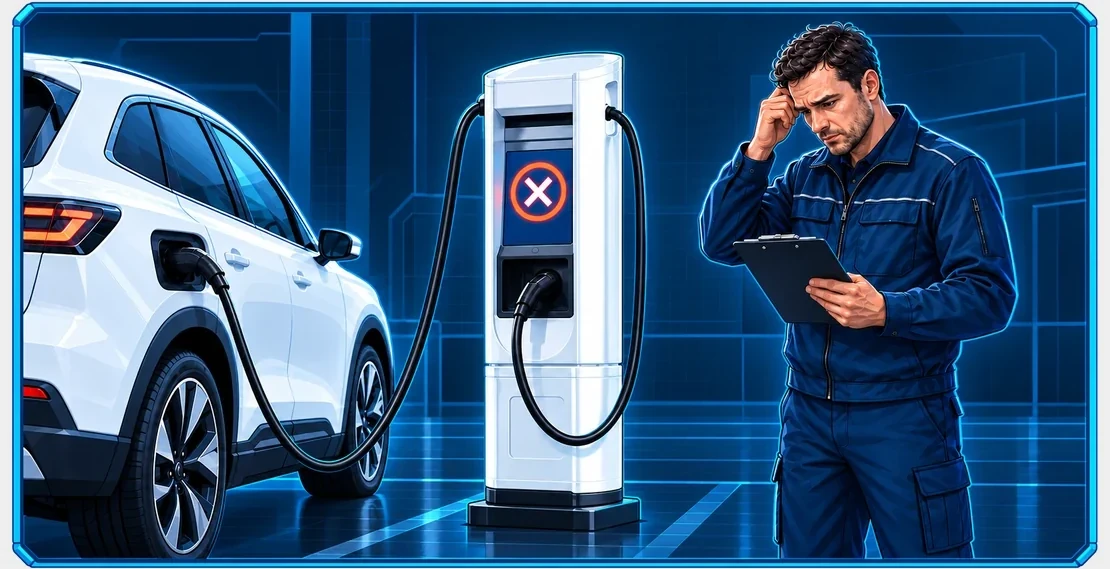
Charging failed. What do you know?
- Symptom: This vehicle does not charge at this station.
- Cause: EV, EVSE, installation, interface or communication has not yet been isolated.
- Test scope: Controlled EVSE safety and fault checks require a defined test setup alongside the real vehicle pairing.
The fault is reproduced and the next action planned.
- Function: Repeat the charging sequence under defined conditions with an EV simulator.
- Safety and faults: Run the applicable configured checks and repeat selected station reactions under defined conditions.
- Documentation: Record the results and involve the EVSE manufacturer with specific findings when needed.
EV-like tolerant charging behaviour supports functional, load and safety tests. It does not relax safety evaluation or replace conformance testing.
Tools and guidance for field testing
Choose your EV charger tester: Micro for AC, Ultimate for AC/DC, EOL for production
See how commissioning and service connect with development, validation, production and operation.
A compact checklist prepares visual, electrical and functional inspection.
Get help with commissioning, training, technical support, repair and lifecycle questions.
Plan installation, inspection and electrical-safety checks alongside the vehicle charging test.
Your own operating figures model unavailable charger-hours, service costs and repeat visits.
Johansen’s feedback refers to the Mini-Charger-Tester, the predecessor of today’s Easy Chester Ultimate.
“As a product-independent full-service provider for sustainable charging systems, comemso not only convinced us because of their market establishment, but above all because of the manufacturer-independent application options. In this way, we can guarantee our customers quick service calls and feedback on the reliable functioning of their charging points.”
“We’ve been using the comemso Mini-Charger-Tester to test our hyper-fast charging, and we’re impressed by the ease of use, stability and precision of the compact solution.”
For operators and integrators
Test the change before it reaches your charging network.
- New supplier
- New station type
- Firmware or hardware update
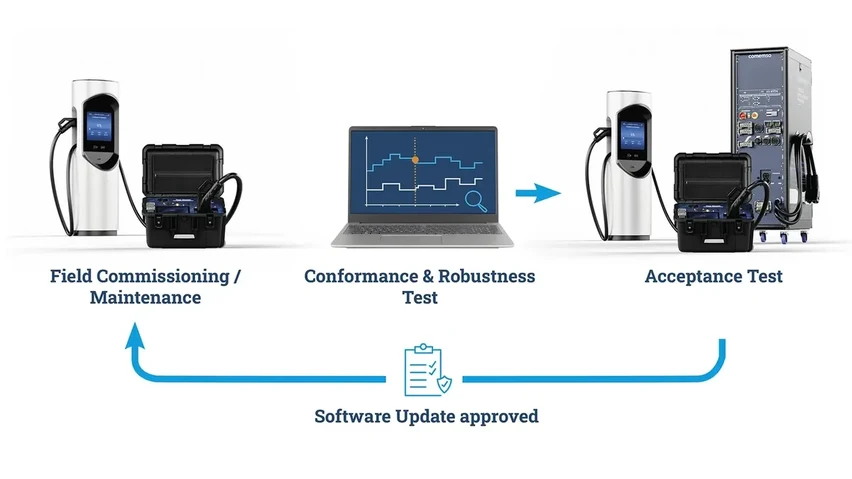
- Validate in the laboratory
- Verify field testability
Easy Chester runs the updated station. Shows whether new control algorithms complicate charging or interrupt field tests.
- Review and release
The record documents versions and results. Resolve deviations with the supplier and repeat the checks before the operator decides on rollout.
CCS, CHAdeMO and NACS: choose the EVSE tester for your DC interfaces
A CCS EVSE tester from the Easy Chester family simulates the vehicle for charging-function checks. For CCS1 and CCS2, select the appropriate interface and required communication profiles. CHAdeMO and NACS also need their intended configurations. The portable EVSE tester follows connector, test objective and electrical operating range; the product label alone does not define the complete test scope.
For CCS, EVSE testing checks the configured charging communication using DIN 70121 or ISO 15118. The supported CHAdeMO protocol version is specified per configuration. For NACS, the coupler and communication profile determine the workflow. EVSE testing compares across interfaces with an explicitly identified test plan.
When testing a fast charger after repair, first record the reason and the changed component. The CCS EVSE tester supplies defined vehicle conditions. The record stores station identity, firmware and configuration, so the next service visit refers to the same records.
Micro is an AC installation tester and does not test DC CCS charging points. An appropriately configured Ultimate combines AC and DC tasks; EOL supports production workflows. A fast charger tester follows the required result and interfaces. The test system used for development analysis can require a different arrangement from field EVSE testing.
CHAdeMO testing: preserve the interface-specific result
CHAdeMO testing needs the correct connector, released profile and defined initial state. It starts with a known normal case; the recording captures any interruption with its timing. When comparing a CHAdeMO fault with CCS, preserve the different protocol sequences. One charging station can produce a different result at each connector.
Guided EVSE testing for service teams
The EV charger tester must make the required inspection steps and active configuration clear to the team. Compare supported test scope, transport requirements, connectors, software, handling and result documentation for the actual service task. These criteria help select suitable EVSE testing equipment for the charging points your team maintains.
Easy Chester · EVSE end-of-line testing
For laboratory development and qualification, the EV Charging Analyzer EVCA provides appropriate simulation and analysis arrangements. For field work, select the EV charger tester around the service workflow, connector and required records.
Frequently asked questions
EVSE commissioning and field-service questions
What should be tested when commissioning an EV charging station?
Identify the station and configuration, inspect the installation and verify the applicable protective measures. Check the EV interface, run a defined charging session and document deviations and the handover result. The exact scope depends on the installation, charging technology, local requirements and configured test system.
Can a DC fast charger be commissioned with a real vehicle?
Use a defined EV simulator for repeatable vehicle states, fault scenarios and station diagnosis, together with the applicable electrical-safety measurements. A successful vehicle session alone does not cover that commissioning scope.
What is the difference between electrical installation testing and EVSE functional testing?
Electrical installation testing evaluates the supply-side installation and protective measures. EVSE functional testing evaluates the charging interface, communication, station reactions and the ability to conduct a controlled charging session. A complete commissioning plan may require both.
What should be checked after an EV charger repair?
Repeat the affected safety and functional tests, reproduce the original symptom where possible, verify the repair under defined conditions and record the final configuration, measured results and release decision.
Does the workflow cover AC and DC charging stations?
Use Easy Chester Micro for AC charging stations and wallboxes, or Easy Chester Ultimate when DC charging tests are also required. Both EV charger testers support configured electrical safety, charging-function and communication checks for commissioning, maintenance and periodic inspection. Match connector hardware, charging standards, electrical ranges and safety functions to the intended work.
Can charging communication faults be diagnosed in the field?
Guided field systems check charging function and expose defined errors. Use EVCA Multi Mobile or EVCA Interop for more complex protocol, timing or cross-layer faults, or reproduce supported recorded behaviour in the laboratory with Charge Playback.
How can a charging-network operator check a supplier firmware update?
Record the baseline with the agreed Easy Chester reference procedure and identify the EVSE hardware and firmware. Apply the supplier update, repeat the defined checks and compare the results. Document the maintenance workflow, release decision and any restrictions.
Deeper supplier, hardware or software qualification may require an appropriately configured EVCA with additional power, fault and standards-based test scope. Passing one reference procedure supports those checks; it does not prove compatibility with every vehicle.
Use the supplier-update release workflow · Explore deeper EVCA qualification
Which EV charger tester do I need for CCS and CHAdeMO?
Select an Easy Chester configuration with the required CCS and CHAdeMO interfaces and released communication profiles. NACS needs its appropriate equipment and profile as well. Micro is intended for AC installation tasks and does not cover this DC CCS role. Match the CCS EVSE tester to the electrical operating range and the records required by the service plan.
How do I test a fast charger after repair?
EVSE testing should establish whether the corrected condition is reproducible, rather than rely on a single successful charging session.
What is the difference between an EV tester and an installation tester with an EV adapter?
An installation tester with an EV test adapter measures the electrical-safety values of the installation and typically simulates basic vehicle states at the connector. An EV tester for charging stations such as Easy Chester also takes the role of the vehicle: it runs through the charging sequence, checks charging function and communication within the selected configuration and documents the safety and function results in one test report.
What does an EV charger tester from comemso cost?
The price depends on model and configuration: Micro or Ultimate, charging interfaces (AC, CCS, CHAdeMO, NACS), test load, safety functions and software options. Describe your test tasks in a demo or quote request and we will recommend a suitable configuration with a quotation.
Customer projects, success stories and technical articles related to this page.
- Customer projectEasy Chester with Long Duration Unit, March 2025Easy Chester with Long Duration Unit lets a customer examine charging continuity and the station’s response over longer sessions. Project March 2025.
- Customer projectEasy Chester Light: DC Check, October 2024Easy Chester Light in the October 2024 project: a focused DC functional check in the DIN 70121 context with a simple operator workflow.
- Webinar archiveWebinar: Commissioning and Inspection of EVSEWebinar archive, 21 April 2026: practical charging-station commissioning and inspection, electrical safety, function and repeatable field checks.
- Product newsEasy Chester Ultimate: Guided EVSE TestingEasy Chester Ultimate guides AC/DC charging, communication and electrical safety tests at the charging station, from connection to PDF report.
Choosing the best EVSE tester for commissioning
Ultimate combines guided AC/DC charging-function and configured safety checks with a test report.
Your next field visit
In a 15-minute online demo, see how Ultimate guides configured checks through to the report. Discuss the charging interfaces and test tasks relevant to your work. After your request, we agree the demonstration scope and appointment.
Systems by test task
Match the test depth to the result you need.
Systems for commissioning, detailed communication diagnosis, real-pair interoperability or energy measurement verification.
Checks AC electrical safety during commissioning, maintenance and periodic inspection.
Explore the AC installation testerChecks AC/DC electrical safety and charging function for commissioning, maintenance and service, with guided reporting.
Easy Chester UltimatePortable signal, protocol and charging analysis for detailed diagnosis beyond guided pass/fail results.
Explore EVCA Multi MobileAnalyses a specific EV and EVSE together when the field problem occurs only with the real combination.
Explore EVCA InteropReproduces supported recorded charging behaviour at the physical interface for laboratory diagnosis and regression.
Open capabilityMobile EVSE calibration for energy measurement verification and legal-metrology evidence.
Open applicationDowntime, repeat visits and truck rolls show the economic effect of a controlled service process.
Open calculator