
Charging interoperability analysis
Vehicle won't charge at a station? See why, on one timeline.
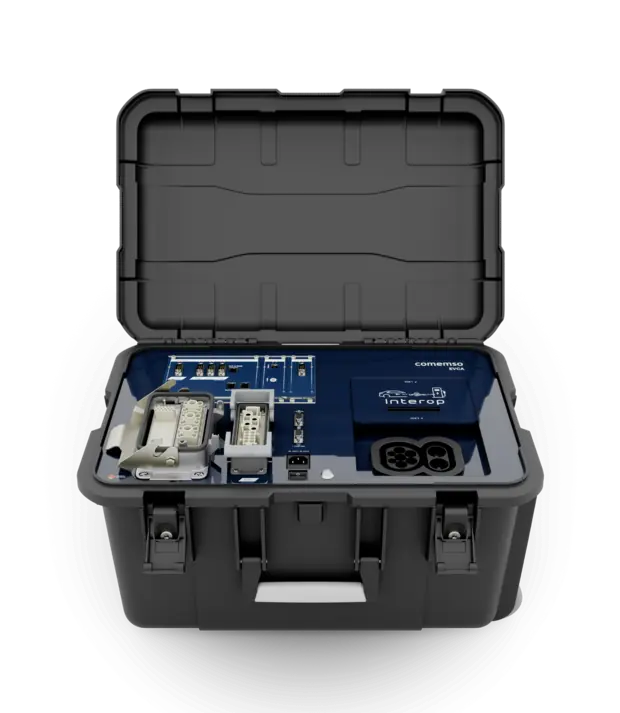
When a vehicle won’t charge, the EVCA Interop analyser sits between the real vehicle and the real station and records messages, voltage and current together. You see the first deviation instead of guessing – in the field, without replacing either side.1
One EVSE manufacturer had searched for seven months. The recording pointed to the precharge response; the analysis took about three minutes.
- What for
- Vehicle and charger teams whose EV and station refuse to charge together – in the field or at a testival.
- What it does
- Records the real pair on one timeline and shows the first deviation; one manufacturer’s seven-month search ended after about three minutes of analysis.
- Not for
- Developing a single controller without its real partner – that is EVCA ComOnly.
Every week an interoperability fault stays unexplained, drivers leave the station without charging.
Focused EV charging interoperability test system
Record in the field. Analyse with comframe.
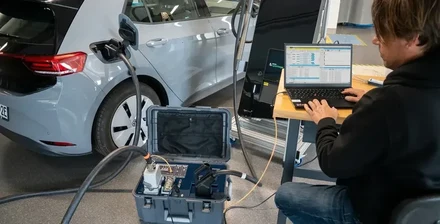
EVCA Interop sits between the real vehicle (EV) and the charging station (EVSE). The mobile hardware records the session through the selected interfaces and measurement channels. comframe shows messages, states and electrical behaviour together.
From recording to test case
From the real charging session to a reusable test case.
- 1Connect the configured hardware
Install EVCA Interop between the real EV and EVSE using the quoted connector and measurement configuration.
- 2Capture synchronised recordings
Record the relevant communication, low-level states, electrical values and reactions on one time base.
- 3Evaluate and validate
Locate the deviation in comframe, then use the released capability options to check the suspected cause under controlled conditions.
- 4Transfer and reuse
Keep the recording, expected state, deviation, validation conditions and system configuration together for reports and supplier discussions. If your configuration includes Charge Playback, use the supported case for laboratory reproduction.
Need the full eight-step investigation method? Open Interoperability & Charging Analysis.
Cross-Layer State Monitoring
Locate deviations in the charging sequence
comframe brings decoded communication, synchronised timelines and technology-specific state views together. Cross-Layer State Monitoring checks whether messages, low-level signals, states and electrical measurements form an allowed combination at each stage of charging.
- High-level communicationMessage direction, content, sequence and timing.
- Low-level signalingTechnology-specific control, connection and stop states.
- Electrical behaviourVoltage, current, power transition and partner reaction.
- Expected contextConfigured or normative phase, allowed combination and highlighted deviation.
Panels, protocol versions, measurement channels and released automatic evaluation rules follow your EVCA Interop hardware and comframe configuration.
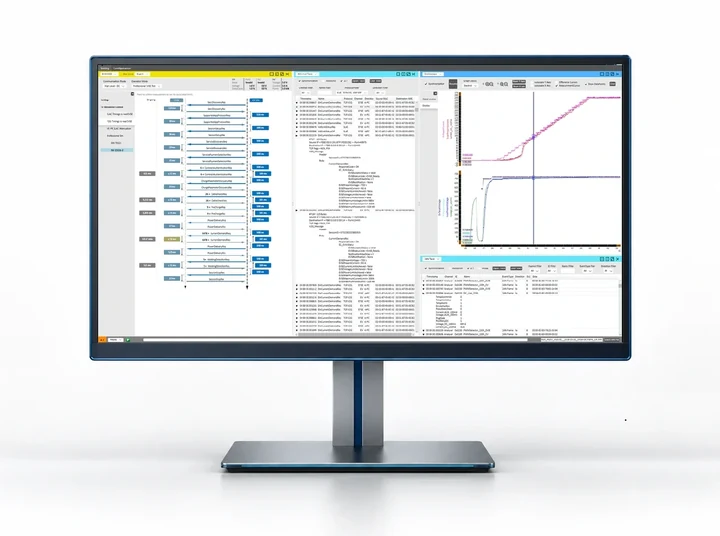
- 1Partner request: charging-message sequence.
- 2Device response: synchronised voltage and current traces.
- 3Result record: decoded messages and event data.
DIN 70121 or ISO 15118 communication, CP and applicable PP context, IEC 61851-23 charging phases, voltage, current and partner reactions appear on one timeline.
CHAdeMO CAN messages and timing line up with technology-specific control states, charging sequence, voltage, current and the reactions of both partners.
GB/T 27930 communication lines up with the applicable GB/T 18487.1 interface states, charging phases, electrical values and highlighted deviations.
Man-in-the-Middle connection
See the full charging interaction.

Measurement at the charging site
Interop captures how vehicle and station interact
Interop records the charging session on site with a shared clock and the relevant measurement context.
Depending on the configuration, comframe synchronises charging communication (PLC, SLAC and HLC), Control Pilot (CP)/Proximity Pilot (PP)/PWM signals, CAN and device data, voltage, current, power, stop events and partner reactions.
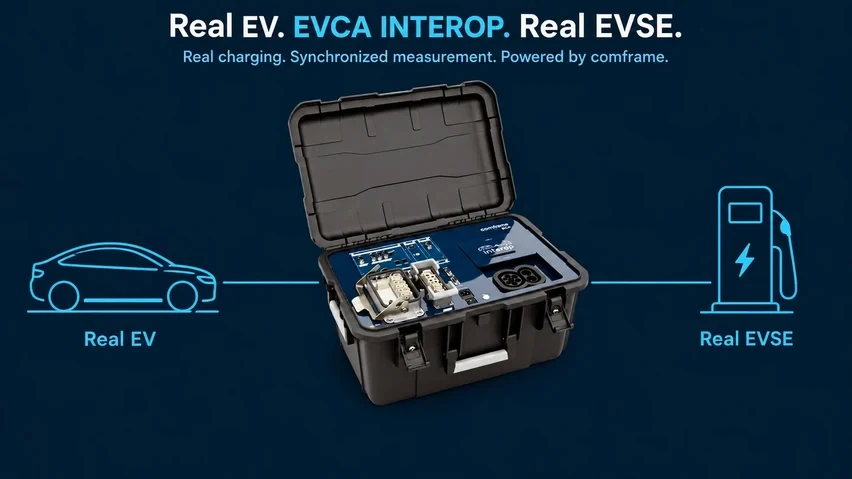
EVCA Interop product architecture
Hardware, interfaces and comframe at a glance.

Capability options
Choose the functions for your investigation
Automated Standards Analysis
comframe relates measured timing, states and values to the released normative or configured expectations.
Review analysis depthYou investigate live communication
Change a selected live communication condition while both real charging partners remain connected.
Review live validation depthCharge Playback
Convert supported protocol-level behaviour from the recorded case into an active laboratory charging partner.
Review playback depth
Charge Playback for an active partner test
Offline replay shows stored data again. Charge Playback lets the device under test (DUT) interact with a repeatable charging partner derived from supported recorded behaviour.
Charging technologies and released scope
Core CCS interoperability testing. Selected configurations for CHAdeMO and GB/T DC.
IEC 61851 basic signaling, PLC (power line communication) and SLAC, DIN 70121, ISO 15118-2 and ISO 15118-3 context support CCS interoperability testing. TLS, certificates, Plug & Charge and ISO 15118-20 functions depend on the selected release.
Selected hardware and software configurations support CHAdeMO real-pair capture, technology-specific state correlation and EV charging interoperability testing.
Selected configurations support GB/T 27930 communication, relevant GB/T 18487.1 state context and synchronised real-pair analysis.
Check protocol editions, operating modes and limits in the EVCA Interop datasheet · Rev. 01.00 (English PDF) and your quotation.
The product, configured around the real charging case
Configure hardware, software and options
Each recording stays with its test conditions, ready for your team to review and reuse.
Additional charging interfaces, external power measurement, protocol extensions, training and application support.
| Area | EVCA Interop product scope | Release qualification |
|---|---|---|
| Real-pair access | Inline connection between a real EV and real EVSE with product-specific connector hardware and synchronised capture. | Connector set, safe operating limits and supported direction are defined by the quotation. |
| Charging communication | CCS communication analysis with DIN 70121 and ISO 15118 context. Selected configurations extend to CHAdeMO and GB/T DC. | Protocol edition, TLS, certificates and ISO 15118-20 depth require current release confirmation. |
| Low-level signaling | Applicable pilot, control, connection and stop-state information for the selected charging technology. | Available signals depend on connector hardware and interface modules. |
| Correlated data | Protocol messages, signaling, CAN data and electrical measurements aligned on one time base. | Electrical channels and external measurement integration depend on the configured system. |
| Analysis | Cross-Layer State Monitoring and standards-aware evaluation where released. | Exact state models, normative rules and user-interface functions follow the selected comframe release. |
| Outputs | Trace, synchronised timeline, evaluated results, report and reusable test case according to scope. | Export formats, report content and Charge Playback preparation depend on licences and release. |
Applications
Charging investigations for engineering and field teams
You investigate charging-station-specific behaviour across firmware versions, regions and field locations.
You validate charger behaviour with real vehicles and keep difficult interaction cases before release.
You compare vehicle-side, charger-side, communication and electrical observations from the same session.
Measurement packages for customer projects keep their test conditions. Retain the vehicle and station cases for later investigations.
The shared recordings and checks help plan targeted field tests, clarify responsibilities and assess the cases relevant to a release.
Product selection and growth path
Choose EVCA Interop to investigate the real charging pair
EVCA Interop can grow into broader portable testing or deeper laboratory validation through a compatible EVCA expansion.
Portable multi-standard measurement, simulation and field work around real EVs and EVSEs.
EVCA Interop
The starting point for real-pair investigation.
External power integration, switching, electrical faults, IEC 61851-23 testing and scalable high-power validation.
Methods, capabilities and test cases
Explore the method or capability for your next test
Interoperability & Charging Analysis
Investigation method, Cross-Layer Analysis and records for reviewing the charging case.
Open the application pageAutomated Standards Analysis in detail
Detailed standards-aware evaluation, release scope and configuration.
Automated standards analysisCharge Playback in detail
Physical reproduction of recorded EV-side or EVSE-side behaviour.
Charge PlaybackConformance Test Libraries
Defined test cases, roles, editions, verdicts and validation scope.
Open Test LibrariesFrequently asked questions
EVCA Interop product questions
What is EVCA Interop?
EVCA Interop is a mobile EV charging interoperability test system connected between a real EV and a real EVSE. It records communication and configured electrical measurements on a shared time base. Use the released analysis and validation functions to investigate the interaction and keep the case for laboratory tests.
Does EVCA Interop replace the EV or charging station?
In passive Man-in-the-Middle operation, the vehicle and charging station remain connected and communicate with each other. EVCA Interop can also simulate the EV or EVSE at ComOnly level, using charging communication and supported low-level signals. No load circuit can be connected, so these simulation modes do not provide charging-power tests.
How is EVCA Interop different from a charging sniffer?
A charging sniffer records communication. EVCA Interop combines communication with configured low-level signals, timing, electrical measurements and charging-state context on one synchronised timeline. Selected configurations add standards-aware evaluation, controlled manipulation or Charge Playback.
Which technologies support Cross-Layer State Monitoring?
Cross-Layer State Monitoring is available in applicable configurations for DC CCS, CHAdeMO and DC China / GB/T DC. Exact protocol versions, state models, channels and evaluation rules depend on the selected EVCA hardware and comframe release.
Can EVCA Interop support CCS interoperability testing?
Yes. CCS is the documented core path, including applicable IEC 61851 signaling, PLC and SLAC, DIN 70121 and ISO 15118 context. Exact connectors, TLS functions, certificates and ISO 15118-20 scope must be confirmed for the quoted release.
Can EVCA Interop address CHAdeMO and GB/T DC?
Yes, through selected configurations with the appropriate connector hardware, CAN communication, low-level state access and released software functions.
Customer projects, success stories and technical articles related to this page.
- Customer projectCharging Interoperability: EV Manufacturer, March 2026A returning vehicle manufacturer expands AC and DC CCS charging interoperability tests with EVCA, building on its existing test workflow.
- KnowledgeReproduce EV–EVSE interoperability faultsRecord an EV–EVSE fault on one time base, identify the first deviation and reproduce supported partner behaviour in the lab.
- Product newsEVCA Interface: Operation Made EasyEVCA user interface: user levels, consistent controls and saved test presets for EV and EVSE testing. Interface concept and update plans published in 2022.
Customer feedback on the EVCA platform.
Real-pair investigation
First you identify vehicle–charger combination, connector, protocol and gateway mode. Measurement and comframe options follow your investigation.