
comframe
comframe modules for charging protocols and BMS tests
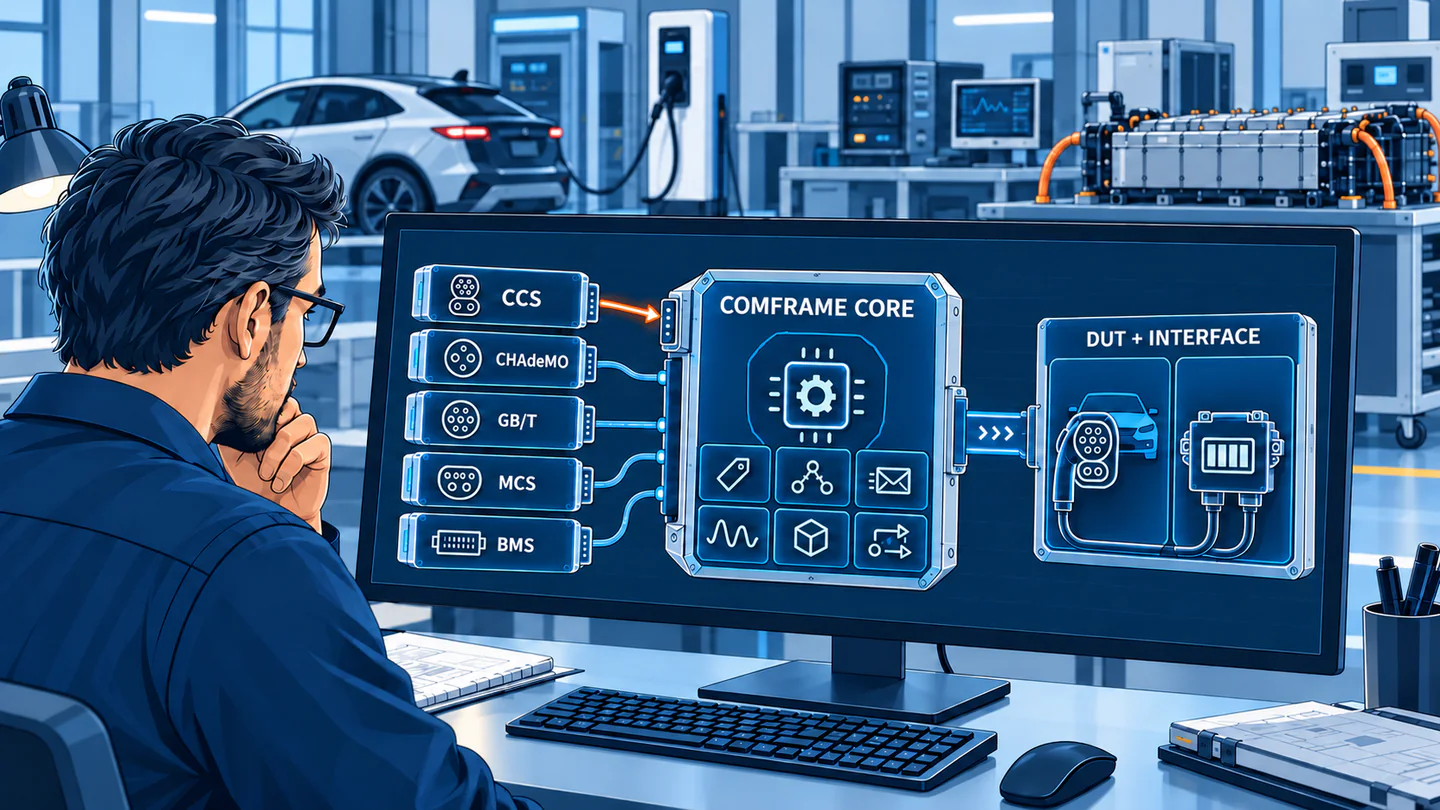
Use a comframe module to work with the messages, states and measurements of your charging or battery management system (BMS) test. It puts the recorded data in the context of the system under test.
01 / comframe
Review protocol data in the context of your test

Use shared comframe software with modules for charging protocols and battery management system (BMS) tests.
Protocol modules relate frames, messages and measurement channels to the charging state, low-level signals and communication sequence of the DUT. They keep the relevant configuration objects together for the test.
Use the comframe modules to relate interface-specific data to your charging or BMS (battery management system) workflow. The shared core provides the common software functions.
02 / comframe
Choose the module from the DUT, interface and required records
CHAdeMO and GB/T both use CAN, but their messages, state models, timing and test assets remain different.
Configure EVCA, Calimera or Battery Cell Simulator hardware for the physical test scope.
Standard edition, DUT direction, product firmware, module version, licence and Test Library must be confirmed together.
03 / comframe
Choose the module for the interface your product uses
Check the current release matrix for supported module functions and combinations.
Applicable NACS and SAE J3400 workflows are handled within the corresponding charging configuration.
Protocol versions, DUT direction and Test Library scope require release-specific confirmation.
CCS / NACS
Relate low-level signals, PLC (power line communication), HLC (high-level communication) messages, timing and electrical behaviour within the charging workflow.
CHAdeMO
Review CHAdeMO messages, states, timing and charging behaviour in the shared comframe workflow.
GB/T
Relate GB/T messages to their state logic, timing and physical interface so you can investigate the recorded charging session in context.
MCS
Connects 10BASE-T1S communication, MCS low-level states, thermal and cooling information and high-power behaviour in one domain-specific workflow.
BMS
Use cell, sensor, balancing, isolation, fault and battery-state concepts within the shared projects, automation, measurement and evidence workflow.
- Control Pilot (CP) and Proximity Pilot (PP) states
- PLC and SLAC
- DIN 70121 and ISO 15118 context
- TLS and certificate context where configured
- AC and DC measurement context
- CAN communication
- Charging states and requests
- Connector and interlock context
04 / comframe
Connect low-level states, PLC communication and high-level protocol on one timeline
The CCS module is the primary EV charging protocol software path for applicable AC, DC-CCS and related NACS or SAE J3400 configurations. It can connect CP and PP behaviour, PLC and SLAC, HLC messages, timing, certificate context and electrical measurements.
This domain context enables software functions such as standards-aware analysis, configurable simulation, issue reproduction, live gateway workflows and executable Test Libraries where those functions are released for the selected product and standard.
05 / comframe
Use protocol-specific workflows for CHAdeMO and GB/T
Use the message meanings, state logic, timing, connector behaviour and released test assets of the selected charging family. CHAdeMO and GB/T have distinct models even though both use CAN.
06 / comframe
Connect MCS communication, states, cooling and power behaviour
The MCS module works with the EVCA MCS physical platform and its released software configuration.
The architecture must be qualified with the standard editions, communication stack, low-level signals, measurement channels, cooling interfaces and EV or EVSE (electric vehicle supply equipment, or charging station) test direction for the selected project.
07 / comframe
Combine cell and sensor simulation with projects, automation and results
The BMS module extends the generic core beyond charging. It relates cell-voltage simulation, NTC and PTC sensor behaviour, balancing, electrical faults, isolation conditions and BMS state information to the configured Battery Cell Simulator.
Use battery-specific terminology in comframe’s shared workflow for BMS tests.
08 / comframe
Use a familiar workflow across test domains
Example of module views in comframe. Screen content depends on the selected domain, system role and released software.
Across supported modules, comframe can provide a common foundation for projects, configuration, synchronised measurement, visualization, filtering, automation, Test Libraries, reports and REST API integration. The current public Release 1.0 material establishes this shared software direction.
Each domain module provides the relevant objects, states, signals and workflows. Panels and capabilities vary across CCS, MCS and BMS.
09 / comframe
Combine the domain module with the capability for your test task
Use the domain module for the application context and the capability for the test method.
Combine the domain module, physical system and released capability scope to configure the complete test.
Automated Standards Analysis
Compare measured behaviour with normative expectations.
Professional Simulation
Configure difficult or non-conform communication behaviour where released.
Charge Playback
Physically reproduce recorded charging-partner behaviour.
Manipulating Gateway
Change selected communication while both real charging partners stay connected.
Charge Cycle Automation
Arrange saved configurations into repeatable campaigns.
Conformance Test Libraries
Run released test cases for a defined standard, role and scope.
10 / comframe
Combine physical test hardware with the module workflow
| Product path | Typical module family | Primary physical role | Qualification |
|---|---|---|---|
| EVCA ComOnly | CCS / NACS | Controller and communication-focused EVCC or SECC testing. | Confirm protocol, DUT direction and capability licence. |
| EVCA Multi Mobile | CCS, CHAdeMO, GB/T | Portable EV, EVSE and interoperability analysis. | Connector, power and gateway scope are configuration-dependent. |
| EVCA Interop | CCS, CHAdeMO, GB/T | Real EV to real EVSE root-cause analysis. | Confirm passive or manipulating mode, TLS and result scope. |
| EVCA Flex | CCS, CHAdeMO, GB/T | Modular laboratory integration, power and fault testing. | Confirm source, load, power level and electrical fault hardware. |
| EVCA MCS | MCS | Megawatt Charging EV and EVSE testing. | Confirm communication, low-level, cooling and power scope. |
| Battery Cell Simulator | BMS | Cell, sensor and fault simulation for BMS validation. | Confirm the Battery Cell Simulator generation, channels, sensors, currents and faults. |
FAQ
Frequently asked questions
What is a comframe protocol or domain module?
A comframe module adds the terminology, signals, messages, states, configuration objects and test workflows of an EV charging or BMS domain to the shared software core.
Why does comframe use modules instead of one generic data viewer?
A domain module relates bus traffic and measurements to the charging or BMS state, the DUT and expected workflow. This context supports standards-aware analysis, simulation and results linked to their test conditions.
Which domain module families does comframe provide?
The public architecture uses CCS, CHAdeMO, GB/T, MCS and BMS module families. Exact protocol editions, DUT directions, hardware connections and software functions depend on the current release and selected configuration.
Is NACS a separate comframe module?
Not in the current public architecture. Applicable NACS and SAE J3400 workflows are handled within the corresponding charging configuration and must be confirmed by product, connector and standard scope.
What does the CCS module add?
It can connect CP and PP states, PLC and SLAC, high-level charging communication, timing, certificate context and electrical measurements for applicable AC, DC-CCS and related charging configurations.
Why are CHAdeMO and GB/T separate modules if both use CAN?
CHAdeMO and GB/T use different message meanings, state models, timing rules, interface concepts and test assets. Separate modules preserve these protocol-specific relationships within the CAN-based workflow.
Software workflow
Define the domain module, released interfaces, control model and result exchange.