BMS-Testing

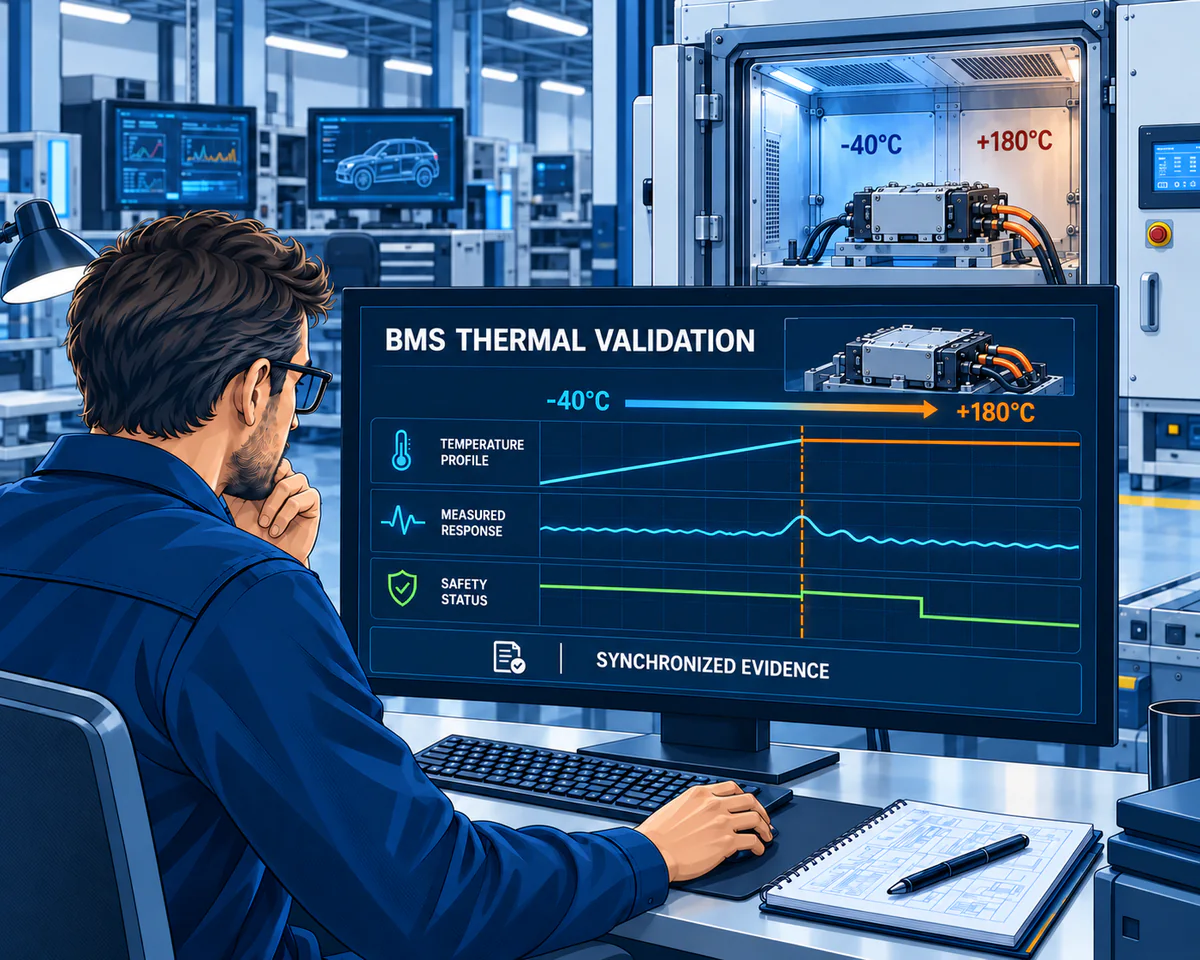
Greater Safety in BMS Validation – from -40°C to +180°C

Practical insights into temperature and environmental testing for battery management systems — including common challenges and technical solutions.

Modern battery systems must function even under extreme conditions: in freezing cold, prolonged heat, rapid temperature changes, and demanding high-voltage test conditions.

This white paper explains what really matters in temperature and climate testing of battery management systems — and how realistic test conditions can be simulated precisely, safely, and throughout the development process.

Download the white paper now to learn what requirements BMS tests must meet in the temperature range from -40°C to +180°C.

Battery systems are becoming more complex. The requirements for BMS testing as well.

The mobility of the future is placing ever-greater demands on battery systems. New cell chemistries, increasing safety requirements, and smarter BMS algorithms mean that today’s test systems must do much more than simply perform standard simulations.

Temperature and climate tests, in particular, determine whether a battery management system operates stably, safely, and reliably even under real-world extreme conditions.

This is because, in vehicle operation, it is not enough to simply test battery behavior at normal ambient temperatures. Depending on the vehicle concept, level of integration, and thermal load, BMS control units may be subjected to significantly higher demands—extending to test ranges from -40°C to +180°C.

What you’ll take away from this white paper:

1. Greater safety in extreme temperature conditions

Learn how to set up realistic cold tests, heat tests, and thermal cycling — and which common pitfalls to avoid.

2. A better understanding of accurate BMS simulation

The white paper explains why realistic cell voltages, temperature signals, and sensor simulations are crucial for obtaining reliable test results.

3. Insight into sophisticated test setups

Learn about the role of climate chambers, long cable runs, high-voltage applications, and galvanically isolated simulation channels in modern test benches.

4. Real-world relevance from demanding test environments

The white paper highlights specific challenges encountered in test operations—from cold-start scenarios and endurance testing in high-temperature conditions to the precise simulation of 200 cell channels.

A look at the white paper

Cold-weather testing: Start-up capability at -40°C
A typical scenario: The vehicle is parked overnight in extremely cold weather. In the morning, the BMS must start up reliably. However, this requires not only a cold environment, but also realistic cell voltages and temperature signals.

Heat Tests: Stability Over Hours or Days
At high temperatures, the BMS must not only start up but also operate stably over extended periods. The white paper explains how simulated driving conditions and thermal stresses are used to test the system’s robustness.

Temperature Changes and Dew Point
Rapid changes between cold and warm temperatures can cause moisture and condensation. Critical conditions arise particularly around the dew point, and these must be taken into account in testing.

Precision Despite Long Cable Runs
In large climate chambers, there can be several meters of cable between the test system and the device under test. Nevertheless, cell voltages must be simulated with high precision. This white paper explains why precision in the microvolt range is crucial in this context.

comemso: Experience in complex BMS test environments

For over 15 years, comemso has been developing battery cell simulators for the validation of battery management systems. These systems are used worldwide by leading automotive OEMs, Tier 1 suppliers, and providers in the stationary storage sector.

The BMS test systems—particularly those from the BCS Compact series—are designed for complex testing requirements: from precise cell voltages and temperature signals to modular open-loop and closed-loop test environments.

For high-voltage applications up to 1500 V, long-term stability, and validation throughout the development process, they provide a reliable foundation—from early development through to series production approval.

Whitepaper anfordern

Gain practical insights into the validation of BMS controllers under extreme temperature conditions.

In this white paper, you’ll learn, among other things:

  • why temperature testing is essential for the safe approval of BMS control units
  • what challenges arise during cold tests at temperatures as low as -40°C
  • how heat tests are conducted under realistic conditions up to +180°C
  • which is why the dew point, condensation, and rapid temperature changes are critical
  • how cell voltages and temperature sensors are accurately simulated
  • what role do modular BMS test systems play in open-loop and closed-loop testing

Ready for deeper insights into BMS temperature testing?

Download the white paper now and learn how to reliably test battery management systems under extreme temperature and environmental conditions.

Visit us on

HEADQUARTER GERMANY

comemso electronics GmbH
Karlsbader Str. 13
73760 Ostfildern
+49 711 982 98 – 0

OFFICE USA

comemso North America Corp.
32000 Northwestern Highway,
Suite 150, Farmington Hills,
MI 48334, United States

SALES TEAM

SUPPORT TEAM

© comemso electronics GmbH 2023

IMPRINT PRIVACY POLICY GTC EULA WEEE RETURN