
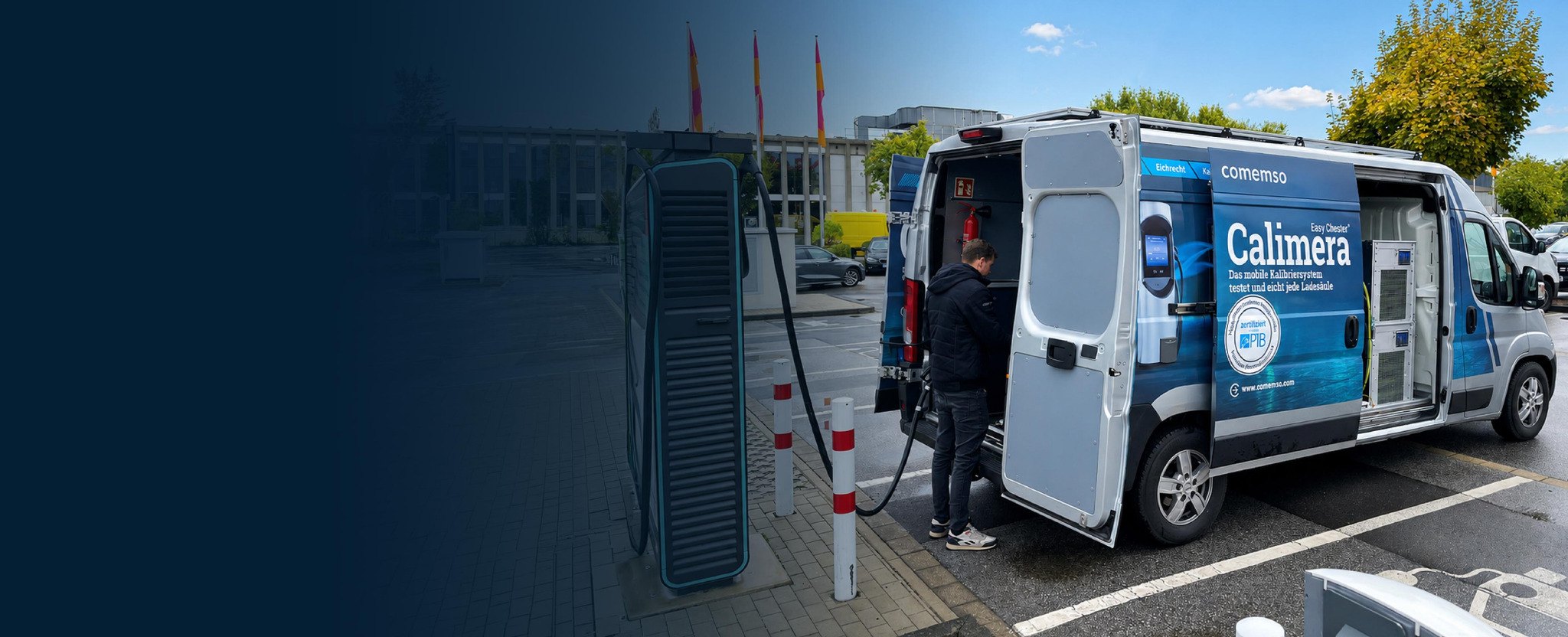
EVSE calibration and legal metrology
Prove on site that your chargers measure the energy they bill.
Easy Chester Calimera compares the charger's energy reading with a calibrated reference under real load, on site, and documents the deviation – instead of a fully equipped laboratory at the charging site.1
PTB-certified. The Czech national metrology institute calibrates chargers with Calimera from its own service vehicle.
In 30 seconds
- What for
- Operators, calibration labs and manufacturers who must prove on site that chargers bill the energy they deliver.
- What it does
- Calimera compares the charger’s reading with a calibrated reference under real load, e.g. 150 V × 500 A = 75 kW, in 400 V and 800 V bands.
- Not for
- Charging-function or safety commissioning – that is EVSE commissioning and service testing.
An energy reading that drifts unnoticed puts every invoice from that charging point at risk.
Your path to mobile EVSE calibration
Plan the mobile EVSE measurement setup.
The measurement task, the certified Calimera system and a published field use case. Then agree the reference chain and requirements for the target market.
15-minute demo. An engineer shows the calibration workflow on a real Calimera system.Written quotation. Reference measurement, charging power, target market and documentation for your task – then you order.Delivery and start. Commissioning and training are agreed in the quotation.
Energy measurement at the charging point
Measure the energy your customer receives.
The test compares the station’s energy reading with a traceable reference at defined operating points. The report records deviation and measurement conditions, so you evaluate energy accuracy separately from charging function.
Controlled operating points
You set voltage, current and dwell time so the same measurement repeats after an adjustment, repair or software change.
The installed charging path
Measurement happens at the charging connection, with real energy flowing. This includes the cable path and the effects present during the charging event.
Comparable results
Calimera records station and reference values together, so stations and repeated tests compare within the documented campaign.
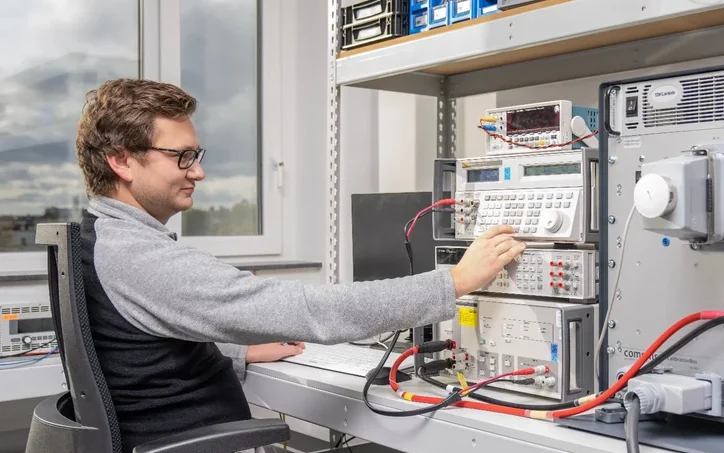
Voltage, current and test duration
Cover the voltage and current combinations that matter.
Covers the relevant 400 V and 800 V charging bands and the boundaries of the station’s operating range. The calibration load matches every required voltage and current point as well as the power rating.
| Example operating point | What it reveals |
|---|---|
| 150 V × 500 A = 75 kW | A demanding high-current point at low voltage. The load must reach the current even though the total power is below its headline rating. |
| 1,000 V × 10 A = 10 kW | A high-voltage point at low current. Stable control and a suitable reference range matter here. |
You plan the campaign around the station’s supported range and the applicable procedure.
Preparation, measurement and reporting
Prepare the campaign, measure on site and document the result.
- Prepare the campaign. Define operating points, dwell times and the information needed for the report in comframe.
- Connect at the station. Establish the charging communication and connect the reference measurement and controlled load.
- Run and review. Follow voltage and current during the measurement; compare the station's energy value with the reference.
- Keep the result. Store the measured values and campaign data and prepare the measurement report for review.

Controlled real-load calibration
Compare station and reference values during real charging.
With Easy Chester Calimera’s controlled load, the reference and station meter observe the same energy transfer at an installed station, including the selected operating point and measurement path.
Include load stability, charging communication and thermal behaviour in the measurement conditions. Voltage, current, duration and synchronisation follow the applicable verification procedure.
Compact meter-circuit setups have a narrower test boundary: stimulating selected conditions does not reproduce the complete station under charging load.
Understand real-load calibration and measurement-scope limits
Requirements and product capability
Calibration of EV charging stations: OIML G 22, NIST HB 44 and German Eichrecht
| Reference | What it addresses | How Calimera supports the work |
|---|---|---|
| VDE-AR-E 2418-3-100 | Measurement systems for AC and DC charging under German legal metrology. | Controlled energy comparison and documented measurement campaigns. |
| OIML G 22:2022 | International guidance for EVSE metrological requirements and tests. | A repeatable load and reference measurement for the selected points. |
| NIST Handbook 44, §3.40 (2026) | EVSE test procedures, including separate DC type-evaluation and field-verification methods. | Configurable charging conditions and recorded station/reference values. |
| GM-P 6.8 Elektromobilität (20 February 2026) | German procedures for verification and in-service investigation of EVSE metering systems. | Reproducible test conditions and documented reference comparisons for the applicable procedure and selected configuration. |
Calibration provides a measurement result.
Easy Chester Calimera
Calibrate installed charging stations on site.
Easy Chester Calimera brings charging communication, reference measurement, a controlled load and comframe to the installed charging station in a mobile setup.
 PTB-certified Easy Chester CalimeraView certification details
The Calimera configuration follows load rating, reference-meter range and required operating points. The product configuration table separates named catalogue variants from CONTINUOUS and Boost mode figures. Voltage, current, holding time and cooling are confirmed for the measurement procedure.
Our calibration experience also comes from the laboratory at comemso eMobility Services GmbH. Its published ISO/IEC 17025 accreditation documents describe the accredited scope. View the laboratory accreditation.
Explore Easy Chester Calimera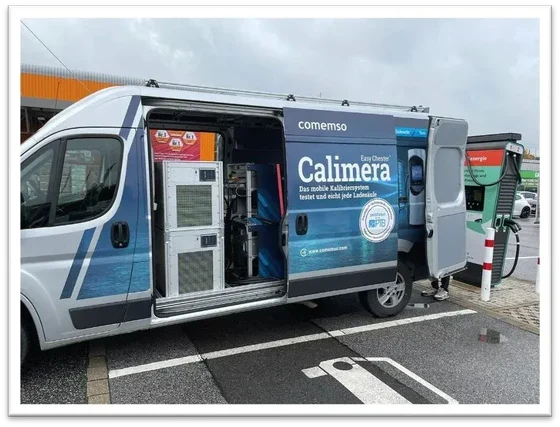
German Eichrecht for charging stations: define the measurement and evidence
For charging-station energy used as the basis of a commercial transaction, establish the applicable legal metrology requirements for the measuring system. Calibration of EVSE determines the difference between the station reading and a traceable reference. It does not replace a required conformity assessment or formal statutory verification. Agree the applicable procedure, configuration and authorized responsibilities before the campaign.
Record station and meter identities, software version, charging connector and the energy value used for billing. The test compares energy from the same charging interval and defines the measurement boundary. Readings, deviation and measurement uncertainty stay together before the result is evaluated against the appropriate criteria.
Easy Chester Calimera supports AC and DC measurements with a controlled real load and reference instrument. This charger tester combines a charging sequence with energy measurement. Evidence for German Eichrecht also requires the prescribed documents, approvals and authorized procedure. Calibration of EVSE must preserve the association between each result, connector, meter and configuration.
ISO/IEC 17025: define the laboratory procedure and reference chain
ISO/IEC 17025 specifies competence requirements for testing and calibration laboratories. Calibration of EV charging stations needs an appropriate calibrated reference, its validity and measurement uncertainty, and a documented procedure. One calibrated instrument does not by itself make the entire mobile system an accredited laboratory. The actual accreditation scope of the laboratory carrying out the work decides.
Under an ISO/IEC 17025 laboratory procedure, the setup, measurement boundary, stable operating point and data acquisition belong together. Record reference and station energy over the same interval. If the firmware or measuring chain changes, retain the original result and identify the changed condition in the repeat measurement. This allows calibration of EV charging stations at different sites to remain comparable.
Practical questions
Practical questions about EVSE calibration
Why use a controlled load instead of a vehicle?
A controlled load makes the voltage and current operating points reproducible within the configured test range. A normal electric vehicle sets its charging demand according to battery state, temperature and charging curve. A vehicle and adapter therefore cannot freely select and reliably repeat all points required for a complete metrological test.
The PTB presentation explains this limitation and states: “Benötigen ein voll-ausgestattetes Labor an der Ladeeinrichtung”.
The permitted method depends on the task: calibration, formal verification (Eichung) and an in-service investigation (Befundprüfung) have different purposes. GM-P 6.8 includes procedure-specific vehicle use for a Befundprüfung; this is not a universal ban on vehicle-based checks. The applicable procedure determines the required test points and any permitted exceptions.
Does a successful charging session prove energy accuracy?
No. Functional charging and energy accuracy answer different questions. Calibration compares the recorded energy with a suitable reference at known conditions.
Can one setup cover every charging station?
Match the required interfaces, voltage/current range, continuous load capacity and reference uncertainty to the station. Share its data and the required test points so we can select the configuration for the campaign.
Does EVSE calibration replace statutory verification?
No. Calibration determines measurement deviation using a traceable reference. Statutory verification follows its own applicable legal procedure and authorized responsibilities.
What does ISO/IEC 17025 mean for an EVSE calibration workflow?
It concerns the competence and procedures of the testing or calibration laboratory. Choose a calibrated reference for the AC/DC range, define the measurement boundary and uncertainty contributions, and document acquisition and assessment. For an accredited task, check that the relevant work falls within the laboratory’s accreditation scope.
Customer projects, success stories and technical articles related to this page.
- Customer projectMobile EVSE Calibration in a Test VanA metrology institute uses Easy Chester Calimera in a mobile test van to compare AC and DC charging station energy measurements with a reference on site.
Plan the EVSE measurement procedure.
First you define measurement task, applicable procedure, reference instrument and operating points. These requirements determine the calibration-system configuration, the repeatable energy transfer and the required records.