
AC/DC installation tester for the field
EV charger tester: one guided pass from safety check to report.
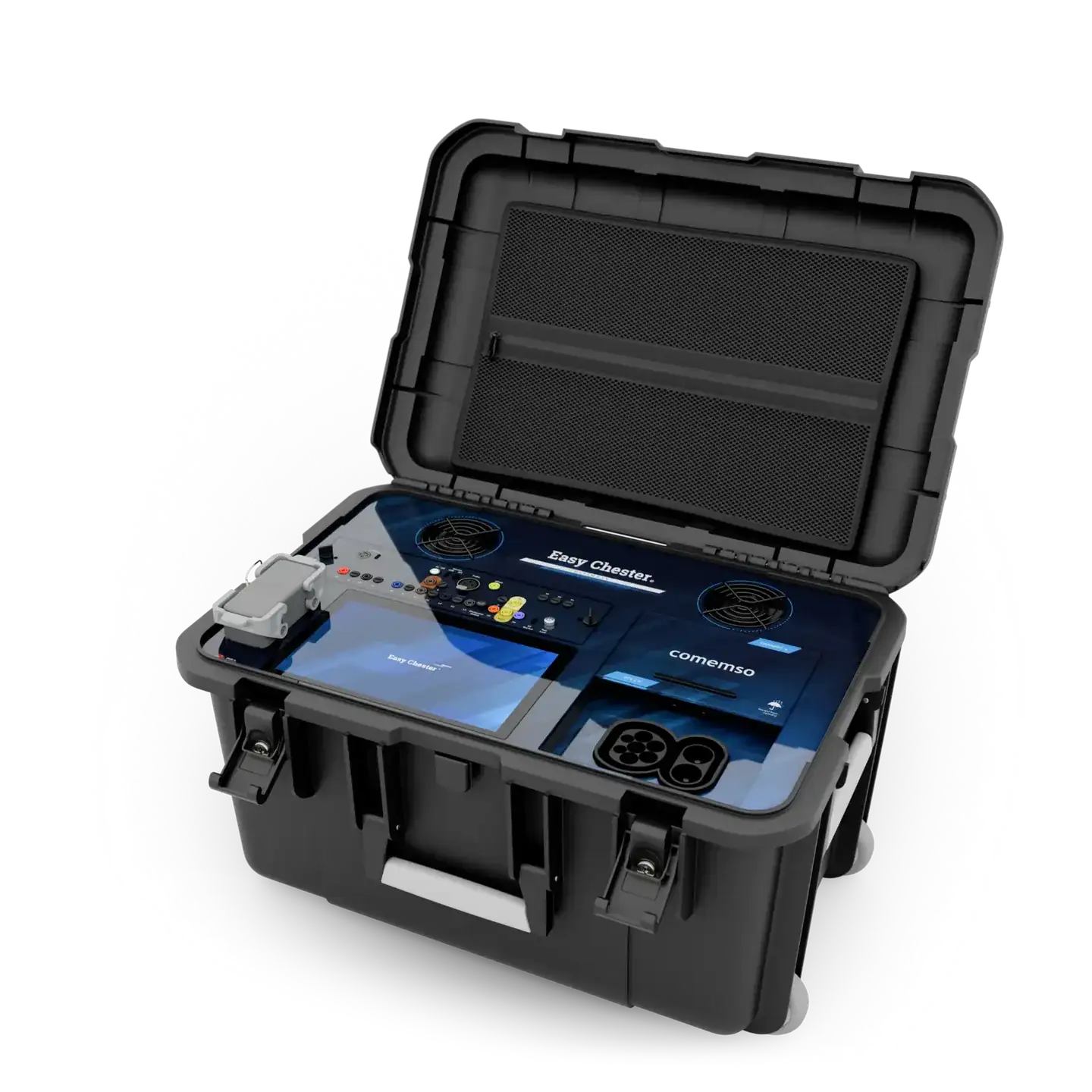
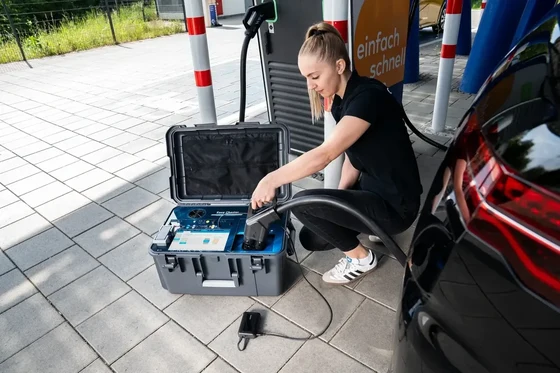
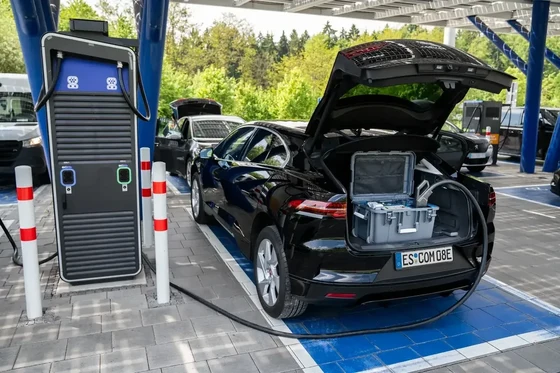
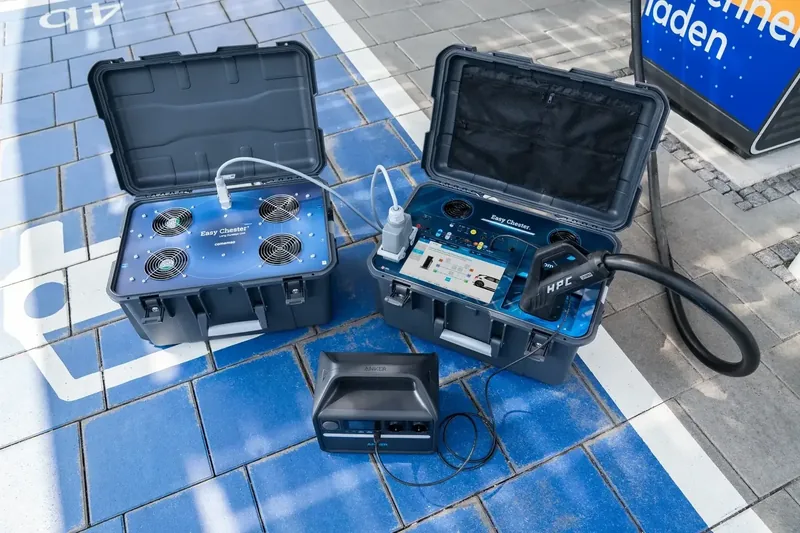
Easy Chester Ultimate is the AC/DC EV tester for DC fast chargers and AC charging stations: it checks the EVSE charging function and electrical safety on the grid as well as vehicle side, and documents every result in one report – instead of an electric vehicle plus separate instruments.1
In the field since 2016 as part of the Easy Chester line. “…we can guarantee our customers quick service calls and feedback on the reliable functioning of their charging points.” – Michael Borowski, synfis
- What for
- Commissioning, maintenance and repair checks of installed AC and DC chargers – one guided pass from safety check to report.
- What it does
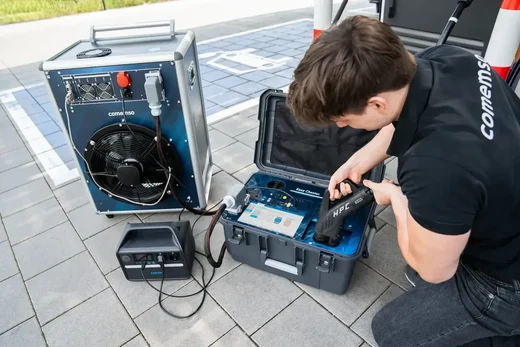
- Grid- and vehicle-side safety measurements, charging function and communication; test load up to 30 kW / 90 A per unit, 60 kW / 180 A with two units cascaded.
- Not for
- Proving the full rated power of a high-power charger, or a standards-conformance test – EVCA covers those.
Without a documented safety test, the handover leaves installer and operator with an open risk.
Charges like a car – then tests what a car can’t.
Ultimate starts a charging session the way a typical EV does, so the station starts charging as it would for a customer’s car. Then it checks what no car can: protective conductor, insulation, RCD and loop impedance on the grid side; insulation, residual voltage and isolation monitoring at the connector – plus defined faults on CP, PP and PE. One guided pass, one PDF report.

Technical data at a glance
| Item | Value |
|---|---|
| Weight · case | 15.7 kg · 60 × 33 × 40 cm · IP66 closed / IP43 open |
| Operating temperature · power | −15 to +40 °C · USB-C, < 100 W (car adapter or power bank) |
| Display · storage | 10.1-inch touchscreen · 128 GB |
| Charging interfaces | AC Type 1 or Type 2, CCS 1, CCS 2, NACS, CHAdeMO – by configuration |
| Connector cover | Slide cover exposes either CCS 2 or CHAdeMO · design protected internationally, including in the EU, the US (US D957,348 S) and China |
| Protocols | IEC 61851-1, SAE J1772, SAE J3400, DIN 70121, ISO 15118-2 with EIM (AC/DC), CHAdeMO up to 2.0 · ISO 15118-20 planned for Q1/2027 |
| Signal measurement range | CP −13 V to +13 V · PP 0 to 4,600 Ω |
| Signal measurement accuracy | CP voltage ±100 mV · PP resistance ±5 % |
| Battery emulation | 330 V and 660 V: Ultimate behaves like a 400 V and an 800 V car – no need to bring two cars. |
| DC test load | 2 kW / 6 A for up to 45 s · with Long Duration Unit up to 60 min · 1 load 30 kW / 90 A, 2 loads 60 kW / 180 A, each up to 4 h |
| Safety checks (option) | Grid side: RPE, RISO, RCD, ZS, phase rotation · Connector: RPE, RISO, UOFF, RCD, phase rotation (AC), IMD simulation |
| Report | PDF; e-mail, GPS address and photos with the maintenance package |
Connect. Select. Test. Verify. Report.
How a test runs – from selection to report
- 1Connect
You identify the charging station and firmware, confirm the selected interface and connect as the device guides you.
- 2Select
You choose the charging protocol, voltage technology, test load, safety scope and report context.
- 3Test
Ultimate runs the guided protective-measure and charging checks with defined EV behaviour and the released fault options.
- 4Verify
You review charging start, voltage and current, stop behaviour and the response to the selected faults – after a repair, against the original test conditions.
- 5Report
The report records station identity, configuration, performed checks, measured values, deviations and your field decision.
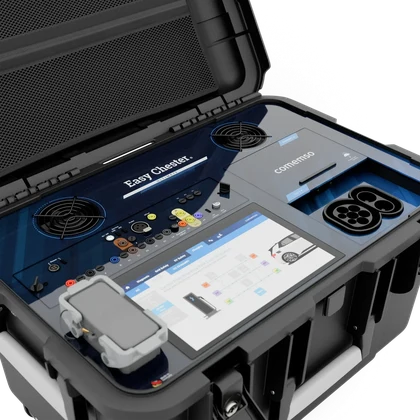
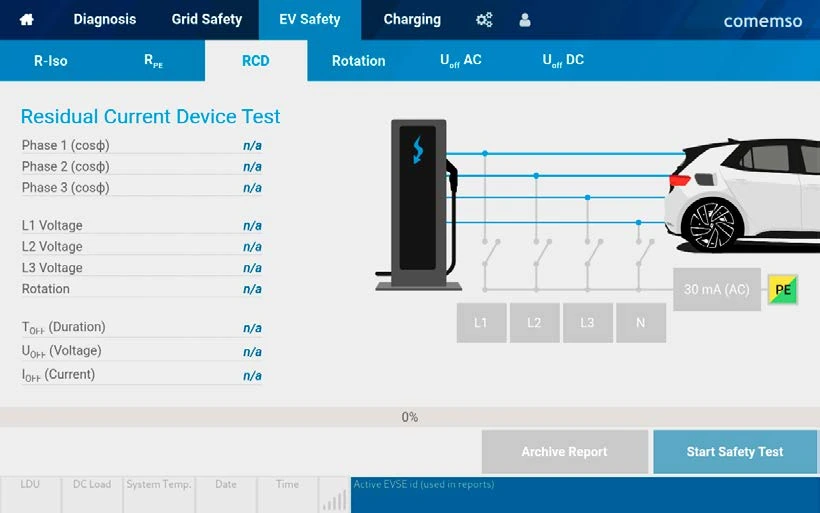
The 10.1-inch touchscreen keeps test selection, active step, measured value and next action on one screen. Ultimate detects the inserted charging plug, checks its internal modules at start-up and runs the whole workflow on the device itself. Built-in videos and a digital manual explain each check in several languages.
Test results in the PDF report
One PDF report for every inspected charger
Station, performed checks, measured values and the result PASSED or FAILED – documented for handover, maintenance or repair.
Contents Charging communication steps, voltage and current, maximum charging power of the station, MAC-PLC address and safety results, each with an explanation of the measurement.
Your context Comments, address fields and your company logo. You open the PDF on a mobile phone and send it by e-mail via a hotspot.
With the maintenance package The location from GPS as address and map, plus photos of the visual inspection or of damage.
Safety first. Then function.
Test protective measures on the grid side and at the EV interface
With the comISO option, the electrical safety checks run in the same guided workflow as the charging test.
| Safety function | Grid side | EV interface | Purpose in the field workflow |
|---|---|---|---|
| RPE, protective conductor resistance | ✓ Yes | ✓ Yes | Checks the protective conductor path. |
| RISO, insulation resistance | ✓ Yes | ✓ Yes | Assesses insulation before or during the relevant test sequence. |
| UOFF, residual voltage | – No | ✓ Yes | Evaluates residual voltage at the vehicle interface. |
| tRCD, residual-current device | ✓ Yes | ✓ Yes | Tests the protective response in the defined setup. |
| IMD / RISO simulation | – No | ✓ Yes | Checks the charging station’s isolation monitoring. |
| Zs, loop impedance L–PE and line impedance L–N | ✓ Yes | – No | Assesses the installation loop path. |
| Phase rotation | ✓ Yes | ✓ Yes (AC chargers) | Checks the phase sequence of the supply. |
Shows whether the station ends charging as expected.
Applies a defined low-level fault – the same way every time.
Tests the configured response to a protective-conductor interruption.
Checks the configured isolation monitoring with defined fault conditions.
Supported charging interfaces and communication
AC and DC interfaces and protocols – today and next
Europe, North America and Asia require different connectors and protocol combinations. We configure Ultimate by region, charging standard, safety scope and extension requirement.
Functional testing for AC charging processes, low-level signalling and configured high-level communication.
- IEC 61851-1
- SAE J1772 and SAE J3400 context
- ISO 15118-2/-3 where configured
- Type 1 or Type 2 by configuration
Direct testing of charging communication and function – no protocol converter in the test path that would itself become part of the test.
- DIN 70121 included in the published base scope
- ISO 15118-2/-3 optional
- CCS 1, CCS 2 or NACS
- SAE J3400 for NACS DC
CAN-based DC charging tests for international service networks with the released CHAdeMO configuration.
- CHAdeMO up to version 2.0 in the current datasheet
- Charging and communication checks
Charging stations can behave differently with 400 V and 800 V vehicle technology – Ultimate emulates both.
- The same decision, without two real vehicles
- Charging behaviour compared under defined conditions

One system for commissioning and service
Handover, maintenance, service and repair
When technicians repeat the same test process, they can compare results across locations and service cases.
Ultimate checks installation, safety, communication and charging function before the charging station enters operation.
You repeat a defined scope at scheduled intervals and record the condition.
You check grid, safety functions, signalling and communication separately and compare the error message with the measured signals.
You run the relevant test before and after the intervention and keep both results.

Downtime and field service
What do unavailable charger-hours and repeat visits cost?
With your figures for installed base, incidents, downtime and field service, the calculator compares today’s service process with a scenario you define.
Longer sessions and higher DC loads
Longer tests, higher load, updates
Some faults appear only after a few minutes: heating of contacts, cable and power electronics, automatic power reduction (derating) or the exchange with the charger’s backend, such as meter value reports or charging profiles via OCPP.
Some faults appear only at higher power, for example when further power modules switch in or in the control of current and voltage.
Two cascaded loads double this to 60 kW and 180 A, closer to how fast chargers operate. This does not replace a full-load test of HPC chargers rated 150 to 400 kW.
With the maintenance package, Ultimate receives firmware updates over the air (FOTA), and comemso support can assist remotely on the device during office hours – both via a hotspot.
Controlled behaviour and documented checks
Real EV, test adapter or Ultimate – what each can show
A charging session with a real vehicle documents how that pair charged under the observed conditions. A controlled test system adds repeatable safety checks, fault scenarios and documented results.
| Test method | Repeatable EV behaviour | Fault simulation | Grid and EV safety | Guided evaluation | Structured report |
|---|---|---|---|---|---|
| Real electric vehicle | Limited | No | No | No | No |
| Basic test adapter | Partial | Limited | Separate tools | No | No |
| Separate instruments | Possible | Possible | Yes | Manual correlation | Manual merge |
| Easy Chester Ultimate | Yes | Option | Integrated (option) | Guided | Integrated |
yes · limited or with extra effort · no







Customer references
What customers say about Easy Chester
Experiences with Easy Chester and the Mini-Charger-Tester, shared by customers in charging infrastructure and field service.

“As a product-independent full-service provider for sustainable charging systems, comemso not only convinced us because of their market establishment, but above all because of the manufacturer-independent application options. In this way, we can guarantee our customers quick service calls and feedback on the reliable functioning of their charging points.”

“We’ve been using the comemso Mini-Charger-Tester to test our hyper-fast charging, and we’re impressed by the ease of use, stability and precision of the compact solution.”
Frequently asked questions
Easy Chester Ultimate FAQ
What are the best tools for testing EV charging stations?
A system that combines electrical safety testing, AC and DC charging communication, controlled EV simulation, reproducible fault tests and a report – from a manufacturer-independent maker, so every charger brand gets the same checks. By task: Micro for AC installation, Ultimate for AC and DC, Easy Chester EOL for production, Calimera for meter calibration, EVCA for the lab.
Can Easy Chester Ultimate test AC and DC charging stations?
Yes. The configuration options include AC, CCS 1, CCS 2, NACS and CHAdeMO. We define the exact connector combination, protocol version and regional release for the delivered system.
Can it test without a real electric vehicle?
Yes. Ultimate takes the role of the vehicle, so the same charging, safety and fault scenarios run at every station – without depending on the state of a production vehicle.
Is Easy Chester Ultimate a standards-conformance tester?
No. Ultimate is an AC/DC installation tester for functional, load and electrical safety checks. For standards-conformance test cases covering IEC 61851-1, DIN 70121, ISO 15118, SAE J1772 or CHAdeMO, select the matching EVCA configuration.
Does a function test on a 400 kW HPC charging station verify its full rated power?
No. Station rating and test load are separate values. Ultimate checks charging function, communication and electrical safety at a defined operating point; see test loads and options. A full-power test needs equipment rated for the intended voltage, current, power and duration, plus defined acceptance criteria.
Which emulation voltage does a test of an 800 V charging station require?
Ultimate represents 400 V and 800 V vehicle technology at approximately 330 V and 660 V. Check whether this operating point, the connector and the protocol configuration fit the station and test task. The measurement range of 0–1,000 V is not an emulation range; for other emulation voltages, see EVCA Flex operating limits.
Customer projects, success stories and technical articles related to this page.
- Customer projectEasy Chester with Long Duration Unit, March 2025Easy Chester with Long Duration Unit lets a customer examine charging continuity and the station’s response over longer sessions. Project March 2025.
- Webinar archiveWebinar: Commissioning and Inspection of EVSEWebinar archive, 21 April 2026: practical charging-station commissioning and inspection, electrical safety, function and repeatable field checks.
- Product newsEasy Chester Ultimate: Guided EVSE TestingEasy Chester Ultimate guides AC/DC charging, communication and electrical safety tests at the charging station, from connection to PDF report.
Your path to Ultimate
15-minute demo. An engineer shows an AC and DC commissioning test with test report on a real Easy Chester Ultimate.Written quotation. Connectors, protocols, load units and safety scope for your chargers – then you order.Delivery and start. Commissioning and training are agreed in the quotation.
Request the EVSE Inspection Guide by email.
Sorted by lifecycle task
Easy Chester Ultimate is the field system within the product family
Micro for installation, commissioning, maintenance and periodic inspection of AC charging stations and wallboxes.
Deep protocol analysis, simulation, manipulation, automation and conformance testing.