
Standards & Knowledge / AFIR for EV charging
AFIR: Charging Access, Payment and Technical Requirements
The Alternative Fuels Infrastructure Regulation (AFIR) sets requirements for public charging infrastructure and its use. Plan the driver’s access, payment and price information together with the technical charging checks. Assign each requirement to the team responsible for it.
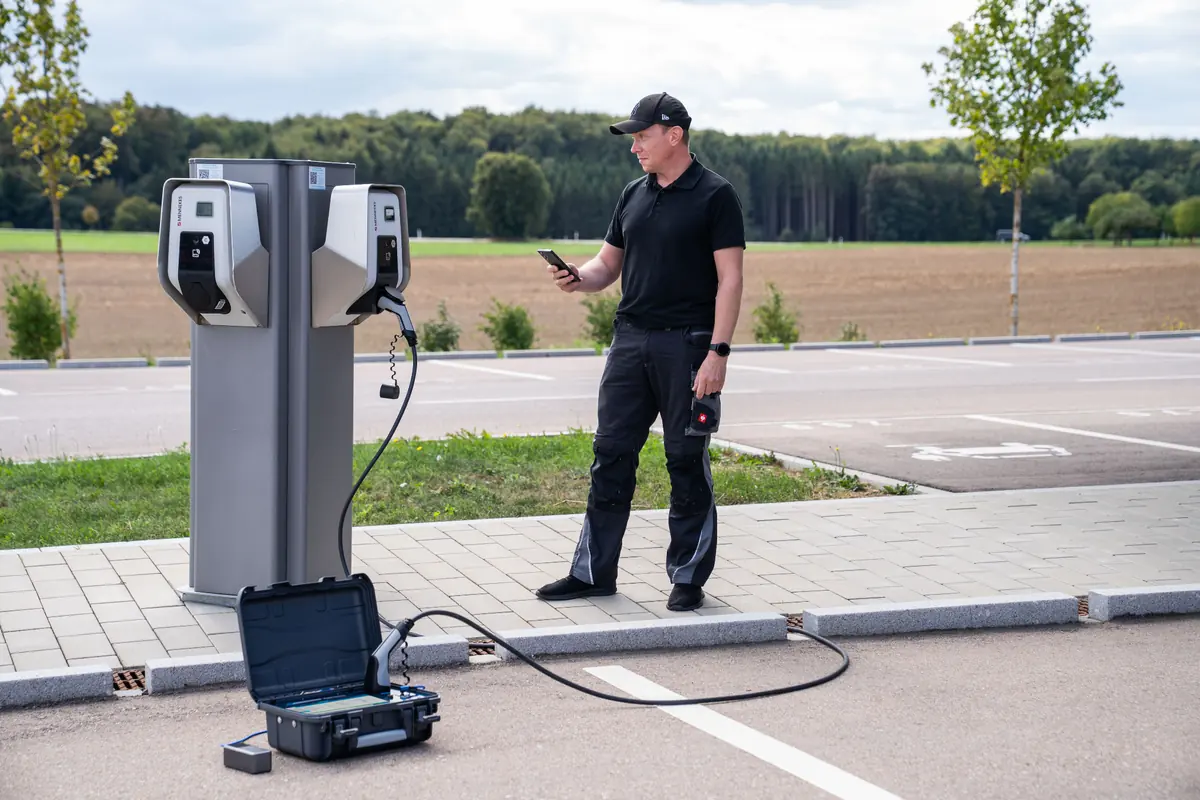
Identify the applicable requirements
AFIR sets requirements across the charging infrastructure.
AFIR covers alternative-fuels infrastructure and user access. Assign technical EVSE (electric vehicle supply equipment, or charging station) requirements to the charging system. Coordinate the other obligations with the operator, payment environment, data platform, infrastructure network or Member State.
Record the applicable obligation, responsible party and evidence needed to assess it.
Assign the requirements to the responsible teams
Choose the verification method for each obligation.
Coverage, distance, aggregate power and infrastructure availability are planned at Member State, network and operator level.
- Primary owner
- Member State, infrastructure owner, CPO
- Typical evidence
- Location, network capacity, asset register, rollout record
Public charging must support the applicable ad hoc route without forcing a user into a contract beyond the charging transaction.
- Primary owner
- Payment terminal, payment provider, CPO backend
- Typical evidence
- User journey, transaction result, terminal and backend records
Price components and the selected charging route must be presented according to power class and deployment context.
- Primary owner
- CPO tariff system, display, application and payment path
- Typical evidence
- Displayed price, tariff calculation, session invoice, screenshots
Public points must meet the applicable digital-connectivity and smart-recharging capability dates.
- Primary owner
- EVSE controller, communication backend, energy-management system
- Typical evidence
- Remote communication, control response, update and operating records
Defined data must be available without charge through a technically compliant API and the national access-point chain.
- Primary owner
- CPO data platform, API provider, national access point
- Typical evidence
- Data model, API response, timestamps, completeness and quality logs
The charging interface, communication path and deployed installation must remain usable with the intended vehicle population.
- Primary owner
- EVSE manufacturer, integrator, operator and service team
- Typical evidence
- Conformance, robustness, interoperability, commissioning and service reports
Plan with the applicable transition dates
Check the deployment date, power class and location for each rule.
The timeline below is an engineering orientation. The current consolidated regulation, applicable delegated and implementing acts, Commission guidance and national enforcement remain authoritative.
AFIR applies
Regulation (EU) 2023/1804 becomes applicable. Rules for points deployed from this date begin to take effect.
Digital connection
All publicly accessible points must be digitally connected. Points built after 13 April 2024, or renovated after this date, must meet the applicable smart-recharging capability rule.
Data and fixed-cable milestones
Static and dynamic infrastructure data become available at no cost. Public DC points reach the fixed-cable milestone.
Updated technical specifications apply
Delegated Regulation (EU) 2025/656 applies to the relevant newly deployed or renovated infrastructure and technical routes.
DATEX II data model milestone
The relevant data exchange follows the implementation timetable in Regulation (EU) 2025/655.
Common European access point target
The Commission is to establish the common European access point for alternative-fuels infrastructure data.
Payment and ISO 15118 transition
Further rules apply to certain existing high-power public points and to newly deployed or renovated communication paths.
Technical specifications and their legal references
Record the exact standard, edition and transition date.
Record the legal reference, exact standard and edition, DUT (device under test) role, deployment status and released test implementation. Use this information to define the acceptance criterion.
Type 2 for AC. Combo 2 for DC.
The delegated technical specifications use EN IEC 62196-2:2022 Type 2 for relevant AC points and EN IEC 62196-3:2022 Combo 2 for relevant DC points that are newly deployed or renovated.
Evidence focus- Connector and inlet configuration
- Deployment or renovation date
- Vehicle-category and power context
ISO 15118-2 is already mandatory.
Since 8 January 2026, newly deployed or renovated publicly accessible AC and DC charging points must comply at least with EN ISO 15118-1 to -5 as listed in the delegated regulation. In practice this means ISO 15118-2 communication over PLC (ISO 15118-3), for example at newly installed public wallboxes.
Evidence focus- Exact part and edition
- EVSE or vehicle-side role
- Protocol, physical layer and sequence result
Communication with EN ISO 15118-20.
From 1 January 2027, newly deployed or renovated charging points move to the EN ISO 15118-20:2022 baseline; this then also covers charging points that are not publicly accessible. Where automatic authentication such as Plug & Charge is offered, both the specified -2 and -20 routes apply. Plan the required protocol checks alongside the other test tasks for your EVSE tester.
Evidence focus- Service and authentication configuration
- Backward-compatibility route
- User choice remains available
- Released protocol behaviour after the transition
Availability, quality and machine-readable access.
Delegated Regulation (EU) 2025/645 defines common API requirements. Implementing Regulation (EU) 2025/655 requires static data to be updated after a change and no later than 24 hours, dynamic data no later than one minute, and the relevant DATEX II data model from 14 April 2026.
Evidence focus- Static and dynamic data completeness
- Timestamp and update latency
- API robustness, security and validation
A compliant communication session documents a defined technical requirement. Combine this result with the payment, tariff-transparency, public-data and infrastructure records from the responsible teams for the overall legal assessment.
Technical, operator and legal records
Collect the records in one file, with responsibility clear for each requirement.
Bring technical reports, operator records and legal assessment together in a controlled compliance file.
- EVSE technical function
Manufacturer, validation and service
- Connector and cable
- Low-level signal states
- High-level communication
- Power and safety response
- Interoperability and faults
- Trace and test report
- Operator and backend
CPO, payment and data platforms
- Ad hoc payment route
- Price and user choice
- Digital connectivity
- Smart recharging control
- Static and dynamic data
- API and operating record
- Legal and operational
Legal assessment and release decision
- Public-access classification
- Deployment and location
- Power class and dates
- Actor responsibility
- National enforcement
- Approved release decision
AFIR requirement and evidence file
Requirement register · technical reports · backend evidence · accountable decision
Charging interface evidence
Connector, low-level signal, high-level communication, power behaviour, safety response, interoperability and field function.
User and data evidence
Payment route, tariff, digital connectivity, smart-control behaviour, identifiers, availability data, API and operational monitoring.
Applicability, assessment and release
Public-access classification, deployment context, actor responsibility, national enforcement, approved assessment and final decision.
Charging-interface tests for the AFIR assessment
Test charging communication, function and safety with comemso.
Use comemso systems to test defined parts of the technical charging path.
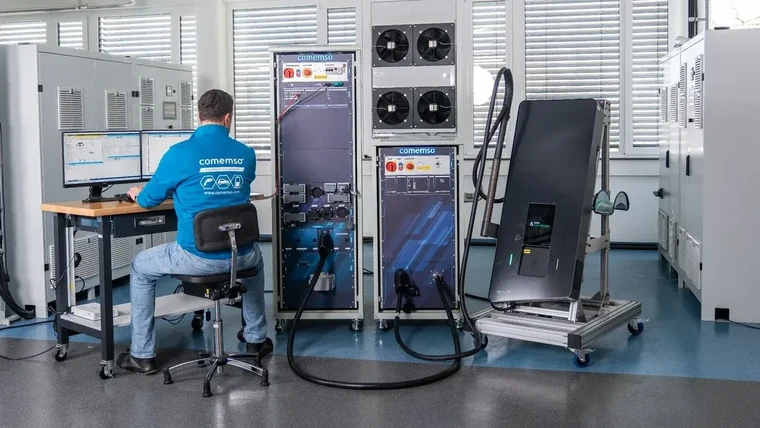
Document the requirement and result
Link each result to the obligation it supports.
Record the legal clause, scope, owner, standard edition and acceptance criterion with each technical test result.
- 1Legal source
Regulation article, annex, delegated act, implementing act and current consolidated version.
- 2Applicability
Public accessibility, location, power class, deployment or renovation date and actor.
- 3System boundary
EVSE, connector, payment, backend, API, operator process or infrastructure network.
- 4Standard and edition
Exact part, publication, profile, DUT role and released implementation.
- 5Method and acceptance
Configuration, counterpart, operating state, stimulus, limit, expected result and verdict rule.
- 6Measured evidence
Trace, screenshot, API response, transaction, field record, calibration status and report.
- 7Release decision
Open gaps, non-EVSE evidence, accountable reviewer, date and approved scope.
| Requirement area | Technical owner | Typical evidence | comemso role |
|---|---|---|---|
| Connector and charging communication | EVSE manufacturer, EVSE controller | Interface configuration, protocol and signal trace, conformance report | Direct technical test path where supported |
| Charging function and safety response | EVSE, installation, service organisation | Commissioning, fault, safety and field report | Laboratory and field test path where configured |
| Payment and price transparency | Payment provider, tariff backend, CPO | User journey, transaction, display and invoice | Charging-interface evidence; separate payment and tariff assessment |
| Static and dynamic data API | CPO data platform, API provider, NAP chain | API schema, response, timestamps, quality and publication record | Charging-interface tests; API verification by the data-platform team |
| Operational availability | CPO, monitoring and maintenance organisation | Status log, incident, repair, re-test and availability record | Field diagnosis and repeat testing of the technical charging function |
| Overall AFIR conformity | Accountable legal and compliance organisation | Complete requirement register and approved release decision | Technical test results for the overall compliance assessment |
Official sources
Confirm the applicable legal text when preparing the test plan.
Use the official EU sources linked below for this engineering map. Check applicable amendments, corrigenda, Commission guidance and national enforcement when preparing the assessment.
Current consolidated AFIR text available on EUR-Lex.
Source: Regulation (EU) 2023/1804 Commission guidancePractical Commission explanations for payment, pricing and implementation questions.
Source: AFIR questions and answers Technical specificationsUpdated standards for relevant recharging and vehicle-to-grid communication routes.
Source: Delegated Regulation (EU) 2025/656 Common APITechnical requirements for the common application programme interface.
Source: Delegated Regulation (EU) 2025/645 Data implementationData format, frequency, quality and accessibility procedures.
Source: Implementing Regulation (EU) 2025/655The current consolidated legal text, applicable standards, competent authorities and qualified legal or compliance assessment control the final decision.
Frequently asked questions
AFIR verification FAQ
Is AFIR a product test standard?
No. AFIR is an EU regulation for alternative-fuels infrastructure. It combines deployment, user access, payment, pricing, data, interoperability and operational obligations. Product tests can prove defined technical functions, but they cannot by themselves deliver a complete AFIR compliance decision.
Does passing an ISO 15118 test prove AFIR compliance?
No. ISO 15118 testing can provide evidence for a defined communication function and edition. AFIR also covers connector requirements, payment, price display, digital connectivity, data availability, operational processes and infrastructure obligations.
Which recharging points are in scope?
The central AFIR obligations discussed here concern publicly accessible recharging points as defined by the regulation. Private, restricted-access or workplace installations can have a different legal context. Classification must be established before the test plan is written.
What changes at 50 kW?
AFIR uses the 50 kW threshold in the ad hoc payment and pricing rules. The exact deployment date, location and transition rule matter. The current consolidated regulation and Commission guidance must be checked for the specific installation.
Plan the technical checks
Identify the applicable requirement, charging-site context and evidence needed. Use the linked technical guidance to define the charging tests and coordinate the remaining records with the responsible teams.