

Installation and function tester for AC chargers
Test wallboxes and AC chargers with one instrument instead of two
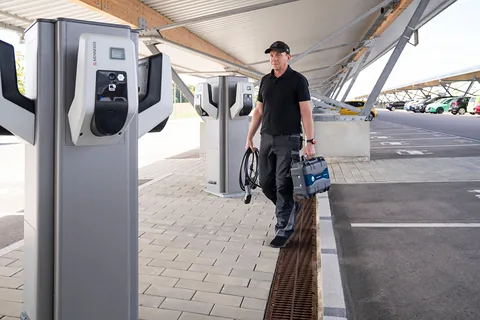
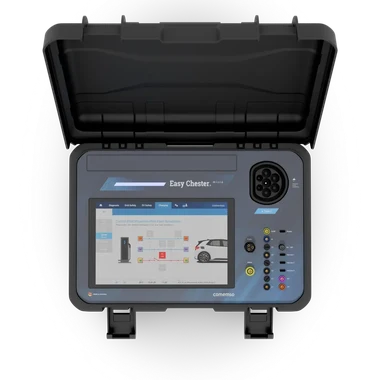
Testing an AC charger used to take two instruments: an installation tester for the protective measures and an adapter box for the charging function, with re-cabling in between. Easy Chester Micro combines both. This wallbox tester guides you step by step on its touchscreen and produces a test report for every charging point.1
Connect once and leave the charging point with a test report.
In 30 seconds
- Who it is for
- Electricians and service teams who install, commission and maintain wallboxes and AC chargers.
- What it tests
- Charging function and communication, plus optional electrical safety tests to VDE 0100-600, VDE 0413 and VDE 0113-1 on the grid and vehicle side – on a 10.1-inch touchscreen, 5.4 kg in its case, with a test report per charging point.
- Not for
- DC chargers. Use Easy Chester Ultimate for those.
- Also known as
- Wallbox tester, AC EV charger tester, ISO 15118-2 tester for AC charging stations.
A wallbox that fails on the first charge brings the electrician back – unpaid.
Charging function and protective measures in one pass
Micro checks whether the charger releases charging correctly and, with the safety option, measures the protective measures of the installation – without switching between two instruments. Station, configuration and results go into one test report for handover, maintenance and proof of repair.

Charging function: Micro takes the role of the vehicle
Micro measures the CP voltage, the PWM duty cycle and the PP values (voltage and resistance). When the charger closes its AC contactors, Micro measures the voltage on the phases. If it is present, the charger has released charging – that is the PASS of the charging-function test. As an option, Micro simulates faults (PE break, CP and PP short circuit, PP break) and checks whether the charger stops the session.
Electrical safety on the grid and vehicle side (option)
On the grid side, Micro measures insulation resistance, protective conductor resistance, RCD trip (tRCD), loop impedance and phase rotation; on the vehicle side, insulation resistance, protective conductor resistance, RCD trip, residual voltage and phase rotation. Micro assesses the protective measures separately from the charging function: a charger that charges is not necessarily safe.
| Measurement | Test values | Standards |
|---|---|---|
| Insulation resistance (RISO) | 250, 500, 750 or 1,000 V – between the active conductors and against PE | VDE 0100-600, VDE 0113-1, VDE 0413 |
| Protective conductor resistance (RPE) | 200 mA or 25 A | VDE 0100-600, VDE 0113-1, VDE 0413 |
| RCD trip (tRCD) | 6, 30, 100 or 300 mA, per phase L1, L2, L3 | VDE 0122-1, VDE 0100-600, VDE 0113-1, VDE 0413 |
| Residual voltage (UOFF) | Pass below 30 V RMS within 1 s after the simulated unplugging | VDE 0113-1 |
| Loop impedance (ZS) | Test current 15 mA or 15 A, phase to PE or N | – |
| Phase rotation | Phase sequence L1, L2, L3 | – |
Periodic inspection and proof after repairs
After repairs, changes and during periodic inspection, repeat the affected tests in the same guided workflow. Inspection intervals follow the applicable requirements and the site’s maintenance plan.
Communication to ISO 15118
Micro also tests the charging communication
Micro establishes ISO 15118-2 communication itself, without an external protocol converter. The test report shows whether the PLC connection between vehicle and charger works.1 AFIR requires this communication at AC and DC charging points. More on the standard in the ISO 15118 guide.
ISO 15118-2 with EIM authentication
Charging is authorised via EIM (External Identification Means), i.e. an external identification such as an RFID card or an app.
Connection setup and attenuation in the report
The test report records the ISO 15118-3 connection setup (SLAC) with the attenuation value. It also lists every communication step and the MAC address of the charger’s PLC interface.
The attenuation value describes signal loss during connection setup. An unusually high value can point to an impaired signal path, for example crosstalk instead of a direct connection to the PLC hardware. Read together with the communication sequence and the test setup, it leads to the cause; on its own it proves neither correct wiring nor crosstalk.
ISO 15118-20
The extension of the communication test is planned for the first quarter of 2027. It stays marked as planned until the software release is available.
What AFIR requires
Since 8 January 2026, publicly accessible charging points that are newly installed or renovated must comply with EN ISO 15118-1 to -5. From 1 January 2027, they must comply at least with EN ISO 15118-20; points offering automatic authentication such as Plug & Charge must also support -2. From the same date, -20 also applies to newly installed or renovated private Mode 3 charging points.
Micro checks the PLC connection that -2 and -20 both depend on. This is not a complete AFIR conformity assessment. See the AFIR evidence map
Source: Commission Delegated Regulation (EU) 2025/656, Annex, point 5 (AFIR Annex II, point 2.1)
TLS-protected charging sessions are outside Micro’s test scope, including the planned ISO 15118-20 extension.
The instrument
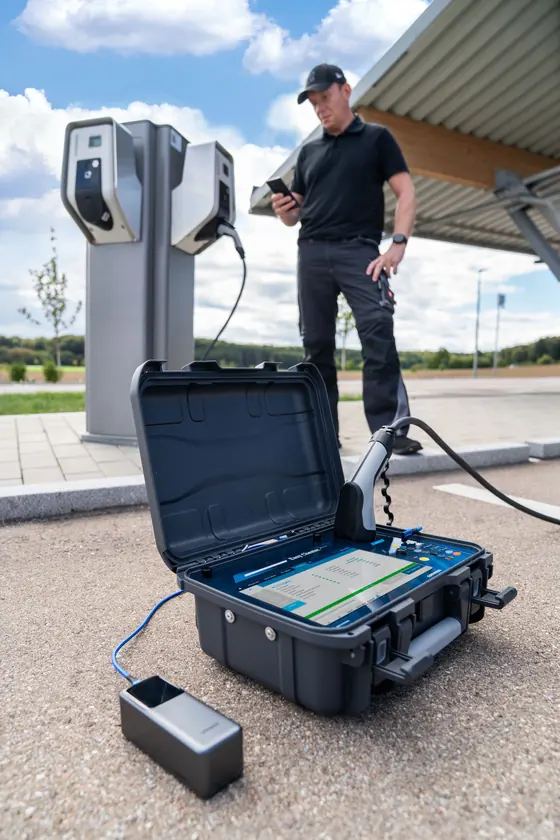
Carried to the charging point, guiding you through the test
Power comes via USB-C, a 12 V car adapter or a power bank; updates and remote support run over a mobile hotspot. All specifications in the datasheet
| Item | Value |
|---|---|
| Display · weight | 10.1-inch touchscreen · 5.4 kg in the case |
| Protection | IP 66 with the case closed |
| Signal measurement range | CP −13 V to +13 V · PP 0 to 4,600 Ω |
| Signal measurement accuracy | CP voltage ±100 mV · PP resistance ±5 % |
Micro or Ultimate?
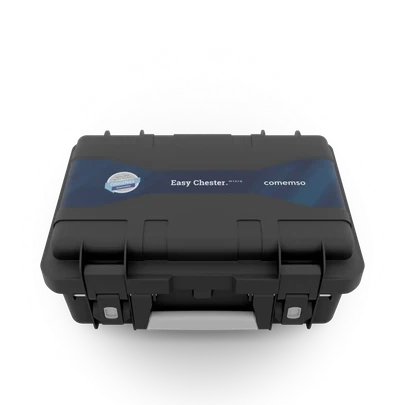
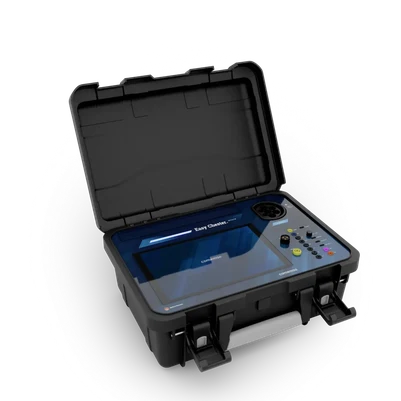
Micro for AC – Ultimate when DC comes in
Choose Easy Chester Ultimate if you also test DC chargers
- Ultimate tests AC and DC chargers.
- Its AC tests match those of Micro.
- The guided field workflow stays the same.
- Ultimate covers ISO 15118-2 with EIM for AC and DC.
Testing a wallbox with Easy Chester Micro: how it works
How to test a wallbox after installation, after a repair or during maintenance. The work is carried out by a qualified electrician.
- Record the charging point: wallbox ID, connection, firmware version and reason for the test.
- Check the protective measures: with the safety option, the grid-side and vehicle-side measurements including phase rotation.
- Check the charging function: Micro takes the role of the vehicle, measures the CP and PP values and, once the contactors close, the voltage on the phases.
- Check the communication: for wallboxes with PLC communication, the connection setup and each ISO 15118-2 step.
- Complete the report: measurements, assessment and comments stay with the charging point; the report can be exported as a PDF. After a repair, repeat the original fault case and the affected tests.
Frequently asked questions
Easy Chester Micro FAQ
What is a wallbox tester?
A wallbox tester checks a wallbox without an electric vehicle connected. It takes the role of the vehicle to test the charging function and, depending on the device, also measures the protective measures of the installation. Easy Chester Micro is such a tester for wallboxes and AC charging stations; measuring the protective measures is an option.
Which chargers does Easy Chester Micro test?
Easy Chester Micro tests wallboxes and AC charging stations, with a Type 1 or Type 2 connection depending on the version. Use it for installation, commissioning, maintenance and periodic inspection. DC chargers are tested with Easy Chester Ultimate.
What makes Micro stand out in the market for AC wallbox testers and AC EVSE installation testers?
Micro includes ISO 15118-2 communication as standard. For AFIR, this lets you check that the PLC communication between vehicle and charger works. Micro establishes the communication itself, without an external protocol converter. The test report shows the connection setup with the attenuation value and every communication step. A simple test adapter does not cover this. Charging function and optional electrical safety tests run on the same instrument, with one test report per charging point. This does not replace a complete AFIR conformity assessment.
How is Micro different from an installation tester with an adapter box?
An installation tester measures the protective measures of the installation; an adapter box simulates vehicle states at the connector, with re-cabling in between. Micro combines both in one instrument: it tests charging function and communication, measures the protective measures with the safety option and keeps all results in one test report per wallbox.
How does Micro test the charging function?
Micro takes the role of the vehicle and measures the CP voltage, PWM duty cycle and PP values (voltage and resistance). When the charger closes its AC contactors, Micro measures the voltage on the phases. If it is present, the charging release is confirmed.
Does Micro test ISO 15118 communication?
Yes, as standard: ISO 15118-2 with EIM authentication, including connection setup and attenuation value. The -20 extension is planned for the first quarter of 2027. For AFIR, Micro thus provides part of the evidence; it is not a complete AFIR conformity assessment, and TLS-protected charging sessions are outside the test scope.
How is Micro different from Easy Chester Ultimate?
Micro covers the AC tests of Ultimate: charging function, communication, electrical safety and phase rotation. Ultimate also tests DC chargers.
Customer projects, success stories and technical articles related to this page.
- Webinar archiveWebinar: Commissioning and Inspection of EVSEWebinar archive, 21 April 2026: practical charging-station commissioning and inspection, electrical safety, function and repeatable field checks.
Your field workflow
Configure Easy Chester Micro for your AC tests
Together we define the charging connection, test scope, safety options and report format.
15-minute demo. An engineer shows an AC wallbox test with test report on a real Easy Chester Micro.Written quotation. Everything we specify together, in one quotation – then you order.Delivery and start. Commissioning and training are agreed in the quotation.