
A measured finding gave the engineers a clear next step.
The team made a targeted correction and checked it on the real EV/EVSE pair. The sequence below follows the investigation from the observed charging failure to the repeat test.
1 · Starting point
Investigating one vehicle and charging station.
For seven months, an EVSE (electric vehicle supply equipment, or charging station) manufacturer had been investigating charging complaints involving one particular vehicle. The task was to identify the relevant behaviour of this real pairing and give the customer’s engineers a basis for a targeted correction.
During a site visit, a comemso product specialist connected the prepared EVCA Multi Mobile system and recorded a charging attempt. The recording brought communication, voltage and current into the same investigation.
2 · Question to check
Could communication timing explain the charging failure?
Communication timing was considered as a possible cause. In the recorded attempt, it was unremarkable. That observation allowed the specialist to exclude this suspected cause for the attempt under review and concentrate on the electrical response.
3 · Decisive observation
The voltage request and measured precharge response did not match.
In comframe, the specialist compared the battery voltage requested by the vehicle with the measured EVSE voltage response during precharge. Precharge prepares the voltage before the main power connection closes. The requested value and the measured response did not match.
Reviewing voltage, current and communicated values together showed the relationship between the vehicle’s request and the charging station’s response.
The recording was reviewed by an experienced product specialist who also delivered product training.
4 · Engineering decision
The customer’s engineers adjusted the EVSE control parameters.
The measurement finding directed the correction to the charging station’s precharge response. The customer’s engineers adjusted the EVSE control parameters and loaded the changed software.
The exact parameter values are not disclosed in the customer account. The sequence documents where the correction was made and how it was checked.
5 · Verified result
A repeat charging test confirmed the correction for this pair.
After the changed software had been loaded, the team repeated the charging test with the observed vehicle and charging station. That repeat test confirmed the correction for this particular pairing.
The result is evidence for the tested EV/EVSE pair.
6 · Transferable method
Compare the request, measured response and next state together.
For EV charging interoperability testing, the useful question is whether the measured electrical behaviour follows the communicated request during the same attempt. A shared timeline helps engineers connect these observations and decide what to test next.
In this case, the sequence was: record the real pair, check the timing hypothesis, compare requested and measured voltage, adjust the control parameters, then repeat the charging test.
What this shows: the result applies to this vehicle–charger pair; times are approximate and were analysed by a comemso specialist.
The visit included setup, recording, analysis and verification.
| Stage | Time | Included work |
|---|---|---|
| Connect prepared system | Up to 5 min | Laptop, Ethernet/CAN, EV and EVSE connections |
| Record charging attempt | 1–2 min | Measurement of the real pairing |
| Review recording | About 3 min | Human analysis in comframe by the product specialist |
| Correct control parameters | About 10 min | Software adjustment by customer engineers |
| Load and verify | Several additional minutes | Software transfer and repeat charging test |
One device, field and laboratory.
The customer purchased EVCA Multi Mobile and a compact 3 kW bidirectional DC source/load. The same analyser supports field measurements and configured EV-simulation work in the laboratory.
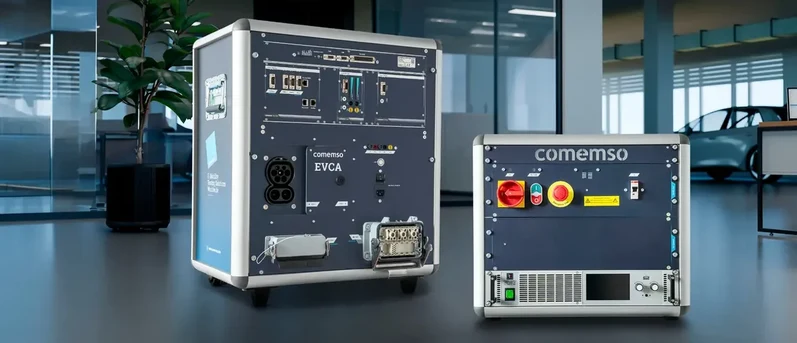
The 3 kW rating belongs to this external laboratory source/load. It does not specify the power rating of every Multi Mobile field-measurement configuration. Voltage, current, power and duty cycle must be considered together.
Source and scope of the account
Source: anonymised customer account supplied by comemso. Underlying measurement data are retained internally and are not published here. The exact parameter values are not disclosed.