
Testing vehicles against chargers that misbehave on purpose: EV testing in the USA.
A customer in the USA uses EVCA Flex to test vehicle responses to unexpected charging messages and delayed replies under controlled conditions.
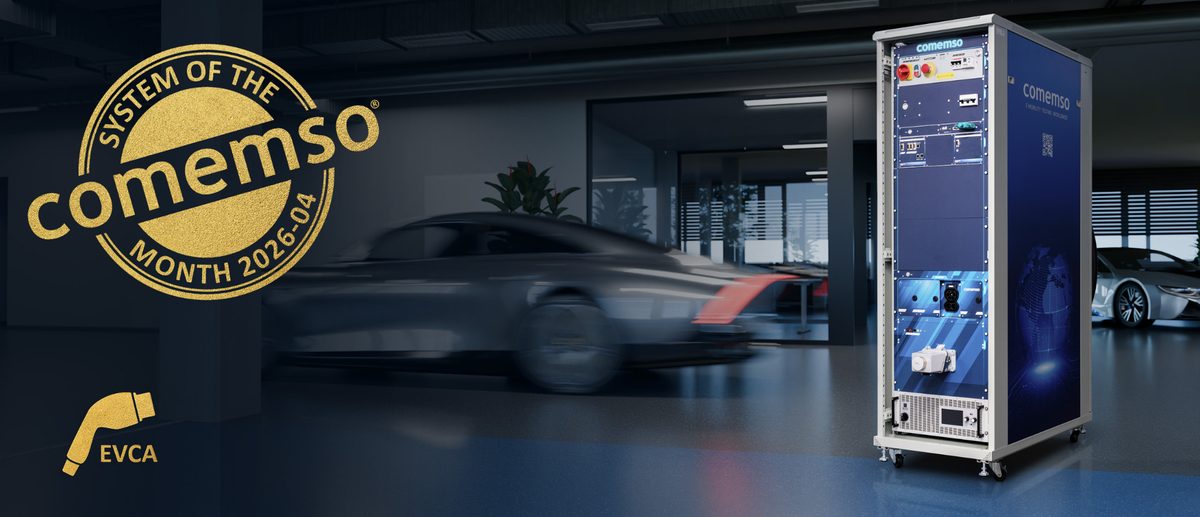
The configuration
- Integrated bidirectional DC CCS power circuit: 30 kW
- Up to 1000 V and up to 80 A, within the 30 kW operating envelope
- EV and EVSE simulation; Man-in-the-Middle with Sniffer
- Higher power and Manipulating Gateway as future extensions
Select the DC CCS operating point
The integrated DC CCS circuit provides a 30 kW power envelope. Its voltage and current limits are 1000 V and 80 A; both limits cannot be reached simultaneously. An upgrade to higher power classes is planned.
Control the simulated charging station’s behaviour
With comframe and Professional EVSE Simulation, the system acts as the charging station. The customer can change communication parameters, message contents and timing, then observe how the vehicle responds to unexpected messages or delayed answers. This supports assessing charging robustness beyond the normal sequence.
Compare simulated and real charging sessions
The customer can also analyse real charging sessions using Man-in-the-Middle with Sniffer. This complements tests with a simulated charging partner.
Planned extension: Manipulating Gateway
For this project, Manipulating Gateway is planned as an extension. It would let the customer change communication parameters during charging between a real vehicle and a real charging station. This would allow a suspected cause of an interoperability issue to be investigated and its effects observed directly.