

EV and EVSE test systems
EVCA EV charging tester: EV tester and EVSE tester in one platform
EVCA (EV Charging Analyzer/Simulator) is the comemso EV charging tester for development, analysis and simulation. Test a station with a simulated vehicle, a vehicle with a simulated station, or a real charging pair. Interfaces, power equipment and software are configured for your test task.
Commissioning or servicing installed charging stations?
For commissioning and service, Easy Chester guides you through the configured installation and field checks and documents the results. Micro covers AC tasks; Ultimate adds DC charging tests.
EV, EVSE (electric vehicle supply equipment, or charging station), EVCC (vehicle-side charging communication controller), SECC (station-side charging communication controller), real pair and MCS paths.
Communication, interface, power, faults, chamber and field.
Charging-focused configuration, analysis, automation and evidence.
Extend the test depth while reusing the platform’s test methods and workflows.
Shared software and test methods
EV charging simulator: reuse test methods across EVCA systems
An EV charging tester from the EVCA family uses charging-specific software and reusable workflows. Keep measurements together with the conditions under which they were recorded.
Charging-protocol analysis
Connect protocol states, timing, low-level signals and measured values with normative expectations.
Configure the physical test setup
Use the configured EV charging tester to simulate the counterpart required by your DUT, or measure a real charging pair. Select the interface, power level and supported faults. Define the chamber connection or real-pair setup where the task requires it.
Reuse configurations and test cases
Reuse approved configurations, test logic, captured charging behaviour and evidence where the released system supports it.
Six system paths
Choose your EV tester or EV charger tester configuration
In the January 2025 customer project, EVCA Multi Mobile connects on-site testing with a Gustav Klein power source in the laboratory.
Choose an electric vehicle tester or EV charger test equipment around your DUT (device under test) and test role. The six system paths cover controller communication, real-pair analysis, portable testing, laboratory power, MCS and EMC.
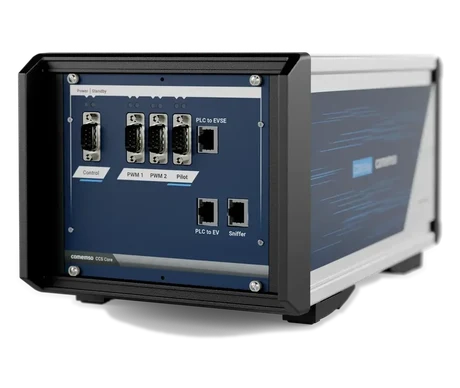
EVCA ComOnly
Develop EVCC or SECC communication with protocol analysis, nominal and advanced simulation and the applicable Conformance Test Libraries at the controller bench.
- Primary DUT
- EVCC or SECC
- Environment
- Bench and laboratory
- Use when
- Protocol behaviour is the test boundary
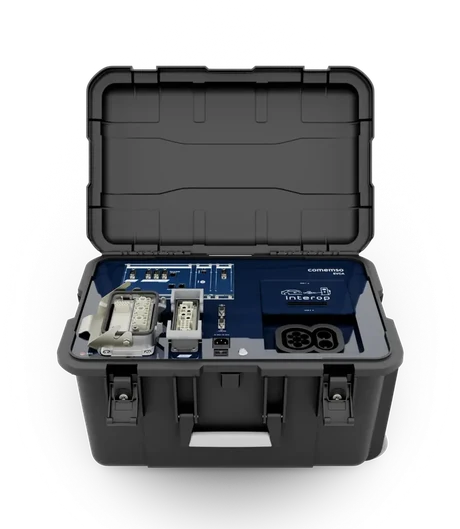
EVCA Interop
Record the real charging pair on one timeline, locate the deviation and test the proposed correction under defined conditions.
- Primary DUT
- The real charging pair
- Environment
- Field and laboratory
- Use when
- You need to investigate how a real vehicle and station interact
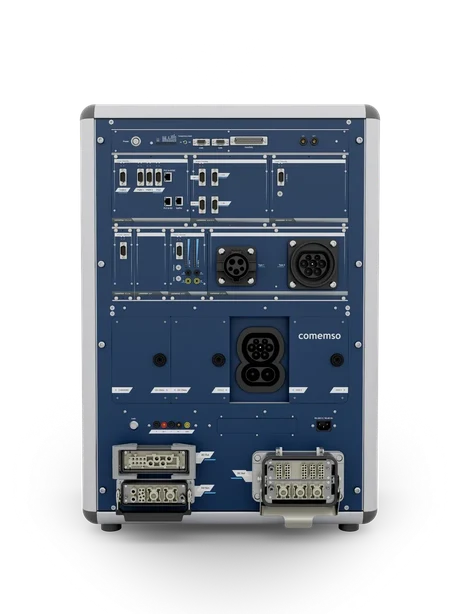
EVCA Multi Mobile
Use portable multi-standard hardware for EV simulation, EVSE simulation and real-pair analysis in the vehicle, laboratory or field.
- Primary DUT
- EV, EVSE or real pair
- Environment
- Mobile laboratory and field
- Use when
- One portable system must cover several roles
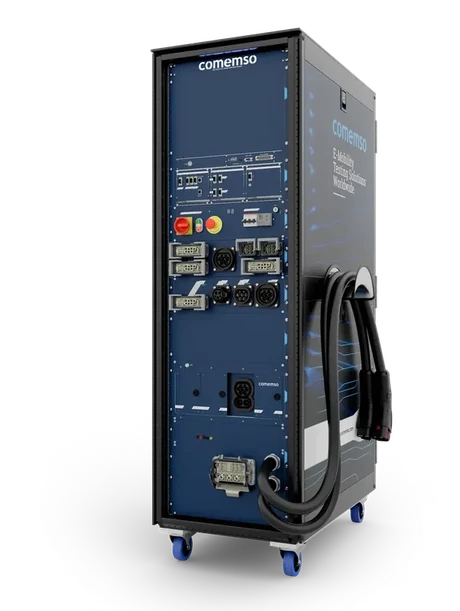
EVCA Flex
Build a modular EV or EVSE test environment around external source and load hardware, synchronised measurement, electrical faults, high-power operation and standards-specific test hardware.
- Primary DUT
- Complete EV or EVSE charging system
- Environment
- Laboratory and validation centre
- Use when
- Power, faults and deeper physical verification matter

EVCA MCS
Address MCS EV, EVSE and communication testing with charging-specific protocol, low-level signals, temperature and cooling interfaces and scalable power integration.
- Primary DUT
- MCS EV, EVSE or controller
- Environment
- MCS laboratory and system test
- Use when
- The complete megawatt charging stack must be controlled
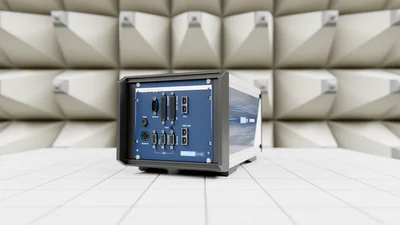
EMC Link
Preserve charging communication through the EMC chamber with a transparent optical link while the approved measurement and test systems remain outside the chamber.
- Primary DUT
- EV, EVSE or charging interface under EMC stress
- Environment
- EMC chamber
- Use when
- The chamber boundary must not distort communication
Selection matrix
Compare EVCA systems by test task
Confirm ratings, interfaces and released scope on the detailed product page.
On smaller screens, scroll the table horizontally to see every column.
| System path | Primary test boundary | Typical environment | What this path adds |
|---|---|---|---|
| EVCA ComOnly | EVCC or SECC communication | Bench and laboratory | Charging-protocol development, simulation, analysis and applicable conformance tests at the EVCC or SECC bench. |
| EVCA Interop | Real EV-to-EVSE interaction | Field and laboratory | Record the real charging pair, locate deviations and check a proposed correction under defined conditions. |
| EVCA Multi Mobile | Portable EV, EVSE and real-pair interface | Vehicle, mobile laboratory and field | Portable access to several test roles and charging standards for work in the vehicle, laboratory and field. |
| EVCA Flex | Controlled EV or EVSE laboratory counterpart | Laboratory and validation centre | External power integration, synchronised electrical depth, controlled faults, high-power and standards-specific hardware. |
| EVCA MCS | MCS communication, low-level signals, cooling and power | MCS system laboratory | Dedicated EV, EVSE and controller paths for the megawatt charging stack. |
| EMC Link | Optical charging communication across the chamber wall | EMC chamber | A transparent chamber boundary for charging communication. Stimulus, measurement and verdict remain with the configured laboratory systems. |
Expand your EVCA system
Keep the core. Expand your test system.
The EVCA core is the central component of the system. In a compatible expansion, move your existing core into a larger EVCA body. The workflow and test logic remain connected in comframe.
 Your EVCA coreThe brain you keep
 The same EVCA core
Choose the hardware for the next test task
Add the power, switching and fault-test hardware needed for the next stage.
comframe
Shared software + test logic
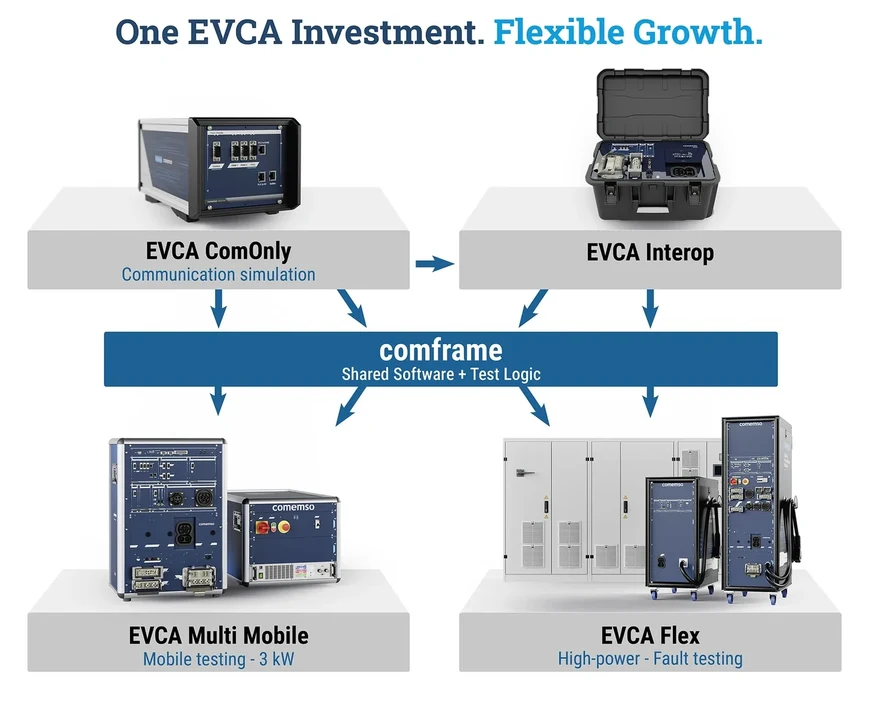
Begin with communication
EVCA ComOnly provides the starting point for controller communication tests.
Begin with the real pair
EVCA Interop provides the starting point for real-pair investigations.
Add portable EV and EVSE testing
EVCA Multi Mobile extends testing to portable EV, EVSE and interoperability work.
Add power, faults and standards hardware
EVCA Flex adds external power, switching and physical fault-test hardware.
Customer system: EVCA Flex for certification laboratories. System of the Month.
Charging standards supported by the EV charging tester
The EVCA EV charging tester connects the device role with the required interfaces. As an EV tester it simulates the station; as an EVSE tester it simulates the vehicle. The EV Charging Analyzer/Simulator records communication alongside electrical measurements. This overview identifies the relevant charging standards; supported editions and test cases depend on selected modules and the released test library.
| Interface | Standard and protocol context | Define in the test plan |
|---|---|---|
| CCS1 / CCS2 | DIN 70121, ISO 15118-2 and ISO 15118-20 | Specify the communication profile and released functions, including Plug & Charge. |
| AC / DC | IEC 61851-1, IEC 61851-23 and IEC 61851-24 | Separate basic signals, the DC power path and communication scope. |
| CHAdeMO | CHAdeMO protocol and corresponding interface | Select the hardware, protocol version and device role. |
| GB/T | GB/T 27930 and GB/T 18487.1 | Identify the Chinese DC communication and electrical-interface editions. |
| North America | NACS / SAE J3400 and SAE J1772 | Specify the coupler, AC/DC operation and communication profile together. |
| MCS | Megawatt Charging System | Review the dedicated EVCA MCS configuration for megawatt charging. |
ISO 15118 and IEC 61851 address different parts of charging tests. A matching connector does not establish which communication functions a test covers. Specify protocol edition, Test Library release, electrical operating range and supported fault insertion together. This makes the requirement behind each result traceable and shows where another test is needed.
The EV charging tester supports this comparison through the common software platform. An EV charging simulator reproduces defined partner behaviour; analysis of a real pair records what both partners actually do. Match the required test plan to the actual configuration: not every EVCA variant covers every interface or standard clause.
EVCA capabilities
What an EV charging tester checks
An EV charging tester can analyse charging behaviour, introduce supported faults and repeat recorded scenarios. Choose analysis, manipulation, reproduction and automation functions for the selected EVCA product and software release.
Relate measured charging behaviour to normative expectations automatically.
Configure nominal, boundary and non-conform charging behaviour in depth.
ValidateTest a live correction hypothesis between real charging partners.
ReproducePhysically reproduce recorded protocol-level charging behaviour at the interface.
AutomateTurn saved configurations into repeatable charging campaigns.
VerifyExecute released, versioned standards-based test logic with attributable verdicts.
Trusted charging tester for EVSE manufacturers, OEMs and certification labs












Customer experience
Customer voices on the EVCA platform

“We ensure high-quality test results with the right test equipment”
“The charging specialists at umlaut use the comemso EV Charging Analyzer in our EFECT lab at the Braunschweig site. Since our collaboration with comemso has been excellent for many years, umlaut has once again upgraded the EFECT with comemso hardware.”

“Currently the best and most complete vehicle simulator / sniffer / man in the middle we have used.”
EV charger test equipment for lab, production and field
In the development lab, the EV charging tester forms part of a defined test setup. Identify whether the vehicle, EVCC, station or SECC is the device under test. Record firmware, communication profile, load conditions and the expected result. This lets you repeat a fault from the same initial conditions rather than collect a failed charging session without a reproducible starting point.
For AC charger testing, define the required signals and the response to normal or deliberately changed conditions. DC tests also require the appropriate power path and load configuration. As an electric vehicle tester, EVCA connects measurements to the communication sequence. Use EV charger test equipment that makes both layers available when investigating a charging interruption.
For production, release a repeatable test sequence for each variant and associate results with the tested unit. A charger testing system does not replace the process definition. Specify limits, version status and what happens after a failed test. Compare the required EV charger test equipment with Easy Chester EOL when selecting a specialised production solution.
For field work, choose a portable charging station tester with the necessary analysis and simulation scope. An EVCA charging station tester investigates communication and product behaviour. Commissioning, service and electrical-safety inspection follow a different workflow with an appropriate Easy Chester configuration. Select the EV charger tester around the result you need, rather than assume that one setup covers every field task.
For environmental and EMC tests, the device, exposure and measurement chain determine the arrangement. Locate equipment according to its permitted operating conditions and use a suitable EMC configuration at the chamber boundary. Connecting an EV charging tester outside a chamber to a device inside it differs from exposing the entire test instrument to chamber conditions. EV charging simulation must remain defined while the device experiences the selected environment.
Platform FAQ
EVCA selection and configuration FAQ
Is EVCA one physical device?
EVCA is a family of test systems for different charging tasks. Applicable systems share charging-specific software, capabilities and test methods; the hardware is selected for the charging interface and physical test scope.
Which EVCA system should be selected first?
Start with the DUT and physical boundary. Select ComOnly for controller communication, Interop for a real EV-to-EVSE pair, Multi Mobile for portable multi-role work, Flex for laboratory power and faults, MCS for megawatt charging or EMC Link for the chamber boundary.
Can an EVCA configuration grow later?
Yes, where the hardware generation, interfaces, licences, Test Libraries and project architecture allow it. The reviewed upgrade or migration path is authoritative for the concrete system.
Does every EVCA contain every capability?
No. Capability availability depends on the selected product, charging standard, role, software modules, licences, Test Libraries, interfaces and released configuration.
What is the difference between an EV tester and an EVSE tester?
An EV tester provides the charging-station side for testing a vehicle or EVCC. An EVSE tester provides the vehicle side for testing a station or SECC. The device role therefore determines the setup. EVCA can provide both roles within the platform, using the selected interfaces, power equipment and released functions.
Which charging standards does the EV charging tester support?
The EVCA family offers configurations for CCS, CHAdeMO, GB/T, NACS and MCS. For CCS, DIN 70121 and ISO 15118 are relevant; IEC 61851 provides basic and DC-specific requirements. Check the editions and test cases supported by your configured EV charging tester against its released Test Library and system specification.
Can the EVCA test AC and DC chargers?
Yes, the platform includes appropriate AC and DC configurations. The interface, device role and electrical operating range must match the test. Define the test plan first. An EV charger tester for development and analysis can require different equipment from an instrument used for electrical-safety checks at installed charging points.
EVCA system planning
Select your EVCA platform.
Specify the DUT, interfaces and software for your EVCA configuration.