
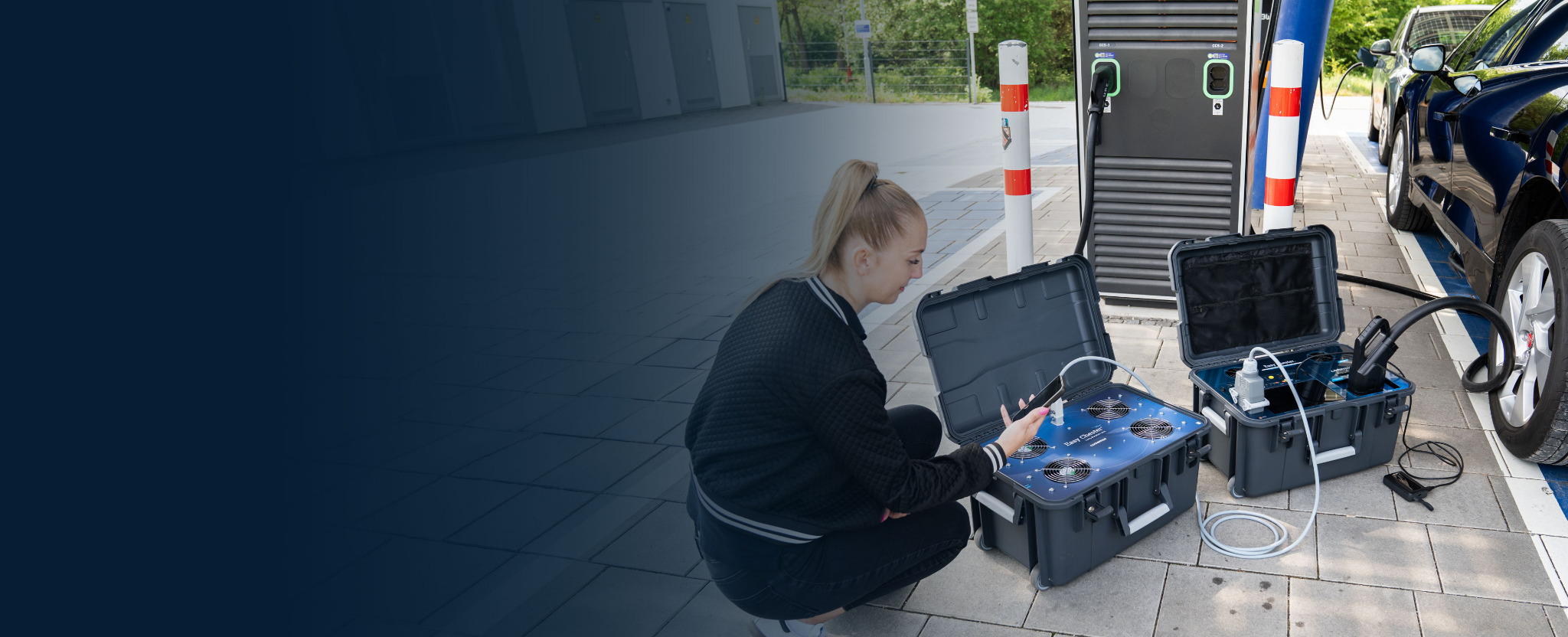
Commissioning and electrical safety testing
EVSE commissioning and electrical safety testing
Commission AC charging stations and CCS DC fast chargers with guided checks for electrical safety and charging function. Choose Easy Chester Micro for AC or Easy Chester Ultimate for AC and DC. Record the configured safety and communication checks for handover, periodic inspection and field service.
Choose the installation tester for your charging station
Choose Easy Chester Micro for AC commissioning or Easy Chester Ultimate for AC and DC. Match the interfaces, electrical safety functions and options to the work planned at the site.
AC EVSE installation tester
Easy Chester Micro
Commission AC charging stations and wallboxes with a compact installation tester. Check grid-side and EV-side electrical safety, phase sequence, communication and charging function within the selected configuration.
Explore the AC installation testerAC/DC EVSE installation tester
Easy Chester Ultimate
Commission CCS DC fast chargers and AC charging stations with guided electrical safety, charging-function and communication checks. Record the results for commissioning, maintenance and service. For HPC sites, match the connector and electrical ranges to the selected test setup.
Explore the AC/DC installation testerMatch the test configuration to the required checks. Evaluate electrical safety separately from a successful charging session.
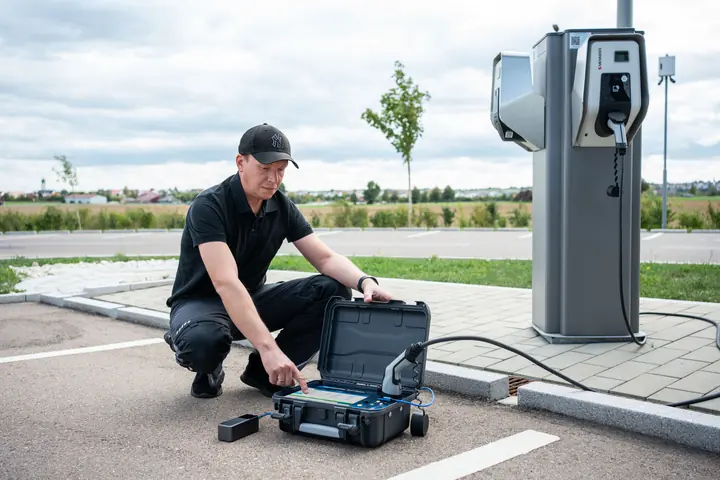
Before testing HPC or 800 V charging stations, check station rated power and test load, emulation voltage and measurement range, and communication checks and standards-conformance scope.
Your path to DC EVSE commissioning
Plan the DC commissioning workflow.
Select the Easy Chester Ultimate configuration for your DC charging station, review the test scope and see the planned commissioning or service workflow in a demo.
Testing throughout the charging station lifecycle
Repeat defined checks at handover, during operation and after repair.
Record the station identity, test configuration, observed behaviour and final decision at each stage. This gives later inspections and repairs a clear reference.
Initial commissioning
Check the installed charging station before handover. Verify the applicable protective measures, charging communication and energy transfer, and record the initial configuration.
Decision: ready for operation?Preventive maintenance
Repeat defined checks before a failure occurs. Compare the results with the commissioning baseline to identify changes in safety, interface behaviour or charging stability.
Decision: continue operating or intervene?Corrective service
Reproduce the reported fault with a defined test counterpart. Isolate the affected layer and record the findings to guide the repair.
Decision: root cause found?Recommissioning
After a repair, component replacement, firmware update or site modification, repeat the affected checks. Document whether the station meets the requirements for its released condition.
Decision: repair verified?Results for the next field action
Verify safety, charging function and repair results.
Is the electrical installation safe?
Have qualified personnel evaluate the applicable grid-side and charger-side protective measures with suitable test equipment.
Does the EVSE interface behave correctly?
Check connector and locking behaviour, Control Pilot (CP) and Proximity Pilot (PP) states, PLC (power line communication) or CAN communication, interlocks and configured error reactions.
Can the station complete a defined charging test?
Use an EV simulator to define charging requests, repeat start and stop conditions, and verify the station’s response.
Has the reported fault actually been removed?
Repeat the affected checks under the original test conditions and compare the results before and after repair.
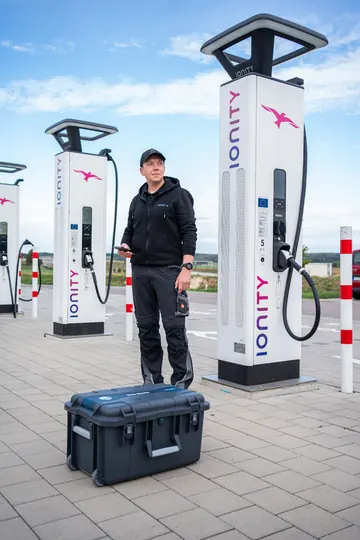
Inspection, safety and charging tests
Check the installation and charging behaviour together.
Set the test plan for the station, installation, charging technology, market and available equipment. Document the included checks and any checks outside that scope.
Cables, connectors, enclosure, labeling, damage, contamination and accessible components.
Applicable protective conductor, insulation, residual-current and installation measurements using the required qualified equipment.
Protective-earth interruption, isolation-monitoring behaviour, CP faults, residual voltage and configured interlocks.
CP and PP states, duty cycle, plug connection, locking and technology-specific control signals.
DIN 70121, ISO 15118, CHAdeMO, NACS or other supported communication according to the selected configuration.
Charge start, contactor sequence, voltage, current, stop behaviour and the station reaction to a controlled vehicle request.
Defined 400 V or 800 V conditions, extended charging time, load behaviour and faults that emerge only after operation.
Station identity, test configuration, executed checks, measured values, deviations and the handover or service decision.
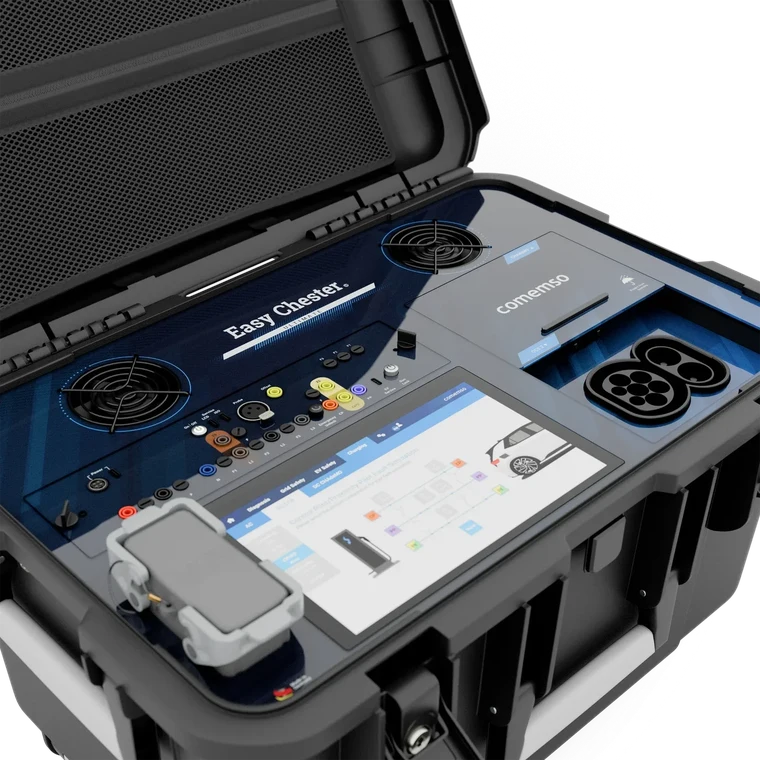
Configured test scope. Select the hardware, software and options for the required grid measurements, charging interfaces, power levels, communication standards, fault simulation and reporting. The selected configuration determines which layers and checks are available.
How to test a CCS DC fast charger in the field
Use Easy Chester Ultimate for CCS DC commissioning and maintenance within the selected configuration. Follow the released device procedure and installation inspection plan. Record the results of each step below.
- Define the test boundary
Record station identity and firmware. Confirm the connector, protocol, voltage technology, test load and required inspection scope.
- Verify electrical safety
Perform the applicable grid-side and EV-side protective-measure checks with the configured equipment and qualified responsibility.
- Check the charging sequence
Use controlled EV behaviour to check communication, charge start, voltage/current and charging stop within the selected test-load limits.
- Verify faults and repairs
Run released fault scenarios and repeat the affected checks after repair. Compare results under the same defined conditions.
- Document the result
Record the configuration, executed checks, measured values, deviations and handover or service decision in the report.
For an HPC site, the charger rating and applied test load are different quantities. Confirm the Ultimate test scope and DC load options before specifying the checks.
Download the EVSE inspection checklistDocumented field results
Keep field results useful for the next inspection or repair.
Record what was tested, the test conditions, observations and final decision. This lets the next technician or responsible team follow the result.
Responsibilities in the field
Give installers, service teams, CPOs and manufacturers a shared record.
Different teams may test the same station. Agree responsibilities so the required checks are completed without duplicating work.
Installers and commissioning teams
Establish the initial safety and functional baseline before handover.
Service technicians
Reproduce the fault, guide the repair and verify the corrective action.
Charge point operators
Use consistent maintenance records to compare locations and pass unresolved incidents to the responsible team.
EVSE manufacturers
Provide product knowledge for field procedures and use the test results as technical feedback.
From a charging fault to a diagnosis
Locate the fault before contacting support.
Use a vehicle to check a real vehicle–station pairing. Add an EV simulator and the applicable safety measurements for controlled fault diagnosis and documented station checks.

Charging failed. What do you know?
- Symptom: This vehicle does not charge at this station.
- Cause: EV, EVSE, installation, interface or communication has not yet been isolated.
- Test scope: Controlled EVSE safety and fault checks require a defined test setup alongside the real vehicle pairing.
Reproduce the fault and plan the next action.
- Function: Repeat the charging sequence under defined conditions with an EV simulator.
- Safety and faults: Run the applicable configured checks and repeat selected station reactions under defined conditions.
- Evidence: Record the results and involve the EVSE manufacturer with specific findings when needed.
EV-like tolerant charging behaviour supports functional, load and safety tests. It does not relax safety evaluation or replace conformance testing.
Tools and guidance for field testing
Prepare the test, choose the system and get support.
See how commissioning and service connect with development, validation, production and operation.
Field methodPrepare visual, electrical and functional inspection with a compact checklist.
Physical systemGuided AC/DC field testing with recorded station settings and results.
Installed systemGet help with commissioning, training, technical support, repair and lifecycle questions.
Plan the installation, inspection and electrical-safety checks alongside the vehicle charging test.
Use your own operating figures to model unavailable charger-hours, service costs and repeat visits.
Customer references
Customer experience in commissioning and service.
Customers describe their testing work with Easy Chester.

“Fantastic piece of testing kit.”

“As a product-independent full-service provider for sustainable charging systems, comemso not only convinced us because of their market establishment, but above all because of the manufacturer-independent application options. In this way, we can guarantee our customers quick service calls and feedback on the reliable functioning of their charging points.”
For operators and integrators
Test the change before it reaches your charging network.
- New supplier
- New station type
- Firmware or hardware update
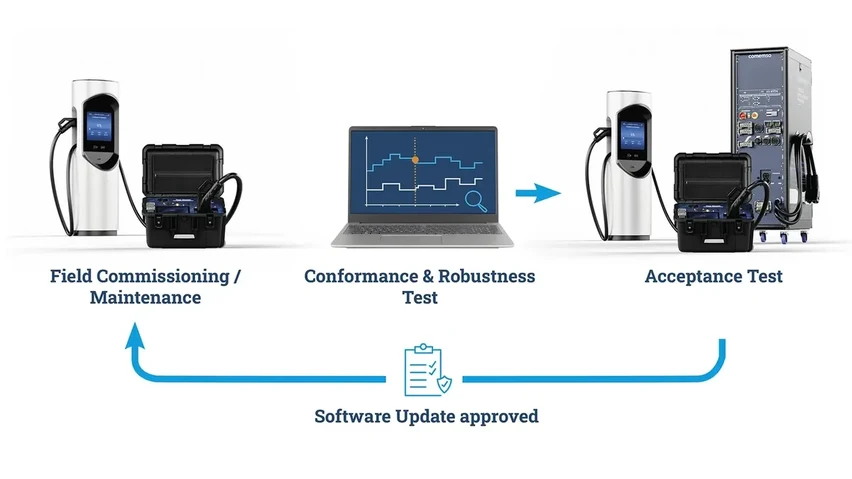
- Validate in the laboratory
Use EVCA Flex to check EVSE conformance and robustness after a hardware or firmware change.
- Verify field testability
Run the updated station with Easy Chester. Check whether new control algorithms complicate charging or interrupt field tests.
- Review and release
Document the versions and results. Resolve deviations with the supplier and repeat the checks before the operator decides on rollout.
Frequently asked questions
EVSE commissioning and field-service questions
What should be tested when commissioning an EV charging station?
Identify the station and configuration, inspect the installation and verify the applicable protective measures. Check the EV interface, run a defined charging session and document deviations and the handover result. The exact scope depends on the installation, charging technology, local requirements and configured test system.
Can a DC fast charger be commissioned with a real vehicle?
A real vehicle checks one vehicle–charger pairing under the conditions present at that moment. Use a defined EV simulator for repeatable vehicle states, fault scenarios and station diagnosis, together with the applicable electrical-safety measurements. A successful vehicle session alone does not cover that commissioning scope.
What is the difference between electrical installation testing and EVSE functional testing?
Electrical installation testing evaluates the supply-side installation and protective measures. EVSE functional testing evaluates the charging interface, communication, station reactions and the ability to conduct a controlled charging session. A complete commissioning plan may require both.
What should be checked after an EV charger repair?
Repeat the affected safety and functional tests, reproduce the original symptom where possible, verify the repair under defined conditions and record the final configuration, measured results and release decision.
Does the workflow cover AC and DC charging stations?
Use Easy Chester Micro for AC charging stations and wallboxes, or Easy Chester Ultimate when DC charging tests are also required. Both installation testers support configured electrical safety, charging-function and communication checks for commissioning, maintenance and periodic inspection. Match connector hardware, charging standards, electrical ranges and safety functions to the intended work.
Can charging communication faults be diagnosed in the field?
Guided field systems check charging function and expose defined errors. Use EVCA Multi Mobile or EVCA Interop for more complex protocol, timing or cross-layer faults, or reproduce supported recorded behaviour in the laboratory with Charge Playback.
How can a charging-network operator check a supplier firmware update?
Record the baseline with the agreed Easy Chester reference procedure and identify the EVSE hardware and firmware. Apply the supplier update, repeat the defined checks and compare the results. Document the maintenance workflow, release decision and any restrictions.
Deeper supplier, hardware or software qualification may require an appropriately configured EVCA with additional power, fault and standards-based test scope. Passing one reference procedure supports those checks; it does not prove compatibility with every vehicle.
Use the supplier-update release workflow · Explore deeper EVCA qualification
Your next field visit
See the AC/DC checks for your field task.
In a 15-minute online demo, see how Easy Chester Ultimate guides configured checks through to the report. Discuss the charging interfaces and test tasks relevant to your work. After your request, we agree the demonstration scope and appointment.
Choose the system for the test task
Match the test depth to the result you need.
Choose the system for commissioning, detailed communication diagnosis, real-pair interoperability or energy measurement verification. Each task requires its own test scope.
Compact AC installation tester for commissioning, electrical safety, maintenance and periodic inspection.
Explore the AC installation testerAC/DC installation tester for commissioning, electrical safety and charging-function checks, with guided reporting for maintenance and service.
Explore Easy Chester UltimatePortable signal, protocol and charging analysis for detailed diagnosis beyond guided pass/fail results.
Explore EVCA Multi MobileAnalyse a specific EV and EVSE together when the field problem occurs only with the real combination.
Explore EVCA InteropReproduce supported recorded charging behaviour at the physical interface for laboratory diagnosis and regression.
Open capabilityMobile EVSE calibration for energy measurement verification and legal-metrology evidence.
Open applicationUse downtime, repeat visits and truck rolls to assess the economic effect of a controlled service process.
Open calculator