
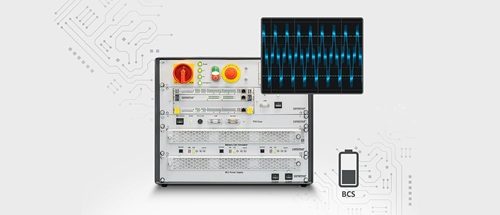
BCS Advanced module and Voltage Oscillation software function

The Advanced module for the Battery Cell Simulator (BCS) expanded fault simulation and introduced controlled voltage-oscillation scenarios for battery management system (BMS) testing.

BCS Advanced module and Voltage Oscillation software function
QuestionStart with the engineering problem
ContextConnect application, standard and product
SourceIdentify document and publication status
Next stepContinue to current technical scope
Original comemso publication

This dated article describes its original release context. Check the linked current product or application for available configurations and supported scope.

View original publication

The Advanced variant of the battery cell simulator supports continuous source and sink currents up to 7.5 A per cell and cascading of emulated cells up to a stack voltage of 1500 V.

The BCS Compact Advanced modules deliver up to 7.5 A at 5 V cell voltage; the previous 6 A remain available at 8 V. They retain cable-break, cell-short-circuit and cell-polarity-reversal simulation, with precision of 2 mA and 0.5 mV for both measurement and generation of current and voltage.

During alternating current (AC) charging, the vehicle’s on-board charger can expose the BMS (battery management system) to electromagnetic interference. Filtering must reject this interference while preserving dynamic cell behaviour.

To evaluate that balance, Voltage Oscillation superimposes a quasi-sine interference signal on the DC voltage. The amplitude is individually adjustable per cell up to 35 mV (70 mVpp), with a frequency of 1 to 1000 Hz.

Also special: this new feature can be updated to delivered BCS Gen. 8 and even on request to Gen. 7, which is covered by the software maintenance at no additional cost.
Related reading

Continue through the archive.

Related entries retain the publication date and lead to the current technical route.

Free BMS testing whitepaper

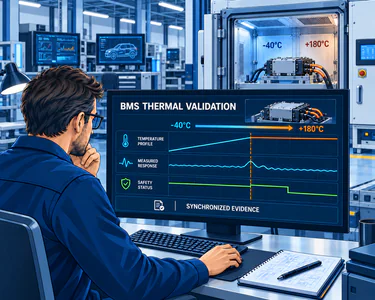
Planning BMS temperature tests?

Explore the practical questions behind cold starts, heat exposure, climate-chamber wiring and reliable cell and sensor simulation.

Illustration of an engineer planning BMS thermal validation with cell simulation and a climate chamber
Explore the BMS testing whitepaper

Continue from technical context

Turn the information into the next engineering decision.

Continue to the relevant application, current product scope or responsible comemso team.